O'Neill C, Brown M, Schaefer B, Gazi J A
Department of Earth and Environmental Science, Macquarie Planetary Research Centre, Macquarie University, Sydney, 2109, Australia.
Origins Research Institute (ORI), Research Centre for Astronomy and Earth Sciences, 15-17 Konkoly Thege Miklós Road, Budapest, 1121, Hungary.
Sci Rep. 2022 Jun 21;12(1):10460. doi: 10.1038/s41598-022-13885-9.
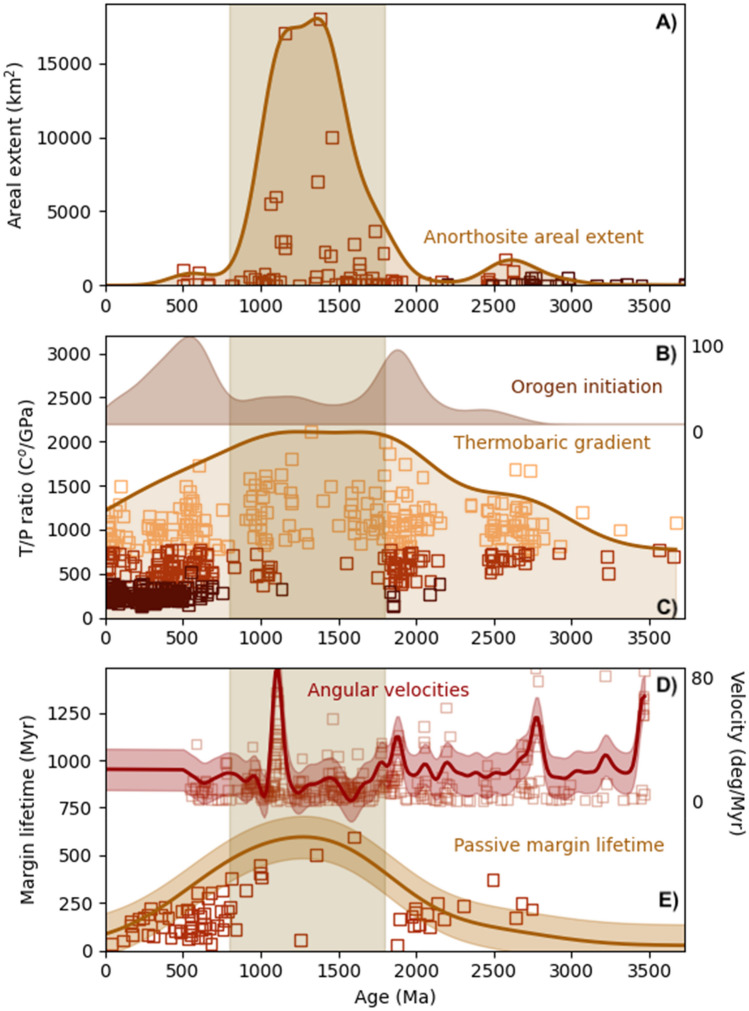
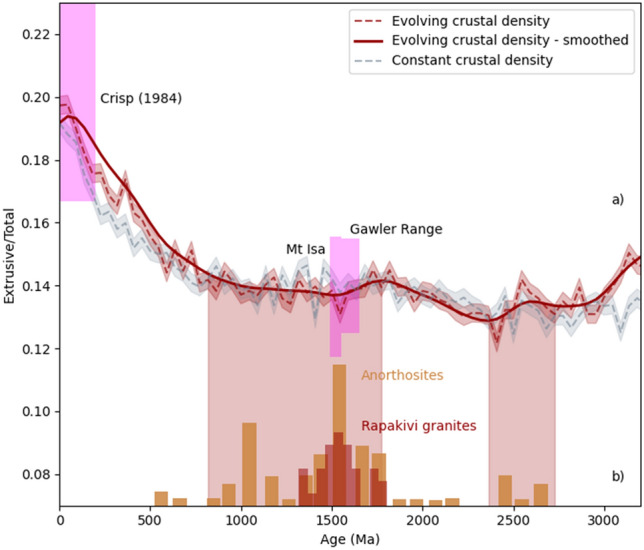
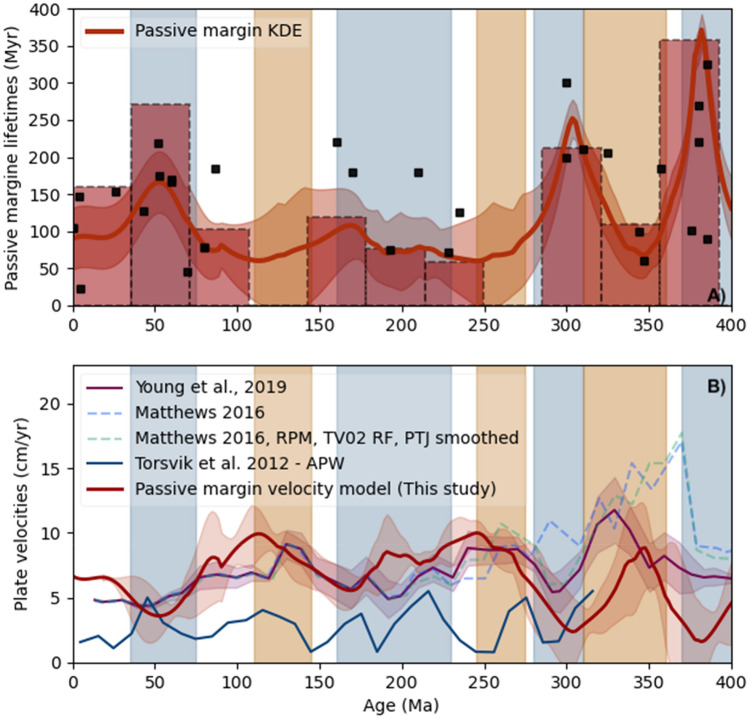
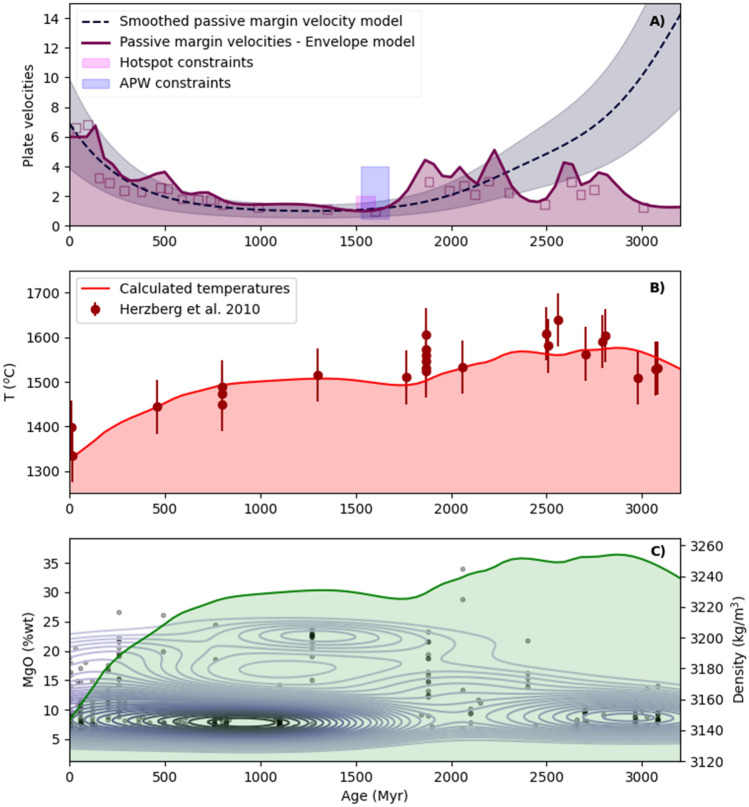
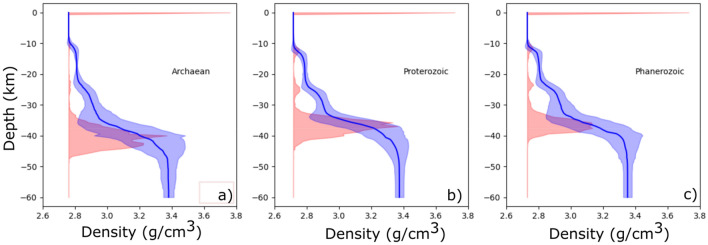
The mid-Proterozoic or "boring billion" exhibited extremely stable environmental conditions, with little change in atmospheric oxygen levels, and mildly oxygenated shallow oceans. A limited number of passive margins with extremely long lifespans are observed from this time, suggesting that subdued tectonic activity-a plate slowdown-was the underlying reason for the environmental stability. However, the Proterozoic also has a unique magmatic and metamorphic record; massif-type anorthosites and anorogenic Rapakivi granites are largely confined to this period and the temperature/pressure (thermobaric ratio) of granulite facies metamorphism peaked at over 1500 °C/GPa during the Mesoproterozoic. Here, we develop a method of calculating plate velocities from the passive margin record, benchmarked against Phanerozoic tectonic velocities. We then extend this approach to geological observations from the Proterozoic, and provide the first quantitative constraints on Proterozoic plate velocities that substantiate the postulated slowdown. Using mantle evolution models, we calculate the consequences of this slowdown for mantle temperatures, magmatic regimes and metamorphic conditions in the crust. We show that higher mantle temperatures in the Proterozoic would have resulted in a larger proportion of intrusive magmatism, with mantle-derived melts emplaced at the Moho or into the lower crust, enabling the production of anorthosites and Rapakivi granites, and giving rise to extreme thermobaric ratios of crustal metamorphism when plate velocities were slowest.
中元古代或“乏味的十亿年”呈现出极其稳定的环境条件,大气氧含量变化很小,浅海处于轻度氧化状态。从这个时期可以观察到数量有限的具有极长寿命的被动大陆边缘,这表明构造活动减弱——板块减速——是环境稳定的根本原因。然而,元古代也有独特的岩浆和变质记录;块状斜长岩和非造山环斑花岗岩主要局限于这一时期,麻粒岩相变质作用的温度/压力(热压比)在中元古代达到超过1500℃/GPa的峰值。在这里,我们开发了一种从被动大陆边缘记录计算板块速度的方法,并以显生宙构造速度为基准进行了验证。然后,我们将这种方法扩展到元古代的地质观测中,并首次对元古代板块速度提供了定量约束,证实了假定的减速。利用地幔演化模型,我们计算了这种减速对地壳地幔温度、岩浆活动和变质条件的影响。我们表明,元古代较高的地幔温度会导致侵入岩浆作用的比例更大,地幔衍生的熔体侵入莫霍面或下地壳,从而能够形成斜长岩和环斑花岗岩,并在板块速度最慢时导致地壳变质作用出现极高的热压比。