Department of Obstetrics and Gynecology, Qilu Hospital, Cheeloo College of Medicine, Shandong University, Address: No.107, west culture road, Jinan, 250012, Shandong, China.
Key Laboratory of Gynecologic Oncology of Shandong Province, Jinan, China.
J Transl Med. 2022 Jun 21;20(1):280. doi: 10.1186/s12967-022-03480-x.
TIGIT/CD155 has attracted widespread attention as a new immune checkpoint and a potential target for cancer immunotherapy. In our study, we evaluated the role of TIGIT/CD155 checkpoints in the progression of cervical cancer.
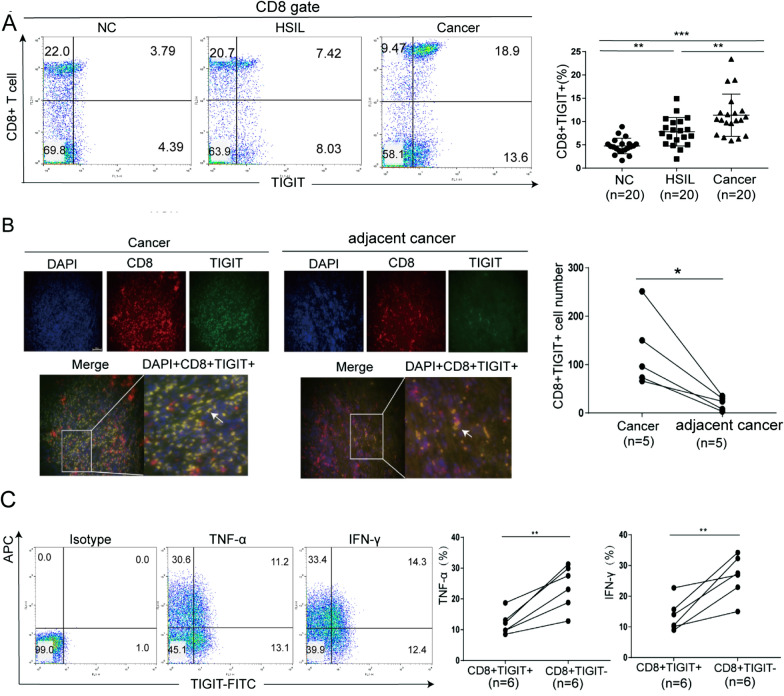
The expression of CD155 and TIGIT in cervical cancer tissues was detected using flow cytometry, immunohistochemistry (IHC) and gene expression profiling. In vivo and in vitro experiments have proven that blocking TIGIT/CD155 restores the ability of CD8 T cells to produce cytokines. Changes in the NF-κB and ERK pathways were detected using western blotting (WB) after blocking TIGIT/CD155 signalling.
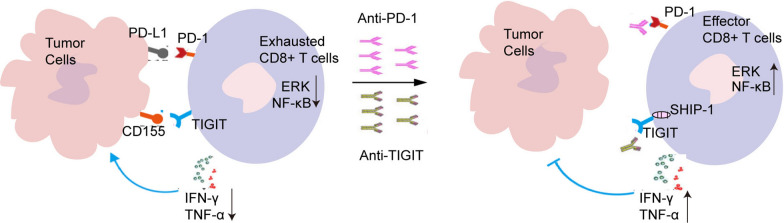
TIGIT expression was elevated in patients with cervical cancer. High TIGIT expression in CD8 T lymphocytes from patients with cervical cancer promotes the exhaustion of CD8 T lymphocytes. In addition, CD155 is expressed at high levels in cervical cancer tissues and is negatively correlated with the level of infiltrating CD8 T cells. We found that TIGIT, upon binding to CD155 and being phosphorylated, inhibited NF-κB and ERK activation by recruiting SHIP-1, resulting in the downregulation of cytokine production. Blocking TIGIT in activated CD8 T cells attenuates the inhibitory effect of SHIP-1 on CD8 T cells and enhances the activation of NF-κB and ERK. In vivo and in vitro experiments have proven that blocking TIGIT/CD155 restores the ability of CD8 T cells to produce cytokines. Injecting the blocking antibody TIGIT in vivo inhibits tumour growth and enhances CD8 T lymphocyte function. Treatment with a combination of TIGIT and PD-1 inhibitors further increases the efficacy of the TIGIT blocking antibody.
Our research shows that TIGIT/CD155 is a potential therapeutic target for cervical cancer.
TIGIT/CD155 作为一种新的免疫检查点和癌症免疫治疗的潜在靶点,引起了广泛关注。在本研究中,我们评估了 TIGIT/CD155 检查点在宫颈癌进展中的作用。
采用流式细胞术、免疫组织化学(IHC)和基因表达谱分析检测宫颈癌组织中 CD155 和 TIGIT 的表达。体内和体外实验证明,阻断 TIGIT/CD155 可恢复 CD8 T 细胞产生细胞因子的能力。阻断 TIGIT/CD155 信号后,通过 Western blot(WB)检测 NF-κB 和 ERK 通路的变化。
宫颈癌患者 TIGIT 表达升高。宫颈癌患者 CD8 T 淋巴细胞中高表达 TIGIT 促进 CD8 T 淋巴细胞衰竭。此外,CD155 在宫颈癌组织中高表达,与浸润性 CD8 T 细胞水平呈负相关。我们发现,TIGIT 与 CD155 结合并磷酸化后,通过招募 SHIP-1 抑制 NF-κB 和 ERK 的激活,从而下调细胞因子的产生。在激活的 CD8 T 细胞中阻断 TIGIT 可减弱 SHIP-1 对 CD8 T 细胞的抑制作用,并增强 NF-κB 和 ERK 的激活。体内和体外实验证明,阻断 TIGIT/CD155 可恢复 CD8 T 细胞产生细胞因子的能力。体内注射 TIGIT 阻断抗体抑制肿瘤生长并增强 CD8 T 淋巴细胞功能。TIGIT 和 PD-1 抑制剂联合治疗进一步提高了 TIGIT 阻断抗体的疗效。
我们的研究表明,TIGIT/CD155 是宫颈癌的潜在治疗靶点。