Brutger Ryan, Chaudoin Stephen, Kagan Max
Travers Department of Political Science, University of California, Berkeley, USA.
Department of Government, Harvard University, Cambridge, USA.
Rev Int Organ. 2023;18(1):1-25. doi: 10.1007/s11558-022-09464-2. Epub 2022 Jun 11.
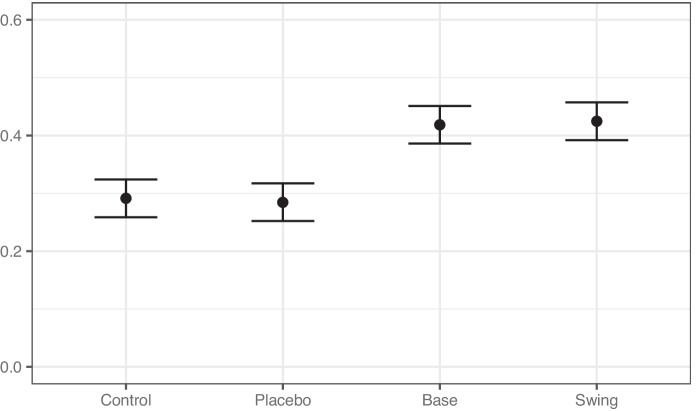
In response to the Trump trade war, China, the EU, and other countries enacted politically-targeted trade retaliation (PTTR) against swing states and Republican strongholds in the United States. We argue that PTTR increases public concerns about foreign election interference and assess the effects of such retaliation across partisan affiliations. We test our predictions using a national survey experiment in the United States fielded before the 2020 election. In contrast to findings about sanctions and foreign endorsements, we find strong evidence that PTTR increases fears of election interference among Republicans and Democrats. Partisan double standards in reaction to PTTR were strongest for retaliation targeting swing states and smaller for retaliation targeting the President's base. Overall, the evidence shows that economic policies which are not primarily intended to influence elections may nevertheless come to be viewed by the public as foreign election interference.
The online version contains supplementary material available at 10.1007/s11558-022-09464-2.
作为对特朗普贸易战的回应,中国、欧盟和其他国家对美国的摇摆州和共和党据点实施了政治针对性贸易报复(PTTR)。我们认为,PTTR加剧了公众对外国干涉选举的担忧,并评估了这种报复行为在不同党派归属中的影响。我们利用2020年大选前在美国进行的一项全国性调查实验来检验我们的预测。与关于制裁和外国支持的研究结果不同,我们发现有力证据表明,PTTR增加了共和党人和民主党人对选举干涉的恐惧。对PTTR反应中的党派双重标准在针对摇摆州的报复中最为强烈,而针对总统支持基础的报复则较弱。总体而言,证据表明,并非主要旨在影响选举的经济政策可能仍会被公众视为外国干涉选举。
在线版本包含可在10.1007/s11558-022-09464-2获取的补充材料。