The First Affiliated Hospital of Xi'an Jiaotong University, Xi'an, Shaanxi 710061, China.
Department of Medical Oncology, The First Affiliated Hospital of Xi'an Jiaotong University, Xi'an, Shaanxi 710061, China.
Dis Markers. 2022 Jun 11;2022:1561607. doi: 10.1155/2022/1561607. eCollection 2022.
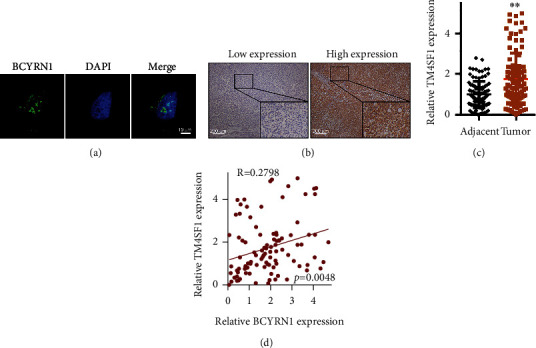
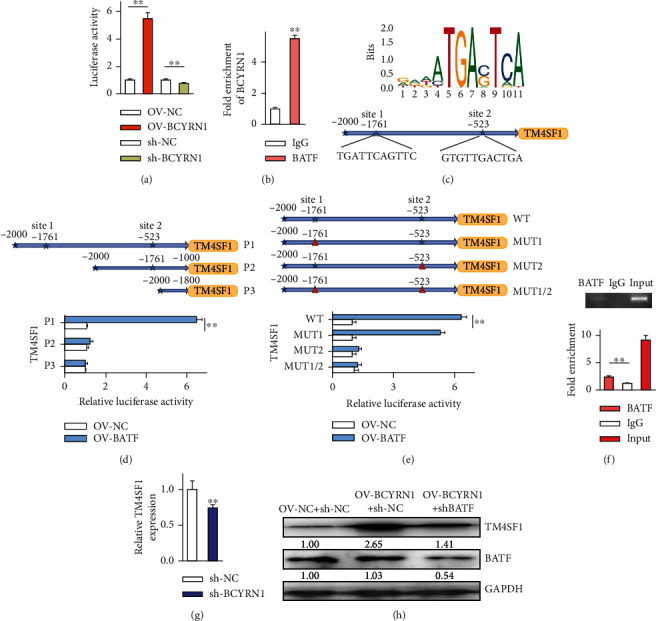
Hepatocellular carcinoma (HCC) is a common form of cancer for which a subset of reliable clinical biomarkers has been defined. However, other factors including long noncoding RNAs (lncRNAs) can also regulate HCC development. This study was thus designed to understand how the lncRNA Brain cytoplasmic RNA 1 (BCYRN1) modulates HCC progression. Bioinformatics approaches were used to identify genes, lncRNAs, and transcription factors that were differentially expressed in the context of HCC, after which the relative expression of BCYRN1 in HCC and control tissues was assessed via qPCR. The ability of BCYRN1 to bind the transcription factor BATF was further evaluated in an RNA immunoprecipitation (RIP) assay, while chromatin immunoprecipitation (ChIP) was used to gauge the binding of the TM4SF1 promoter by BATF. Luciferase reporter assays were also used to assess the association between BCYRN1 and the TM4SF1 promoter. Subsequent loss- and gain-of-function assays were then conducted to explore the effects of altering BCYRN1 expression levels on the proliferative, invasive, and migratory activity of HCC cells. BCYRN1 upregulation was associated with poorer clinical outcomes in HCC patients, and knocking down this lncRNA impaired HCC cell migration and invasion. From a mechanistic perspective, BATF was recruited to the TM4SF1 promoter by BCYRN1, and reducing the expression of this lncRNA was sufficient to constrain xenograft tumor growth in mice. These results highlight BCYRN1 as a putative therapeutic target in HCC tumors.
肝细胞癌 (HCC) 是一种常见的癌症,已经确定了一些可靠的临床生物标志物。然而,其他因素,包括长链非编码 RNA(lncRNA),也可以调节 HCC 的发展。因此,本研究旨在了解 lncRNA 脑细胞质 RNA 1 (BCYRN1) 如何调节 HCC 的进展。生物信息学方法用于鉴定 HCC 背景下差异表达的基因、lncRNA 和转录因子,然后通过 qPCR 评估 HCC 和对照组织中 BCYRN1 的相对表达。通过 RNA 免疫沉淀 (RIP) 测定进一步评估 BCYRN1 与转录因子 BATF 的结合能力,而染色质免疫沉淀 (ChIP) 用于评估 BATF 对 TM4SF1 启动子的结合。荧光素酶报告基因测定也用于评估 BCYRN1 与 TM4SF1 启动子之间的关联。随后进行了缺失和获得功能实验,以探讨改变 BCYRN1 表达水平对 HCC 细胞增殖、侵袭和迁移活性的影响。BCYRN1 的上调与 HCC 患者的不良临床结局相关,敲低这种 lncRNA 会损害 HCC 细胞的迁移和侵袭能力。从机制角度来看,BCYRN1 将 BATF 募集到 TM4SF1 启动子,降低这种 lncRNA 的表达足以限制小鼠异种移植肿瘤的生长。这些结果突出了 BCYRN1 作为 HCC 肿瘤的潜在治疗靶点。