Department of Acute and Tertiary Care, School of Nursing, and.
Department of Critical Care Medicine, University of Pittsburgh Medical Center, Mercy Hospital, Pittsburgh, Pennsylvania.
Ann Am Thorac Soc. 2022 Nov;19(11):1900-1906. doi: 10.1513/AnnalsATS.202203-255OC.
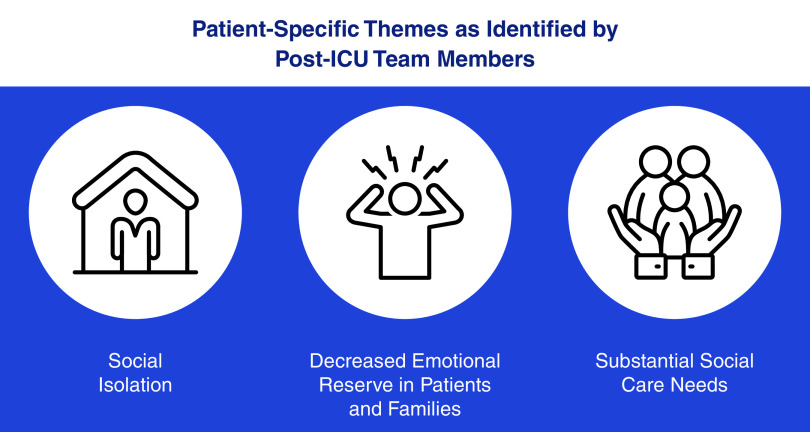
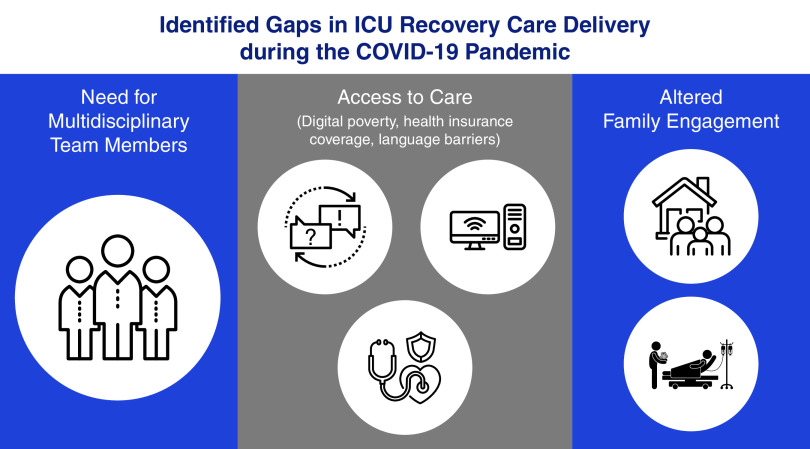
There are limited data on the impact of the coronavirus disease (COVID-19) pandemic on intensive care unit (ICU) recovery clinic care delivery practices. We sought to better understand the patient-level factors affecting ICU recovery clinic care and changing clinical thinking during the COVID-19 pandemic. We also sought to understand how the COVID-19 pandemic sparked innovation within ICU recovery clinics. A multicenter qualitative study was conducted with ICU recovery clinic interprofessional clinicians involved with the Critical and Acute Illness Recovery Organization (CAIRO) between February and March 2021. Data were collected using semistructured interviews and were analyzed using thematic analysis. Key themes were organized in a working analytical framework. Twenty-nine participants from 15 international sites participated in the study. Participants identified three patient-level key themes that influenced care delivery in ICU recovery programs: ) social isolation, ) decreased emotional reserve in patients and families, and ) substantial social care needs. Changes in ICU recovery clinic care delivery occurred at both the clinician level (e.g., growing awareness of healthcare disparities and inequities, recognition of financial effects of illness, refinement of communication skills, increased focus on reconstructing the illness narrative) and the practice level (e.g., expansion of care delivery modes, efforts to integrate social care) in response to each of the patient-level themes. Identified gaps in ICU recovery clinic care delivery during the COVID-19 pandemic included a need for multidisciplinary team members, access to care issues (e.g., digital poverty, health insurance coverage, language barriers), and altered family engagement. This study demonstrates that addressing patient-level factors such as efforts to integrate social care, address financial needs, refine provider communication skills (e.g., empathic listening), and enhance focus on reconstructing the illness narrative became important priorities during the ICU recovery clinic visit during the COVID-19 pandemic. We also identified several ongoing gaps in ICU recovery clinic care delivery that highlight the need for interventions focused on the integration of social and clinic services for critical care survivors.
关于冠状病毒病(COVID-19)大流行对重症监护病房(ICU)康复诊所护理服务的影响,数据有限。我们试图更好地了解影响 ICU 康复诊所护理的患者层面因素和 COVID-19 大流行期间临床思维的变化。我们还试图了解 COVID-19 大流行如何在 ICU 康复诊所内引发创新。这是一项多中心定性研究,涉及参与 Critical and Acute Illness Recovery Organization (CAIRO) 的 ICU 康复诊所跨专业临床医生,于 2021 年 2 月至 3 月进行。使用半结构化访谈收集数据,并使用主题分析进行分析。关键主题组织在一个工作分析框架中。来自 15 个国际站点的 29 名参与者参加了这项研究。参与者确定了三个影响 ICU 康复项目护理服务的患者层面关键主题:)社会隔离、)患者和家庭情绪储备减少、)大量社会护理需求。在 ICU 康复诊所护理服务方面的变化发生在临床医生层面(例如,越来越意识到医疗保健差距和不平等,认识到疾病的经济影响,沟通技巧的提高,对重建疾病叙述的关注增加)和实践层面(例如,扩大护理服务模式,努力整合社会护理),以应对每个患者层面的主题。在 COVID-19 大流行期间,ICU 康复诊所护理服务方面存在的差距包括需要多学科团队成员、获得护理的问题(例如,数字贫困、医疗保险覆盖范围、语言障碍)以及改变家庭参与度。这项研究表明,在 COVID-19 大流行期间,解决患者层面的因素(例如,努力整合社会护理、解决财务需求、提高提供者沟通技巧(例如,同理心倾听),以及加强对重建疾病叙述的关注)成为 ICU 康复诊所就诊期间的重要优先事项。我们还确定了 ICU 康复诊所护理服务方面的几个持续差距,这些差距突出表明需要干预措施,重点是整合社会和诊所服务,以满足重症监护幸存者的需求。