van Veenendaal Nadine, van der Meulen Ingeborg C, Onrust Marisa, Paans Wolter, Dieperink Willem, van der Voort Peter H J
Department of Critical Care, University Medical Center Groningen, University of Groningen, P.O. Box 30.001, 9700 RB Groningen, The Netherlands.
Department of Anesthesiology, University Medical Center Groningen, University of Groningen, P.O. Box 30.001, 9700 RB Groningen, The Netherlands.
Healthcare (Basel). 2021 Jul 8;9(7):865. doi: 10.3390/healthcare9070865.
The COVID-19 pandemic has resulted in a major influx of intensive care unit (ICU) admissions. Currently, there is limited knowledge on the long-term outcomes of COVID-19 ICU-survivors and the impact on family members. This study aimed to gain an insight into the long-term physical, social and psychological functioning of COVID-19 ICU-survivors and their family members at three- and six-months following ICU discharge.
A single-center, prospective cohort study was conducted among COVID-19 ICU-survivors and their family members. Participants received questionnaires at three and six months after ICU discharge. Physical functioning was evaluated using the MOS Short-Form General Health Survey, Clinical Frailty Scale and spirometry tests. Social functioning was determined using the McMaster Family Assessment Device and return to work. Psychological functioning was assessed using the Hospital Anxiety and Depression Scale.
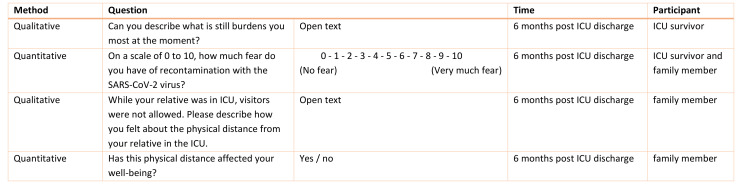
Sixty COVID-19 ICU-survivors and 78 family members participated in this study. Physical functioning was impaired in ICU-survivors as reflected by a score of 33.3 (IQR 16.7-66.7) and 50 (IQR 16.7-83.3) out of 100 at 3- and 6-month follow-ups, respectively. Ninety percent of ICU-survivors reported persistent symptoms after 6 months. Social functioning was impaired since 90% of COVID-19 ICU-survivors had not reached their pre-ICU work level 6 months after ICU-discharge. Psychological functioning was unaffected in COVID-19 ICU-survivors. Family members experienced worse work status in 35% and 34% of cases, including a decrease in work rate among 18.3% and 7.4% of cases at 3- and 6-months post ICU-discharge, respectively. Psychologically, 63% of family members reported ongoing impaired well-being due to the COVID-19-related mandatory physical distance from their relatives.
COVID-19 ICU-survivors suffer from a prolonged disease burden, which is prominent in physical and social functioning, work status and persisting symptoms among 90% of patients. Family members reported a reduction in return to work and impaired well-being. Further research is needed to extend the follow-up period and study the effects of standardized rehabilitation in COVID-19 patients and their family members.
新冠疫情导致大量患者涌入重症监护病房(ICU)。目前,对于新冠ICU幸存者的长期预后以及对其家庭成员的影响,我们了解有限。本研究旨在深入了解新冠ICU幸存者及其家庭成员在出院后3个月和6个月时的长期身体、社会和心理功能状况。
对新冠ICU幸存者及其家庭成员开展了一项单中心前瞻性队列研究。参与者在ICU出院后3个月和6个月时收到问卷。使用医学结局研究简表36健康调查、临床衰弱量表和肺活量测定测试评估身体功能。使用麦克马斯特家庭评估工具并结合复工情况来确定社会功能。使用医院焦虑抑郁量表评估心理功能。
60名新冠ICU幸存者和78名家庭成员参与了本研究。ICU幸存者的身体功能受损,在3个月和6个月随访时,100分制的得分分别为33.3(四分位间距16.7 - 66.7)和50(四分位间距16.7 - 83.3)。90%的ICU幸存者在6个月后仍有持续症状。社会功能受损,因为90%的新冠ICU幸存者在出院6个月后仍未恢复到ICU前的工作水平。新冠ICU幸存者的心理功能未受影响。35%和34%的家庭成员工作状况变差,分别有18.3%和7.4%的家庭成员在ICU出院后3个月和6个月时工作效率下降。在心理方面,63%的家庭成员报告称,由于与亲属保持新冠疫情相关的强制身体距离,他们的幸福感持续受损。
新冠ICU幸存者承受着长期的疾病负担,在身体和社会功能、工作状况以及90%的患者持续症状方面表现突出。家庭成员报告复工情况减少且幸福感受损。需要进一步研究以延长随访期,并研究标准化康复对新冠患者及其家庭成员的影响。