Vanderbilt University Medical Center, Nashville, TN, USA.
University of Nebraska Medical Center, Omaha, NE, USA.
Sci Rep. 2022 Jun 22;12(1):10547. doi: 10.1038/s41598-022-14954-9.
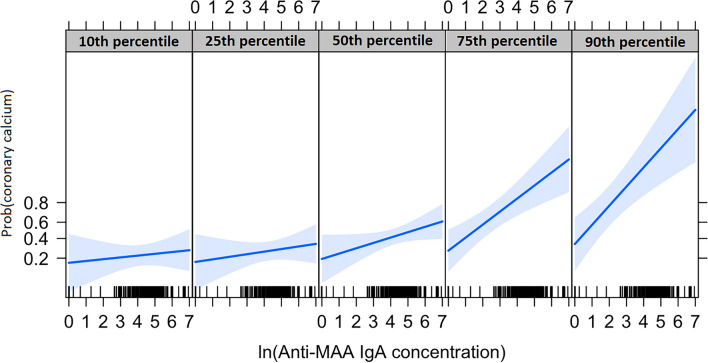
Patients with rheumatoid arthritis (RA) have increased atherosclerosis; oxidative stress may be a contributor. Oxidative stress produces immunogenic malondialdehyde-acetaldehyde (MAA) protein adducts and anti-MAA antibodies are detectable in human serum. We hypothesized that anti-MAA antibody concentrations are associated with coronary atherosclerosis in RA patients. Serum concentrations of anti-MAA antibodies (IgA, IgG, and IgM) were measured in 166 RA patients using ELISA cross-sectionally. Relationship between anti-MAA antibody concentrations and cardiovascular and metabolic measures and predictive accuracy of anti-MAA antibodies for presence of coronary artery calcium (CAC) and high CAC (≥ 300 Agatston units or ≥ 75 percentile) were assessed. Only serum IgA anti-MAA antibody concentration was associated with increased CAC, insulin resistance, and decreased high-density lipoprotein particle number. When added as an interaction term with ACC/AHA 10-year risk score plus high-sensitivity C-reactive protein, IgA anti-MAA antibody concentration improved the C-statistic for prediction of any CAC and high CAC compared to ACC/AHA 10-year risk score plus hs-CRP alone. IgA anti-MAA concentration is associated with multiple cardiovascular risk factors and modifies the relationship between ACC/AHA 10-year risk score and CAC in RA patients. IgA anti-MAA concentration could assist in prediction of atherosclerotic CVD and risk stratification when added to standard measures of cardiovascular risk.
类风湿关节炎(RA)患者的动脉粥样硬化程度增加;氧化应激可能是一个促成因素。氧化应激会产生免疫原性的丙二醛-乙醛(MAA)蛋白加合物,并且在人类血清中可检测到抗 MAA 抗体。我们假设抗 MAA 抗体浓度与 RA 患者的冠状动脉粥样硬化有关。使用 ELISA 法在 166 例 RA 患者中进行了血清抗 MAA 抗体(IgA、IgG 和 IgM)浓度的横断面测量。评估了抗 MAA 抗体浓度与心血管和代谢指标之间的关系,以及抗 MAA 抗体对冠状动脉钙(CAC)和高 CAC(≥300 个 Agatston 单位或≥75 百分位)存在的预测准确性。只有血清 IgA 抗 MAA 抗体浓度与 CAC 增加、胰岛素抵抗和高密度脂蛋白颗粒数减少有关。当与 ACC/AHA 10 年风险评分加高敏 C 反应蛋白作为交互项添加时,与仅 ACC/AHA 10 年风险评分加 hs-CRP 相比,IgA 抗 MAA 抗体浓度改善了对任何 CAC 和高 CAC 的预测的 C 统计量。IgA 抗 MAA 浓度与多种心血管危险因素相关,并改变了 ACC/AHA 10 年风险评分与 RA 患者 CAC 之间的关系。当添加到心血管风险的标准测量中时,IgA 抗 MAA 浓度可以帮助预测动脉粥样硬化性心血管疾病和风险分层。