Veterinary Biomedical Sciences, University of Saskatchewan, Saskatoon, Canada.
Faculty of Animal Science and Veterinary Medicine, Nong Lam University, Ho Chi Minh City, Vietnam.
Respir Res. 2022 Jun 22;23(1):165. doi: 10.1186/s12931-022-02078-7.
Asthma is a major cause of morbidity and mortality in humans. The mechanisms of asthma are still not fully understood. Leukocyte-specific protein-1 (LSP-1) regulates neutrophil migration during acute lung inflammation. However, its role in asthma remains unknown.
An OVA-induced mouse asthma model in LSP1-deficient (Lsp1) and wild-type (WT) 129/SvJ mice were used to test the hypothesis that the absence of LSP1 would inhibit airway hyperresponsiveness and lung inflammation.
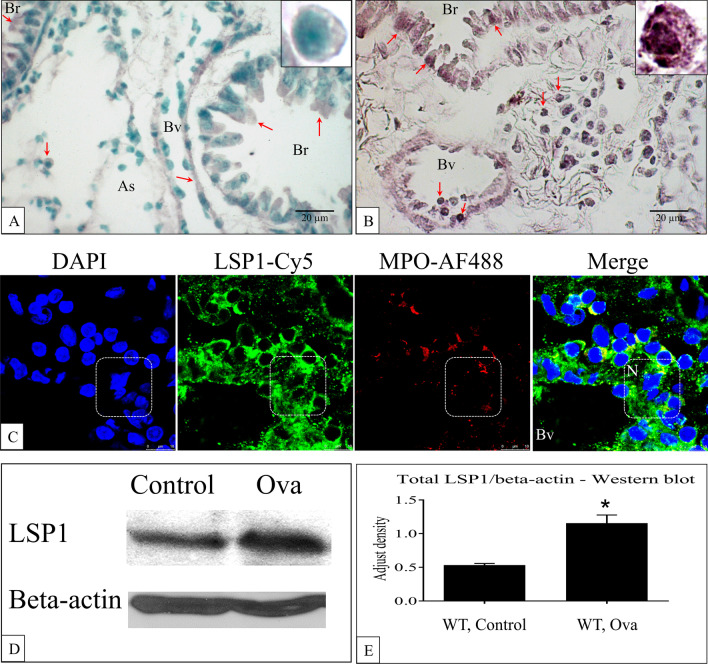
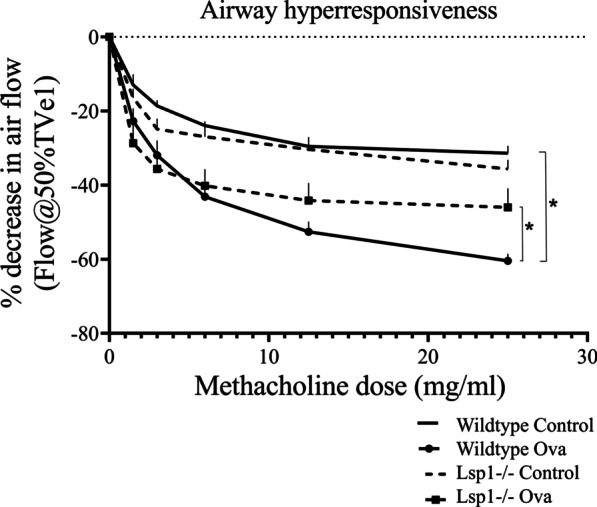
Light and electron microscopic immunocytochemistry and Western blotting showed that, compared with normal healthy lungs, the levels of LSP1 were increased in lungs of OVA-asthmatic mice. Compared to Lsp1 OVA mice, WT OVA mice had higher levels of leukocytes in broncho-alveolar lavage fluid and in the lung tissues (P < 0.05). The levels of OVA-specific IgE but not IgA and IgG1 in the serum of WT OVA mice was higher than that of Lsp1 OVA mice (P < 0.05). Deficiency of LSP1 significantly reduced the levels of IL-4, IL-5, IL-6, IL-13, and CXCL1 (P < 0.05) but not total proteins in broncho-alveolar lavage fluid in asthmatic mice. The airway hyper-responsiveness to methacholine in Lsp1 OVA mice was improved compared to WT OVA mice (P < 0.05). Histology revealed more inflammation (inflammatory cells, and airway and blood vessel wall thickening) in the lungs of WT OVA mice than in those of Lsp1 OVA mice. Finally, immunohistology showed localization of LSP1 protein in normal and asthmatic human lungs especially associated with the vascular endothelium and neutrophils.
These data show that LSP1 deficiency reduces airway hyper-responsiveness and lung inflammation, including leukocyte recruitment and cytokine expression, in a mouse model of asthma.
哮喘是人类发病率和死亡率的主要原因。哮喘的发病机制尚不完全清楚。白细胞特异性蛋白 1(LSP-1)调节急性肺炎症期间中性粒细胞的迁移。然而,其在哮喘中的作用尚不清楚。
采用 LSP1 缺陷(Lsp1)和野生型(WT)129/SvJ 小鼠卵清蛋白(OVA)诱导的哮喘小鼠模型,验证 LSP1 缺失是否会抑制气道高反应性和肺炎症的假说。
光镜和电镜免疫细胞化学及 Western blot 显示,与正常健康肺相比,OVA 哮喘小鼠肺组织中 LSP1 水平升高。与 Lsp1 OVA 小鼠相比,WT OVA 小鼠支气管肺泡灌洗液和肺组织中的白细胞水平更高(P < 0.05)。WT OVA 小鼠血清中 OVA 特异性 IgE 水平高于 Lsp1 OVA 小鼠,但 IgA 和 IgG1 水平无差异(P < 0.05)。LSP1 缺陷显著降低哮喘小鼠支气管肺泡灌洗液中 IL-4、IL-5、IL-6、IL-13 和 CXCL1 水平(P < 0.05),但不影响总蛋白水平。与 WT OVA 小鼠相比,Lsp1 OVA 小鼠的气道对乙酰甲胆碱的高反应性得到改善(P < 0.05)。组织学显示 WT OVA 小鼠肺部炎症(炎症细胞、气道和血管壁增厚)比 Lsp1 OVA 小鼠更严重。最后,免疫组化显示 LSP1 蛋白在正常和哮喘人类肺组织中定位,特别是与血管内皮细胞和中性粒细胞相关。
这些数据表明,LSP1 缺乏可减少哮喘小鼠模型的气道高反应性和肺炎症,包括白细胞募集和细胞因子表达。