Institut Des Sciences, Cognitives Marc Jeannerod, Centre National de La Recherche Scientifique, 67 boulevard Pinel, 69500, Bron, France.
Claude Bernard University Lyon, Lyon, France.
Orphanet J Rare Dis. 2022 Jun 22;17(1):244. doi: 10.1186/s13023-022-02395-6.
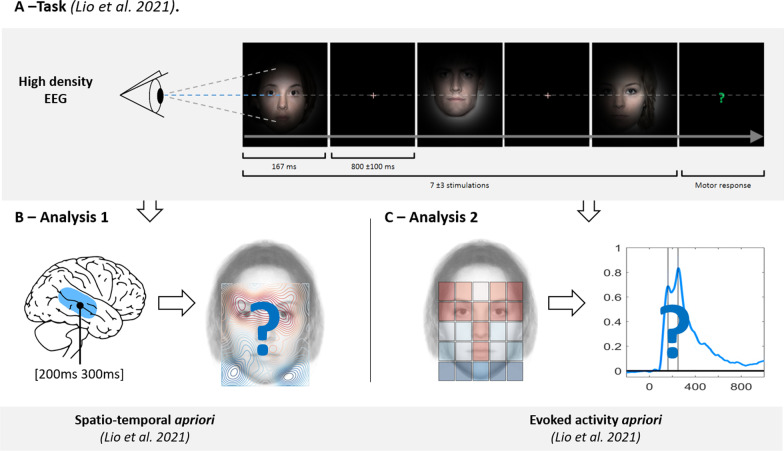
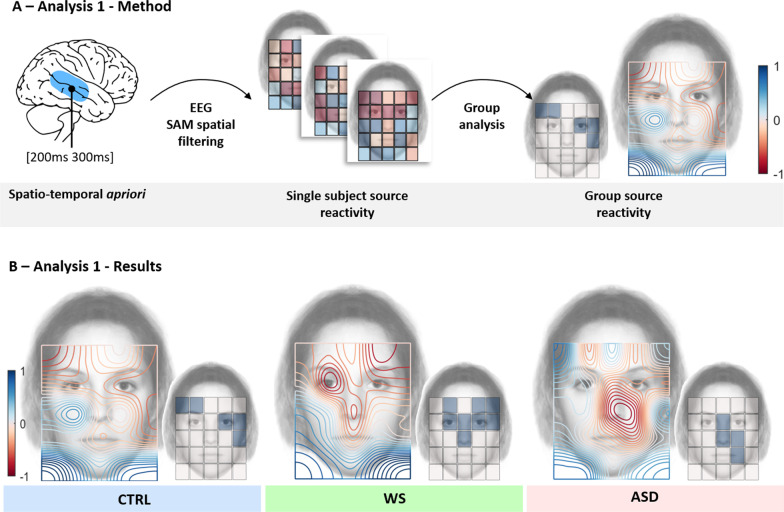
Williams syndrome (WS) and Autism Spectrum Disorders (ASD) are neurodevelopmental conditions associated with atypical but opposite face-to-face interactions patterns: WS patients overly stare at others, ASD individuals escape eye contact. Whether these behaviors result from dissociable visual processes within the occipito-temporal pathways is unknown. Using high-density electroencephalography, multivariate signal processing algorithms and a protocol designed to identify and extract evoked activities sensitive to facial cues, we investigated how WS (N = 14), ASD (N = 14) and neurotypical subjects (N = 14) decode the information content of a face stimulus.
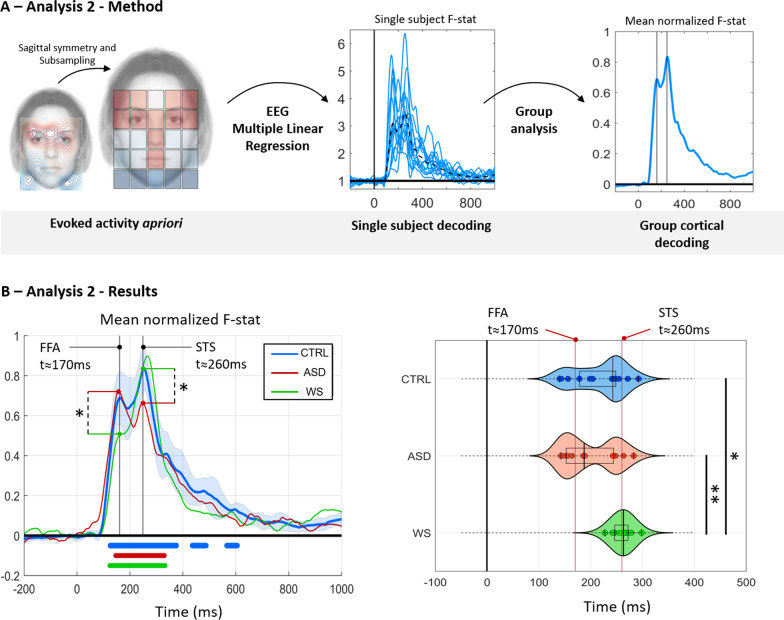
We found two neural components in neurotypical participants, both strongest when the eye region was projected onto the subject's fovea, simulating a direct eye contact situation, and weakest over more distant regions, reaching a minimum when the focused region was outside the stimulus face. The first component peaks at 170 ms, an early signal known to be implicated in low-level face features. The second is identified later, 260 ms post-stimulus onset and is implicated in decoding salient face social cues. Remarkably, both components were found distinctly impaired and preserved in WS and ASD. In WS, we could weakly decode the 170 ms signal based on our regressor relative to facial features, probably due to their relatively poor ability to process faces' morphology, while the late 260 ms component was highly significant. The reverse pattern was observed in ASD participants who showed neurotypical like early 170 ms evoked activity but impaired late evoked 260 ms signal.
Our study reveals a dissociation between WS and ASD patients and points at different neural origins for their social impairments.
威廉姆斯综合征(WS)和自闭症谱系障碍(ASD)是与非典型但相反的面对面互动模式相关的神经发育障碍:WS 患者过度注视他人,ASD 个体逃避眼神接触。这些行为是否源于枕颞通路上可分离的视觉过程尚不清楚。使用高密度脑电图、多元信号处理算法和专门设计的协议来识别和提取对面部线索敏感的诱发活动,我们研究了 WS(N=14)、ASD(N=14)和神经典型受试者(N=14)如何解码面部刺激的信息内容。
我们在神经典型参与者中发现了两个神经成分,当眼区投射到受试者的中央凹时,这两个成分最强,模拟直接的眼神接触情况,而当注视区域更远时,这两个成分最弱,当聚焦区域在刺激面之外时,这两个成分达到最小值。第一个成分在 170 毫秒时达到峰值,这是一个已知与低水平面部特征有关的早期信号。第二个成分在刺激后 260 毫秒出现,与解码显著的面部社交线索有关。值得注意的是,WS 和 ASD 中这两个成分都明显受损和保留。在 WS 中,我们可以根据相对于面部特征的回归器微弱地解码 170 毫秒的信号,这可能是由于他们相对较差的处理面部形态的能力,而晚期的 260 毫秒成分则非常显著。ASD 参与者则表现出相反的模式,他们表现出神经典型的早期 170 毫秒诱发活动,但晚期的 260 毫秒诱发信号受损。
我们的研究揭示了 WS 和 ASD 患者之间的分离,并指出了他们社交障碍的不同神经起源。