Shore Danielle M, Ng Rowena, Bellugi Ursula, Mills Debra L
Department of Experimental Psychology, University of Oxford, Tinbergen Building, 9 South Parks Road, Oxford, OX1 3UD, UK.
Institute of Child Development, University of Minnesota, Twin Cities, 51 East River Road, Minneapolis, MN, 55455, USA.
Cogn Affect Behav Neurosci. 2017 Oct;17(5):1002-1017. doi: 10.3758/s13415-017-0528-6.
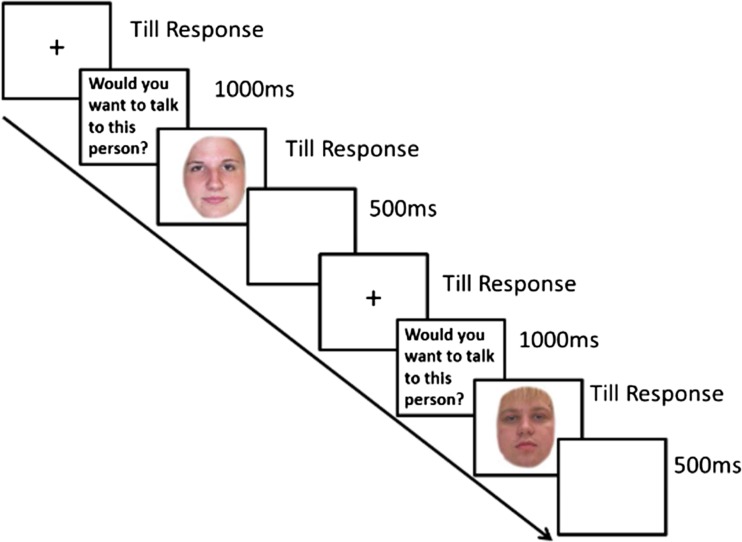
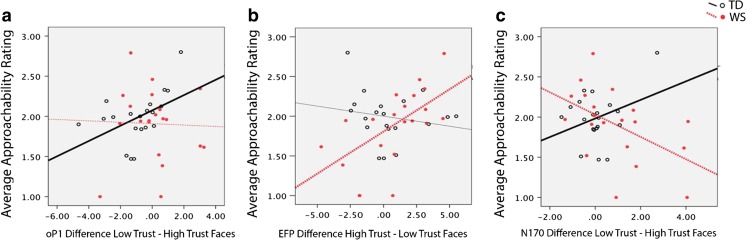
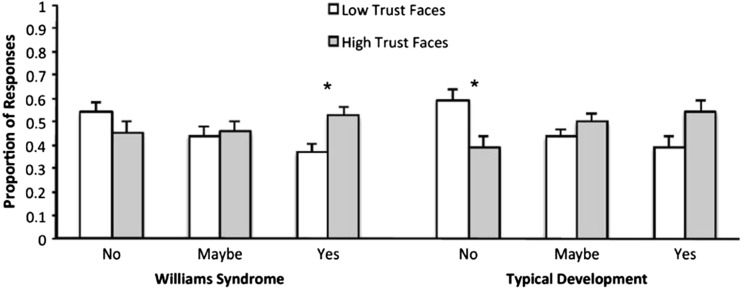
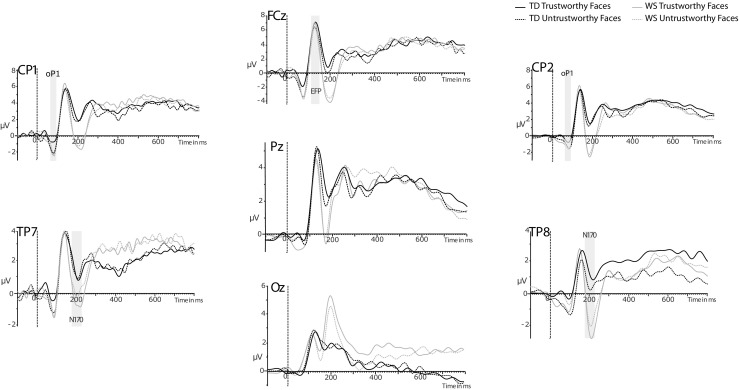
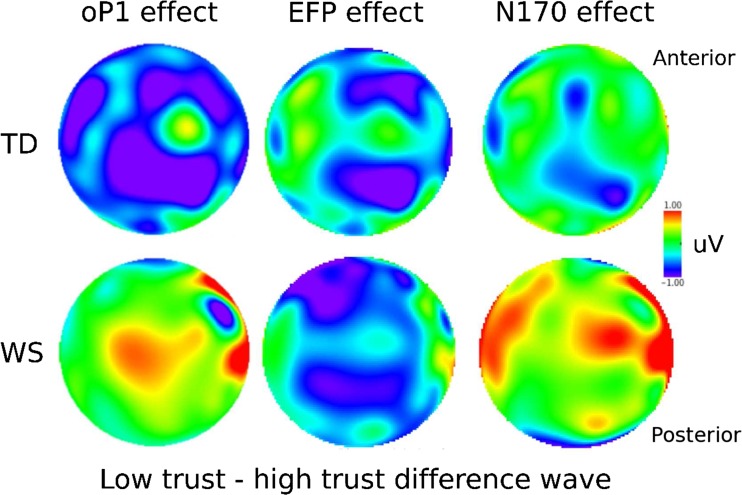
Accurate assessment of trustworthiness is fundamental to successful and adaptive social behavior. Initially, people assess trustworthiness from facial appearance alone. These assessments then inform critical approach or avoid decisions. Individuals with Williams syndrome (WS) exhibit a heightened social drive, especially toward strangers. This study investigated the temporal dynamics of facial trustworthiness evaluation in neurotypic adults (TD) and individuals with WS. We examined whether differences in neural activity during trustworthiness evaluation may explain increased approach motivation in WS compared to TD individuals. Event-related potentials were recorded while participants appraised faces previously rated as trustworthy or untrustworthy. TD participants showed increased sensitivity to untrustworthy faces within the first 65-90 ms, indexed by the negative-going rise of the P1 onset (oP1). The amplitude of the oP1 difference to untrustworthy minus trustworthy faces was correlated with lower approachability scores. In contrast, participants with WS showed increased N170 amplitudes to trustworthy faces. The N170 difference to low-high-trust faces was correlated with low approachability in TD and high approachability in WS. The findings suggest that hypersociability associated with WS may arise from abnormalities in the timing and organization of early visual brain activity during trustworthiness evaluation. More generally, the study provides support for the hypothesis that impairments in low-level perceptual processes can have a cascading effect on social cognition.
准确评估可信度是成功且适应性社会行为的基础。最初,人们仅从面部外观来评估可信度。这些评估随后为关键的接近或回避决策提供依据。患有威廉姆斯综合征(WS)的个体表现出增强的社交驱动力,尤其是对陌生人。本研究调查了神经典型成年人(TD)和患有WS的个体对面部可信度评估的时间动态。我们研究了可信度评估期间神经活动的差异是否可以解释与TD个体相比,WS个体中接近动机的增加。在参与者评估先前被评为可信或不可信的面孔时记录事件相关电位。TD参与者在最初的65 - 90毫秒内对不可信面孔表现出更高的敏感性,以P1起始(oP1)的负向上升为指标。oP1差异(不可信面孔减去可信面孔)的幅度与较低的可接近性得分相关。相比之下,患有WS的参与者对可信面孔表现出增加的N170幅度。N170差异(低信任度面孔到高信任度面孔)与TD中的低可接近性和WS中的高可接近性相关。研究结果表明,与WS相关的过度社交可能源于可信度评估期间早期视觉脑活动的时间和组织异常。更普遍地说,该研究为以下假设提供了支持,即低水平感知过程的损伤会对社会认知产生级联效应。