Cao Shiliang, Chen Keyuan, Jiang Liang, Wei Feng, Liu Xiaoguang, Liu Zhongjun
Department of Orthopaedics, Peking University Third Hospital, Beijing, China.
Front Surg. 2022 Jun 6;9:838235. doi: 10.3389/fsurg.2022.838235. eCollection 2022.
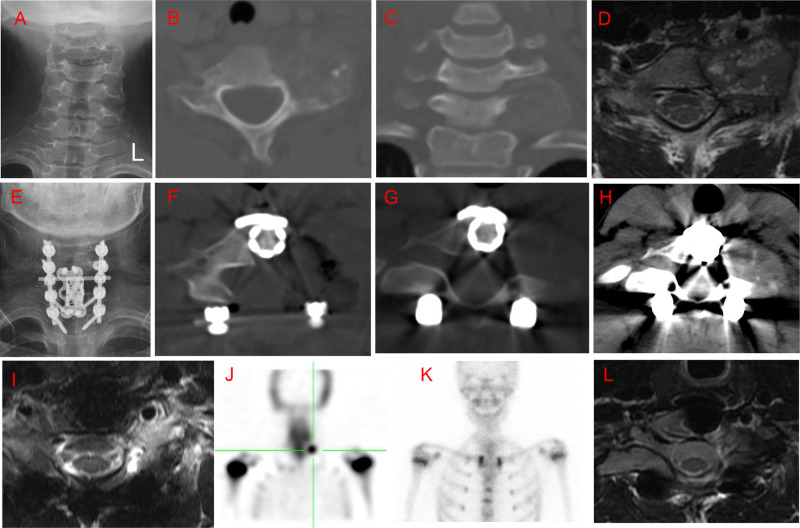
Osteoblastoma (OB) is a benign bone tumor with aggressive behavior and a tendency for local recurrence. The appropriate surgical strategy for spinal OB remains unclear. This retrospective study aimed to verify the clinical efficacy and safety of intralesional marginal resection of OB in the mobile spine. We enrolled 50 consecutive patients with spinal OB between January 2009 and December 2019. The tumors were staged based on the Enneking system, with 21 and 29 lesions being determined as stage 2 (St.2) and stage 3 (St.3), respectively. Among them, 42 patients underwent intralesional marginal resection, five underwent extensive curettage, and three underwent en bloc resection successfully since their lesions were limited to the posterior element in a single vertebra. We analyzed clinical characteristics, perioperative and follow-up images, surgical details, and follow-up data. Within a median follow-up duration of 50 (range: 24-160) months, six (12.0%) patients had local recurrence. The recurrence rates among patients who underwent intralesional marginal resection, curettage, en bloc resection were 7.1%(3/42), 60.0%(3/5), and 0%(0/3), respectively. The recurrence rate of intralesional marginal resection of St.3 lesions was slightly higher than that of St.2 lesions (7.7%[2/26] vs. 6.3%[1/16]). There were 16(38.1%), 3(60.0%), and 0 patients with surgical complications among those who underwent intralesional marginal resection, curettage, and en bloc resection, respectively. Local recurrence was observed in five (5/14, 35.7%) patients who had vertebral artery extension and in none who did not have vertebral artery extension (= 0.02). Our findings suggest that intralesional marginal resection could be an appropriate treatment choice for patients with spinal OB, both St.2 and St.3 lesions, with an acceptable local recurrence rate and a low risk of complications. Vertebral artery extension could be a strong risk factor for local recurrence in patients with spinal OB.
骨母细胞瘤(OB)是一种具有侵袭性且有局部复发倾向的良性骨肿瘤。脊柱OB的合适手术策略仍不明确。这项回顾性研究旨在验证活动脊柱中OB病灶内边缘切除术的临床疗效和安全性。我们纳入了2009年1月至2019年12月期间连续的50例脊柱OB患者。根据Enneking系统对肿瘤进行分期,分别有21个和29个病灶被确定为2期(St.2)和3期(St.3)。其中,42例患者接受了病灶内边缘切除术,5例接受了广泛刮除术,3例因病灶局限于单个椎体的后部结构而成功接受了整块切除术。我们分析了临床特征、围手术期和随访影像、手术细节以及随访数据。在中位随访期50(范围:24 - 160)个月内,6例(12.0%)患者出现局部复发。接受病灶内边缘切除术、刮除术、整块切除术的患者复发率分别为7.1%(3/42)、60.0%(3/5)和0%(0/3)。St.3期病灶的病灶内边缘切除术复发率略高于St.2期病灶(7.7%[2/26]对6.3%[1/16])。接受病灶内边缘切除术、刮除术和整块切除术的患者中,分别有16例(38.1%)、3例(60.0%)和0例出现手术并发症。在有椎动脉受累的5例(5/14,35.7%)患者中观察到局部复发,而在无椎动脉受累的患者中未观察到复发(P = 0.02)。我们的研究结果表明,病灶内边缘切除术对于脊柱OB患者(包括St.2期和St.3期病灶)可能是一种合适的治疗选择,局部复发率可接受且并发症风险低。椎动脉受累可能是脊柱OB患者局部复发的一个重要危险因素。