Pan Shelei, Ye Dezhuang, Yue Yimei, Yang Lihua, Pacia Christopher P, DeFreitas Dakota, Esakky Prabagaran, Dahiya Sonika, Limbrick David D, Rubin Joshua B, Chen Hong, Strahle Jennifer M
Department of Neurosurgery, Washington University School of Medicine, Saint Louis, Missouri, USA.
Department of Mechanical Engineering and Materials Science, Washington University in St. Louis, Saint Louis, Missouri, USA.
Neurooncol Adv. 2022 Apr 26;4(1):vdac059. doi: 10.1093/noajnl/vdac059. eCollection 2022 Jan-Dec.
Leptomeningeal disease and hydrocephalus are present in up to 30% of patients with diffuse intrinsic pontine glioma (DIPG), however there are no animal models of cerebrospinal fluid (CSF) dissemination. As the tumor-CSF-ependymal microenvironment may play an important role in tumor pathogenesis, we identified characteristics of the Nestin-tumor virus A (Nestin-Tva) genetically engineered mouse model that make it ideal to study the interaction of tumor cells with the CSF and its associated pathways with implications for the development of treatment approaches to address CSF dissemination in DIPG.
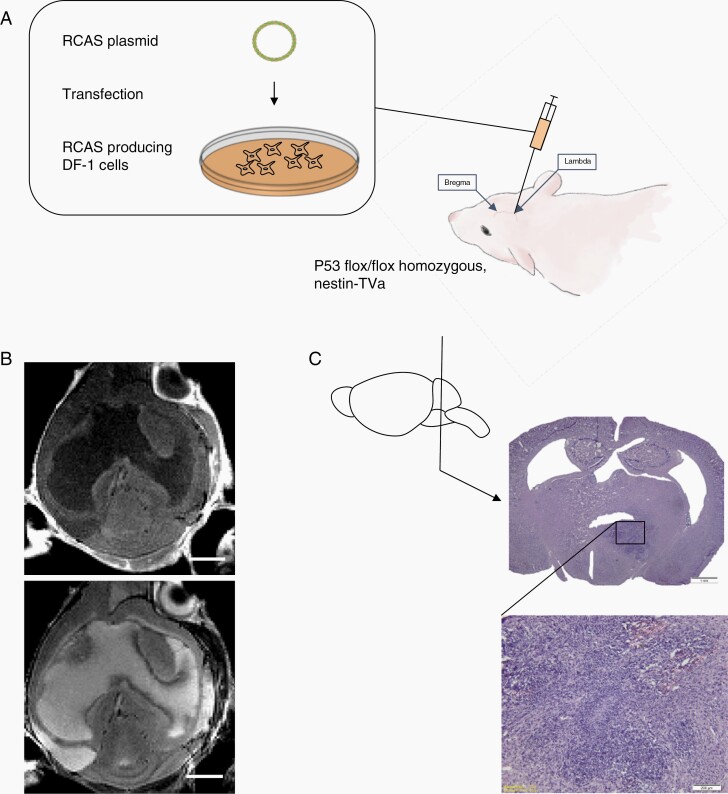
A Nestin-Tva model of DIPG utilizing the 3 most common DIPG genetic alterations (H3.3K27M, PDGF-B, and p53) was used for this study. All mice underwent MR imaging and a subset underwent histopathologic analysis with H&E and immunostaining.
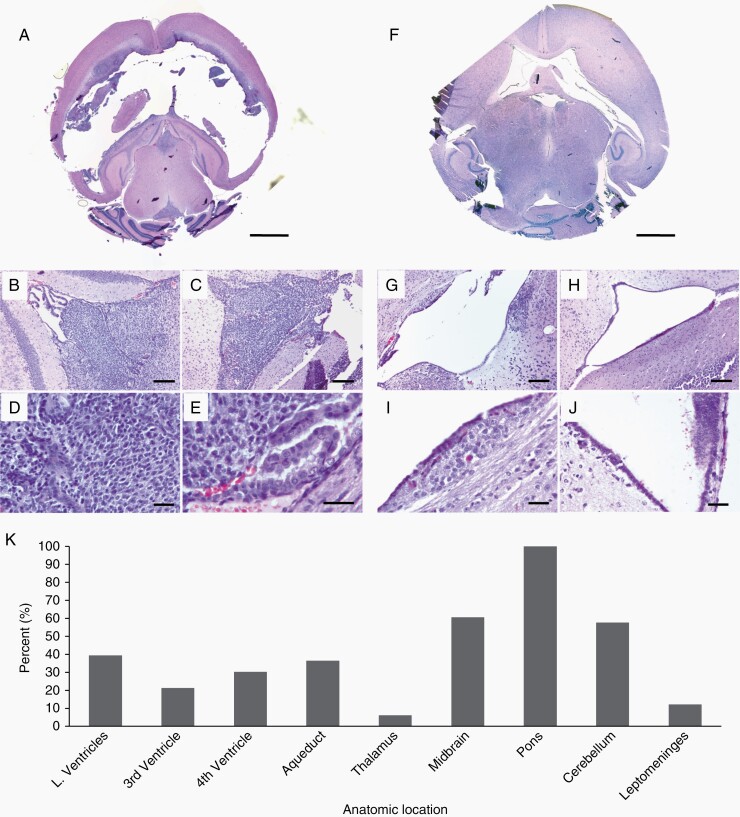
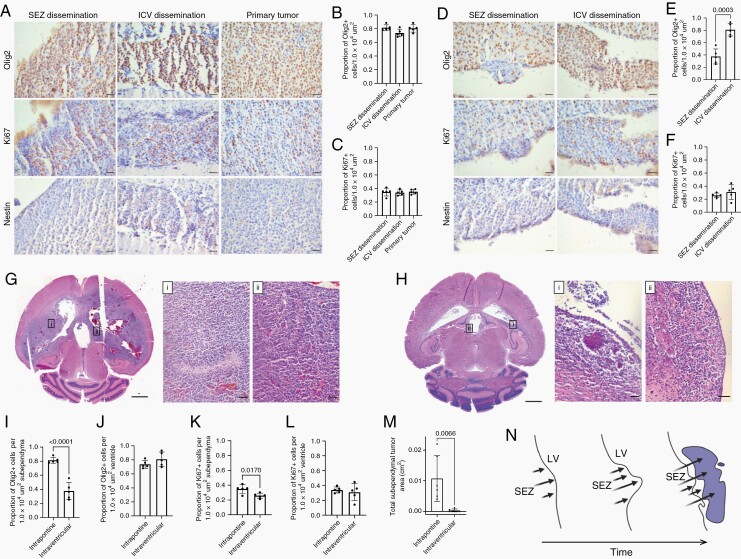
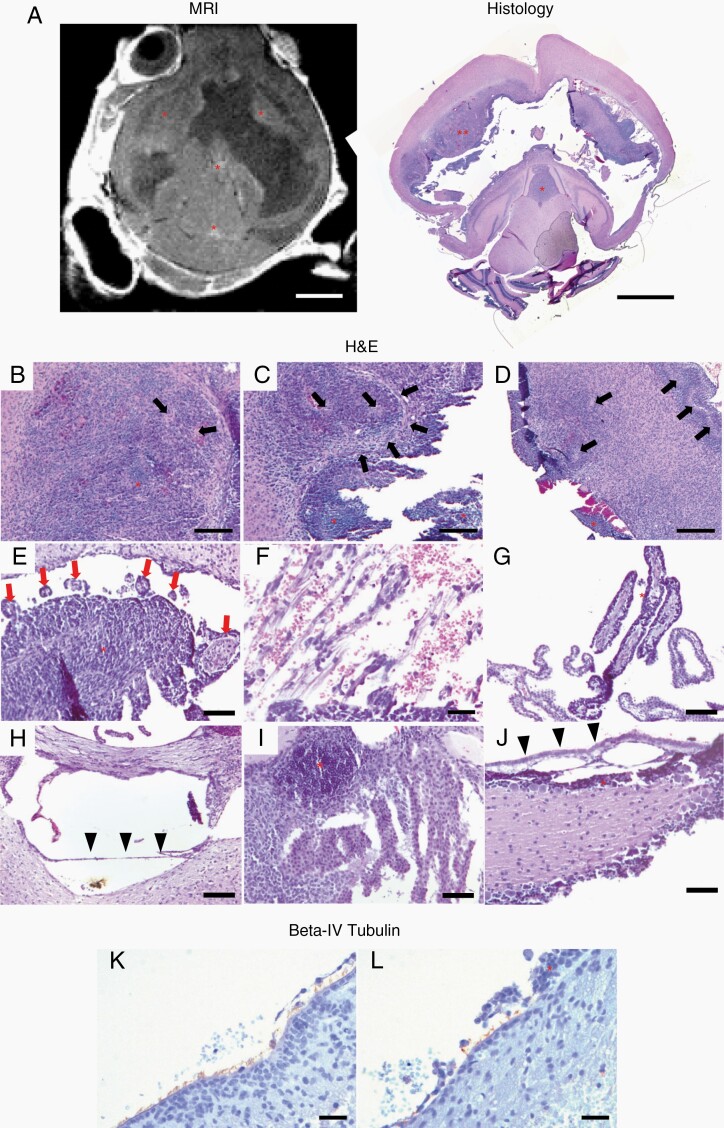
Tumor dissemination within the CSF pathways (ventricles, leptomeninges) from the subependyma was present in 76% (25/33) of mice, with invasion of the choroid plexus, disruption of the ciliated ependyma and regional subependymal fluid accumulation. Ventricular enlargement consistent with hydrocephalus was present in 94% (31/33). Ventricle volume correlated with region-specific transependymal CSF flow (periventricular T2 signal), localized anterior to the lateral ventricles.
This is the first study to report CSF pathway tumor dissemination associated with subependymal tumor in an animal model of DIPG and is representative of CSF dissemination seen clinically. Understanding the CSF-tumor-ependymal microenvironment has significant implications for treatment of DIPG through targeting mechanisms of tumor spread within the CSF pathways.
高达30%的弥漫性脑桥内在型胶质瘤(DIPG)患者存在软脑膜疾病和脑积水,然而目前尚无脑脊液(CSF)播散的动物模型。由于肿瘤 - CSF - 室管膜微环境可能在肿瘤发病机制中起重要作用,我们确定了巢蛋白 - 肿瘤病毒A(Nestin - Tva)基因工程小鼠模型的特征,该模型对于研究肿瘤细胞与CSF的相互作用及其相关途径非常理想,这对开发治疗DIPG中CSF播散的治疗方法具有重要意义。
本研究使用了利用3种最常见的DIPG基因改变(H3.3K27M、血小板衍生生长因子 - B(PDGF - B)和p53)构建的DIPG的Nestin - Tva模型。所有小鼠均接受磁共振成像,部分小鼠接受苏木精 - 伊红(H&E)染色和免疫染色的组织病理学分析。
76%(25/33)的小鼠出现了肿瘤从室管膜下向CSF通路(脑室、软脑膜)的播散,伴有脉络丛浸润、纤毛室管膜破坏和局部室管膜下积液。94%(31/33)的小鼠出现了与脑积水一致的脑室扩大。脑室体积与侧脑室前方局部的区域特异性经室管膜CSF流动(脑室周围T2信号)相关。
这是第一项报道在DIPG动物模型中与室管膜下肿瘤相关的CSF通路肿瘤播散的研究,并且代表了临床上所见的CSF播散情况。了解CSF - 肿瘤 - 室管膜微环境对于通过靶向肿瘤在CSF通路内扩散的机制来治疗DIPG具有重要意义。