Heng Yu, Xu Chengzhi, Lin Hanqing, Zhu Xiaoke, Zhou Liang, Zhang Ming, Wu Chunping, Tao Lei
ENT Institute and Department of Otorhinolaryngology, Eye & ENT Hospital Fudan University Shanghai China.
Laryngoscope Investig Otolaryngol. 2022 Mar 30;7(3):715-722. doi: 10.1002/lio2.762. eCollection 2022 Jun.
Glottic squamous cell carcinoma (GSCC) is the most prevalent type of laryngeal carcinoma. The value of prophylactic lymph node dissection (LND) in resected GSCC remains controversial. This study aims to quantitatively assess the probability of occult lymph node metastasis (LNM) for GSCC patients and devise individualized postoperative radiotherapy strategies.
A total of 1319 patients with GSCC were retrospectively analyzed.
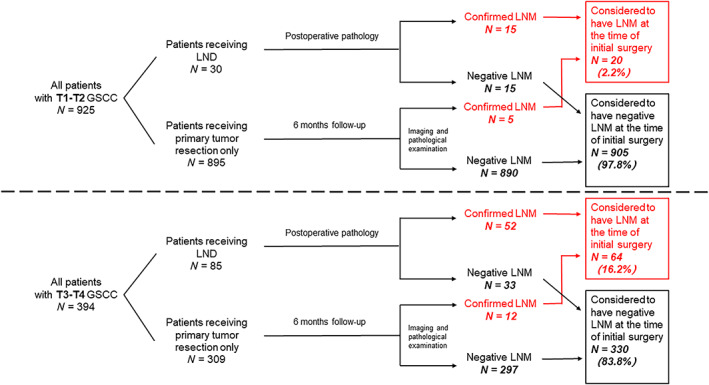
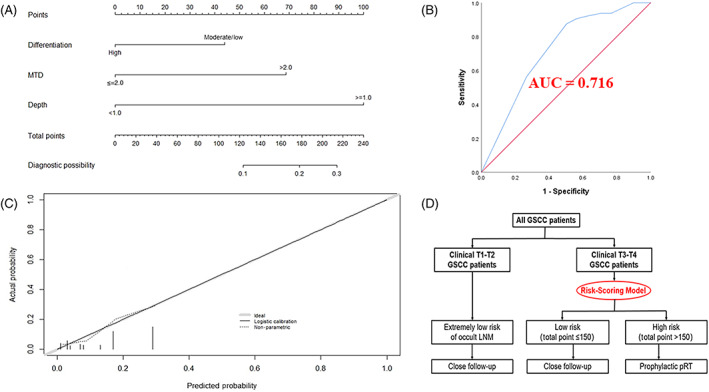
GSCC patients with T1-T2 stages showed significantly lower LNM rate than those with T3-T4 stages. For patients with T3-T4 GSCC, multivariate logistic analyses indicated that three factors-maximum tumor diameter (MTD) of more than 2.0 cm, relatively low differentiation, and tumor invasive depth of no less than 1.0 cm-were independent risk factors for the existence of LNM. A predictive nomogram was established based on these factors. The accuracy and validity of our model were verified by 0.716 and remained at 0.717 after 1000 bootstrapping. The calibration curve was also plotted and showed a favorable agreement. The patients were stratified into two groups based on their individual LNM risk points. Possible LNM rates for low-risk and high-risk subgroups were 4.7% and 25.2%, respectively.
A new post-operative strategy selection flow chart was established based on our newly created nomogram which can effectively predict the individualized possibility of occult LNM for GSCC patients. For clinical T3-4N0 patients in the high-risk subgroup, prophylactic dose post-operative radiation therapy is recommended. However, for all those clinically diagnosed as T1-2N0 stage, regular follow-up is sufficient in view of the low occult LNM rate.Level of Evidence: 2a.
声门型鳞状细胞癌(GSCC)是喉癌最常见的类型。根治性切除的GSCC患者行预防性淋巴结清扫(LND)的价值仍存在争议。本研究旨在定量评估GSCC患者隐匿性淋巴结转移(LNM)的概率,并制定个体化的术后放疗策略。
回顾性分析1319例GSCC患者。
T1-T2期GSCC患者的LNM率显著低于T3-T4期患者。对于T3-T4期GSCC患者,多因素logistic分析表明,肿瘤最大直径(MTD)大于2.0 cm、分化程度相对较低、肿瘤浸润深度不少于1.0 cm这三个因素是LNM存在的独立危险因素。基于这些因素建立了预测列线图。我们模型的准确性和有效性经检验为0.716,经1000次自抽样后仍为0.717。还绘制了校准曲线,显示一致性良好。根据患者个体的LNM风险点将其分为两组。低风险和高风险亚组的可能LNM率分别为4.7%和25.2%。
基于新创建的列线图建立了一种新的术后策略选择流程图,该流程图可以有效预测GSCC患者隐匿性LNM的个体化可能性。对于高风险亚组的临床T3-4N0患者,建议行术后预防性剂量放疗。然而,对于所有临床诊断为T1-2N0期的患者,鉴于隐匿性LNM率较低,定期随访就足够了。证据等级:2a。