Wegner Rodney E, Abel Stephen, Bergin John J, Colonias Athanasios
Division of Radiation Oncology, Allegheny Health Network Cancer Institute, Pittsburgh, PA, USA.
Radiat Oncol J. 2020 Mar;38(1):11-17. doi: 10.3857/roj.2019.00619. Epub 2020 Mar 25.
Definitive radiotherapy remains a primary treatment option for early stage glottic cancer. Intensity-modulated radiation therapy (IMRT) has emerged as the standard treatment technique for advanced head and neck cancers, whereas three-dimensional conformal radiotherapy (3D-CRT) has remained standard for early glottic cancers. We used the National Cancer Database (NCDB) to identify predictors of IMRT use and effect on outcome in these patients.
We queried the NCDB from 2004-2015 for squamous cell carcinoma of the glottic larynx staged Tis-T2N0 treated with radiation alone. Logistic regression was used to identify predictors of IMRT. Cox regression was used to identify factors predictive of overall survival. Propensity matching was conducted to account for indication bias.
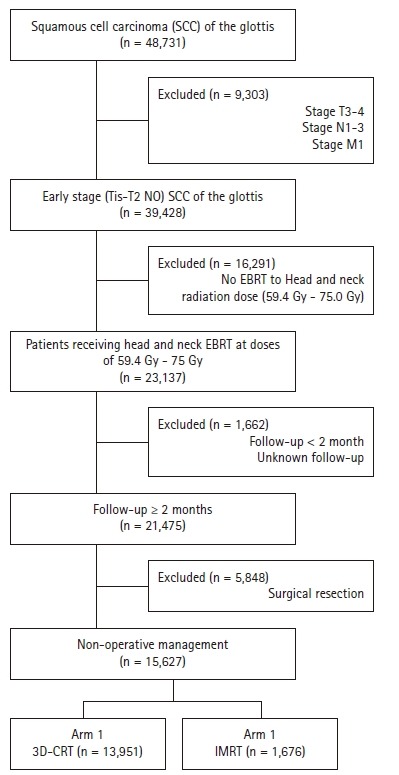
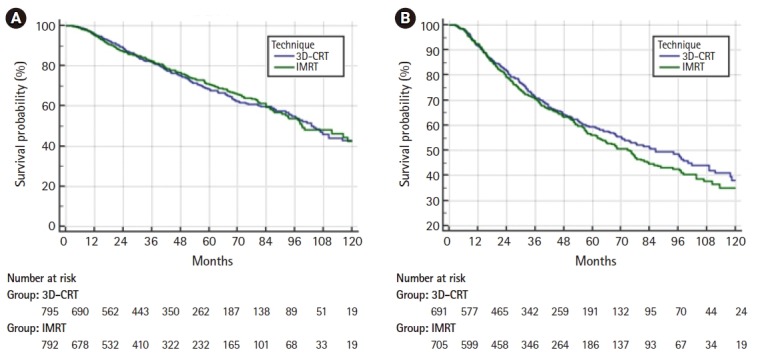
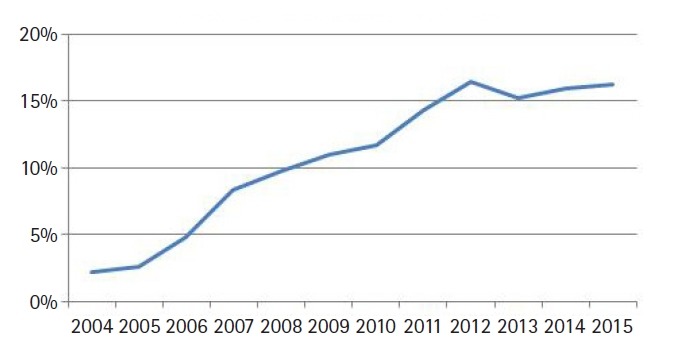
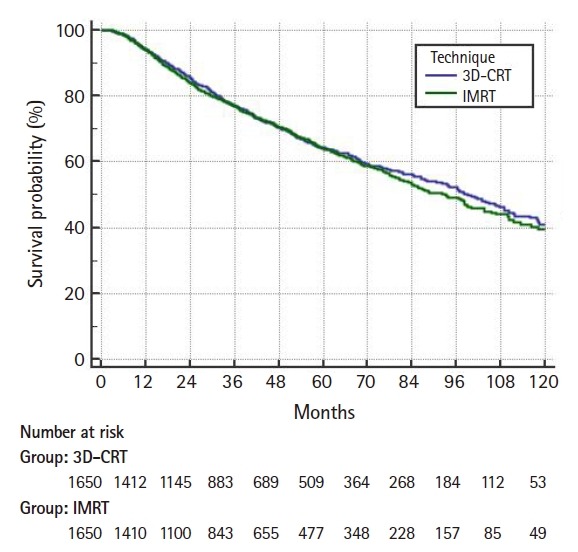
We identified 15,627 patients, of which 11% received IMRT. IMRT use rose from 2% in 2004 to 16% in 2015. Predictors of IMRT include: increased comorbidity, T2 stage, urban location, chemotherapy, treatment at an academic center, and later treatment year. Predictors of improved survival were female gender, higher income, lower stage, no chemotherapy, academic facility, and more remote year. There was no difference in survival between 3D-CRT and IMRT across all stages.
The rate of IMRT use for early stage glottic laryngeal cancer has increased over time. There was no difference in outcome in patients receiving IMRT versus 3D-CRT across the cohort.
根治性放疗仍然是早期声门癌的主要治疗选择。调强放射治疗(IMRT)已成为晚期头颈癌的标准治疗技术,而三维适形放疗(3D-CRT)仍然是早期声门癌的标准治疗方法。我们使用国家癌症数据库(NCDB)来确定这些患者中IMRT使用的预测因素及其对预后的影响。
我们查询了2004年至2015年NCDB中仅接受放疗的Tis-T2N0期声门鳞状细胞癌患者的数据。采用逻辑回归确定IMRT的预测因素。采用Cox回归确定总生存的预测因素。进行倾向匹配以消除指征偏倚。
我们共纳入15627例患者,其中11%接受了IMRT。IMRT的使用比例从2004年的2%上升至2015年的16%。IMRT的预测因素包括:合并症增加、T2期、城市地区、化疗、在学术中心接受治疗以及治疗年份较晚。生存改善的预测因素包括女性、高收入、低分期、未接受化疗、学术机构以及年份较久远。在所有分期中,3D-CRT和IMRT的生存率没有差异。
随着时间的推移,早期声门喉癌患者使用IMRT的比例有所增加。在整个队列中,接受IMRT与3D-CRT的患者预后没有差异。