Kim Yaewon, Rebman Alison W, Johnson Tory P, Wang Hong, Yang Ting, Colantuoni Carlo, Bhargava Pavan, Levy Michael, Calabresi Peter A, Aucott John N, Soloski Mark J, Darrah Erika
Division of Rheumatology, The Johns Hopkins University School of Medicine, Baltimore, MD, United States.
Lyme Disease Research Center, Division of Rheumatology, The Johns Hopkins University School of Medicine, Baltimore, MD, United States.
Front Neurol. 2022 Jun 6;13:874211. doi: 10.3389/fneur.2022.874211. eCollection 2022.
Peptidylarginine deiminase 2 (PAD2) mediates the post-translational conversion of arginine residues in proteins to citrullines and is highly expressed in the central nervous system (CNS). Dysregulated PAD2 activity has been implicated in the pathogenesis of several neurologic diseases, including multiple sclerosis (MS). In this study, we sought to define the cellular and regional expression of the gene encoding for PAD2 (i.e. ) in the human CNS using publicly available datasets and evaluate whether anti-PAD2 antibodies were present in patients with various neurologic diseases.
A total of 491 study participants were included in this study: 91 people with MS, 32 people with neuromyelitis optica (NMO), 281 people with post-treatment Lyme disease (PTLD), and 87 healthy controls. To measure expression in the CNS from healthy individuals, publicly available tissue and single cell RNA sequencing data was analyzed. Anti-PAD2 antibodies were measured in the serum of study participants using anti-PAD2 ELISA. Clinical and demographic variables were compared according to anti-PAD2 antibody positivity for the MS and PTLD groups and correlations between anti-PAD2 levels and disease severity were examined.
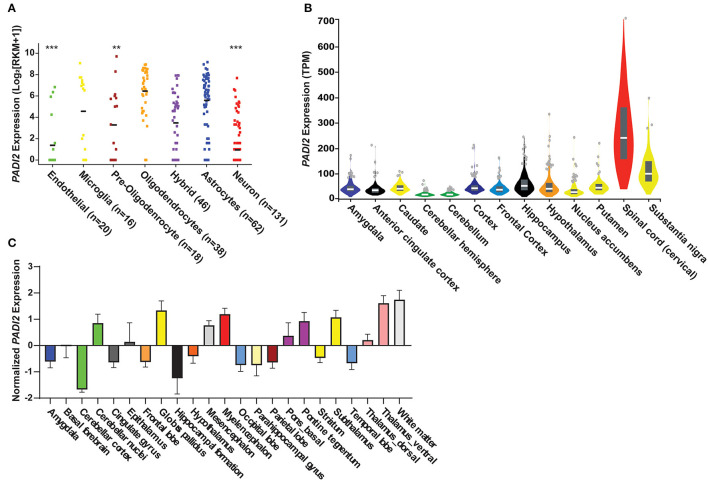
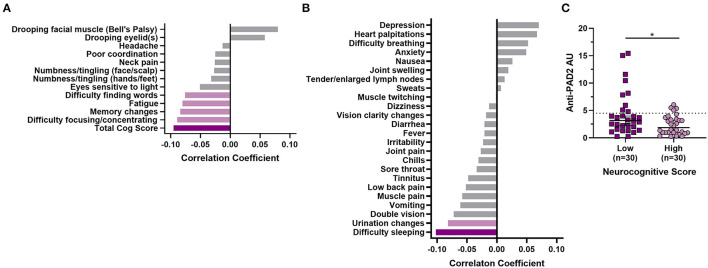
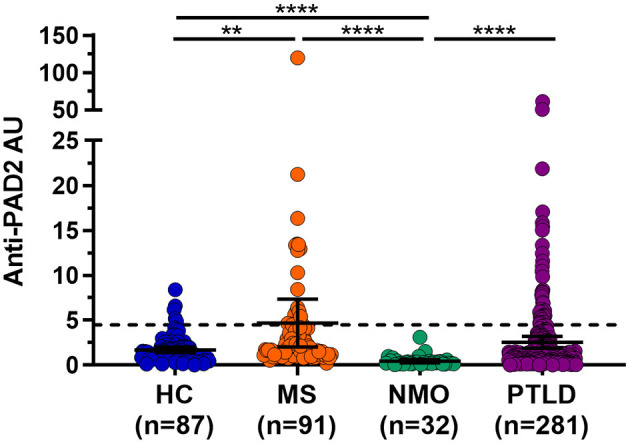
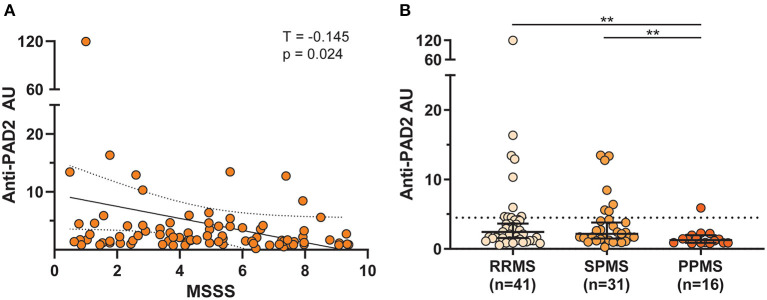
expression was highest in oligodendrocytes (mean ± SD; 6.4 ± 2.2), followed closely by astrocytes (5.5 ± 2.6), microglia/macrophages (4.5 ± 3.5), and oligodendrocyte precursor cells (3.2 ± 3.3). There was an increased proportion of anti-PAD2 positivity in the MS (19.8%; = 0.007) and PTLD groups (13.9%; = 0.057) relative to the healthy controls (5.7%), and these antibodies were not detected in NMO patients. There was a modest inverse correlation between anti-PAD2 levels and disease severity in people with MS (τ = -0.145, = 0.02), with levels being the highest in those with relapsing-remitting disease. Similarly, there was a modest inverse correlation between anti-PAD2 levels and neurocognitive score (τ = -0.10, = 0.027) in people with PTLD, with difficulty focusing, memory changes, fatigue, and difficulty finding words contributing most strongly to the effect.
expression was observed in diverse regions and cells of the CNS, and anti-PAD2 autoantibodies were associated with less severe symptoms in subsets of patients with MS and PTLD. These data suggest that anti-PAD2 antibodies may attenuate inflammation in diseases of different etiologies, which are united by high expression in the target tissue.
肽基精氨酸脱亚氨酶2(PAD2)介导蛋白质中精氨酸残基向瓜氨酸的翻译后转化,且在中枢神经系统(CNS)中高表达。PAD2活性失调与包括多发性硬化症(MS)在内的多种神经系统疾病的发病机制有关。在本研究中,我们试图利用公开可用的数据集确定人CNS中编码PAD2的基因(即 )的细胞和区域表达,并评估各种神经系统疾病患者体内是否存在抗PAD2抗体。
本研究共纳入491名研究参与者:91名MS患者、32名视神经脊髓炎(NMO)患者、281名治疗后莱姆病(PTLD)患者和87名健康对照者。为了测量健康个体CNS中的 表达,分析了公开可用的组织和单细胞RNA测序数据。使用抗PAD2 ELISA法检测研究参与者血清中的抗PAD2抗体。根据MS和PTLD组抗PAD2抗体的阳性情况比较临床和人口统计学变量,并检查抗PAD2水平与疾病严重程度之间的相关性。
在少突胶质细胞中表达最高(均值±标准差;6.4±2.2),其次是星形胶质细胞(5.5±2.6)、小胶质细胞/巨噬细胞(4.5±3.5)和少突胶质前体细胞(3.2±3.3)。与健康对照者(5.7%)相比,MS组(19.8%; =0.007)和PTLD组(13.9%; =0.057)中抗PAD2阳性的比例增加,而在NMO患者中未检测到这些抗体。MS患者中抗PAD2水平与疾病严重程度之间存在适度的负相关(τ=-0.145, =0.02),复发缓解型疾病患者的抗PAD2水平最高。同样,PTLD患者中抗PAD2水平与神经认知评分之间存在适度的负相关(τ=-0.10, =0.027),注意力不集中、记忆力改变、疲劳和找词困难对这种影响的贡献最大。
在CNS的不同区域和细胞中均有表达,抗PAD2自身抗体与MS和PTLD部分患者较轻的症状相关。这些数据表明,抗PAD2抗体可能减轻不同病因疾病中的炎症,这些疾病的共同特点是靶组织中 高表达。