Rheumatology Unit, Department of Medicine, Karolinska Institutet, Stockholm, Sweden.
Department of Dental Medicine, Karolinska Institutet, Huddinge, Sweden.
J Transl Med. 2018 Jul 31;16(1):214. doi: 10.1186/s12967-018-1588-2.
A relationship between rheumatoid arthritis (RA) and periodontitis has been suggested from findings that individuals with RA are prone to have advanced periodontitis and vice versa. In search of possible common pathogenetic features of these two diseases, we investigated the presence of citrullinated proteins and expression of endogenous peptidylarginine deiminases (PAD2 and PAD4), in periodontal tissue of individuals with periodontitis and healthy controls, in relation to the periodontal pathogens Porphyromonas gingivalis (P. gingivalis) and Aggregatibacter actinomycetemcomitans (A. actinomycetemcomitans), producing leukotoxin as virulence factor. These two oral bacteria have been suggested to be linked to anti-citrullinated protein antibodies in patients with RA.
Gingival tissue biopsies were obtained from 15 patients with periodontitis and 15 individuals without periodontal disease. Presence of CD3-positive lymphocytes, citrullinated proteins, PAD2, PAD4, P. gingivalis as well as A. actinomycetemcomitans and Mannheimia haemolytica produced leukotoxins were analysed by immunohistochemistry, followed by triple-blind semi-quantitative analysis. Mann-Whitney and Fisher's exact tests were used to analyse differences between groups. PADI2 and PADI4 mRNA levels were assessed by RT-qPCR and analysed using Wilcoxon signed rank test.
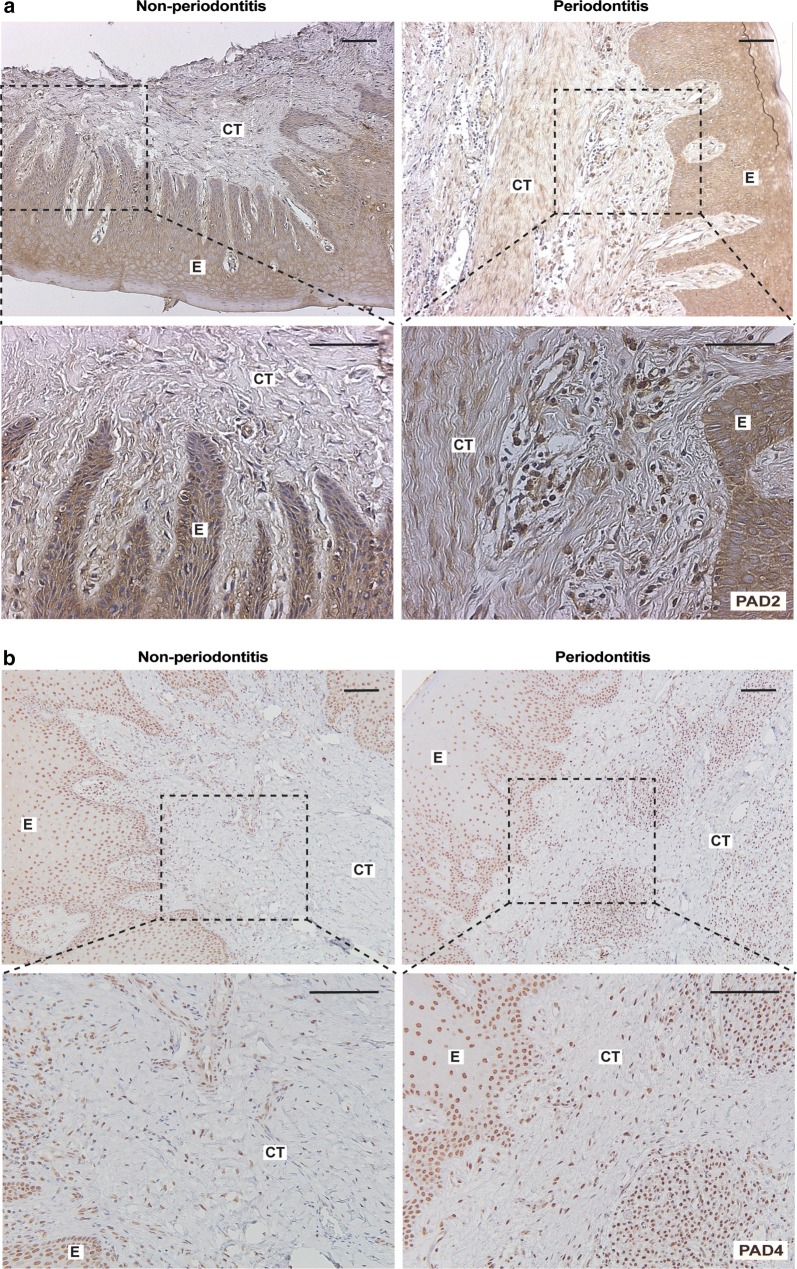
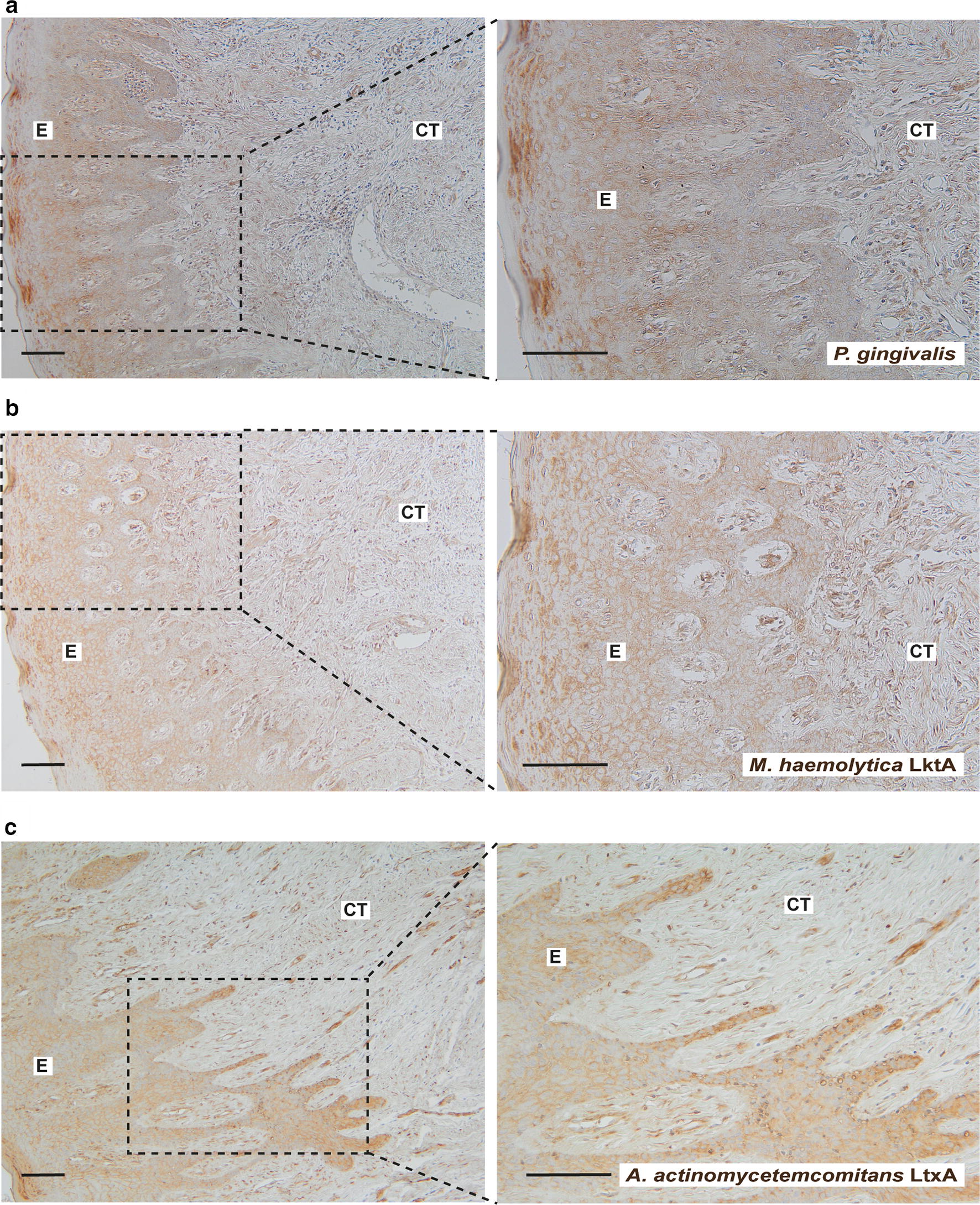
Increased staining of citrullinated proteins was observed in gingival connective tissue from subjects with periodontitis (80%, 12/15) compared to healthy gingival tissue (27%, 4/15), whereas no differences were observed in gingival epithelium. There was also an increased staining of the citrullinating enzymes PAD2 and PAD4 in gingival connective tissue of patients with periodontitis whereas similar levels of PAD2 and PAD4 were observed in the gingival epithelium of the two groups. Similarly, the mRNA levels of PADI2 and PADI4 were also increased in the gingival tissue of patients with periodontitis compared to healthy controls. Furthermore, presence of P. gingivalis and leukotoxins was comparable in both epithelium and connective tissue, from the different investigated individuals with and without periodontitis, and there were no correlations between the presence of periodontal pathogens and the expression of citrullinated proteins or PAD enzymes.
Chronic gingival inflammation is associated with increased local citrullination and PAD2 and PAD4 expression in periodontitis. The increased citrullination and PAD2 and PAD4 expression in periodontitis were, however, independent of the presence of periodontal pathogen P. gingivalis and A. actinomycetemcomitans leukotoxin.
类风湿关节炎(RA)和牙周炎之间存在一定的关系,这是基于以下发现:RA 患者易患牙周炎,反之亦然。为了寻找这两种疾病可能存在的共同发病特征,我们研究了牙周炎患者和健康对照组牙周组织中瓜氨酸化蛋白的存在以及内源性肽基精氨酸脱亚氨酶(PAD2 和 PAD4)的表达情况,同时还研究了牙周病原体牙龈卟啉单胞菌(P. gingivalis)和伴放线放线杆菌(A. actinomycetemcomitans)的情况,这两种口腔细菌产生白细胞毒素作为毒力因子。这两种口腔细菌被认为与 RA 患者的抗瓜氨酸化蛋白抗体有关。
从 15 名牙周炎患者和 15 名无牙周病的个体中获得牙龈组织活检。通过免疫组织化学分析 CD3 阳性淋巴细胞、瓜氨酸化蛋白、PAD2、PAD4、产生白细胞毒素的牙龈卟啉单胞菌以及伴放线放线杆菌和嗜血支原体的存在情况,随后进行三重盲半定量分析。使用 Mann-Whitney 和 Fisher 确切检验比较组间差异。通过 RT-qPCR 评估 PADI2 和 PADI4 mRNA 水平,并使用 Wilcoxon 符号秩检验进行分析。
与健康牙龈组织(27%,15/15)相比,牙周炎患者的牙龈结缔组织中观察到瓜氨酸化蛋白的染色增加(80%,12/15),而在牙龈上皮中未观察到差异。牙周炎患者的牙龈结缔组织中也观察到瓜氨酸化酶 PAD2 和 PAD4 的染色增加,而两组的牙龈上皮中观察到相似水平的 PAD2 和 PAD4。同样,与健康对照组相比,牙周炎患者的牙龈组织中 PADI2 和 PADI4 的 mRNA 水平也增加。此外,在不同的牙周炎患者和无牙周炎患者的上皮组织和结缔组织中,牙龈卟啉单胞菌和白细胞毒素的存在情况相似,并且牙周病原体的存在与瓜氨酸化蛋白或 PAD 酶的表达之间没有相关性。
慢性牙龈炎症与牙周炎中局部瓜氨酸化和 PAD2 和 PAD4 表达增加有关。然而,牙周炎中瓜氨酸化和 PAD2 和 PAD4 表达的增加与牙周病原体牙龈卟啉单胞菌和伴放线放线杆菌白细胞毒素的存在无关。