Alqurashi Ghofran Khalid, Hindi Emad A, Zayed Mohamed A, Abd El-Aziz Gamal S, Alturkistani Hani A, Ibrahim Rabee F, Al-Thepyani Mona Ali, Bakhlgi Refal, Alzahrani Noor A, Ashraf Ghulam Md, Alghamdi Badrah S
Neuroscience Unit, Department of Physiology, Faculty of Medicine, King Abdulaziz University, Jeddah 21589, Saudi Arabia.
Pre-Clinical Research Unit, King Fahd Medical Research Center, King Abdulaziz University, Jeddah 21589, Saudi Arabia.
Behav Sci (Basel). 2022 May 29;12(6):166. doi: 10.3390/bs12060166.
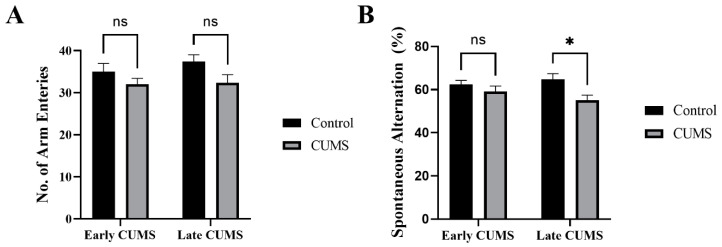
Depression-induced cognitive impairment has recently been given more attention in research. However, the relationship between depression and different types of memory is still not clear. Chronic unpredictable mild stress (CUMS) is a commonly used animal model of depression in which animals are exposed to chronic unpredictable environmental and psychological stressors, which mimics daily human life stressors. This study investigated the impact of different durations of CUMS on various types of memory (short- and long-term spatial memory and recognition memory) and investigated CUMS' impact on the ultrastructural level by histological assessment of the hippocampus and prefrontal cortex. Twenty male C57BL/J6 mice (6 weeks old, 21.8 ± 2 g) were randomly divided into two groups ( = 10): control and CUMS (8 weeks). A series of behavioral tasks were conducted twice at weeks 5-6 (early CUMS) and weeks 7-8 (late CUMS). A tail-suspension test (TST), forced swimming test (FST), elevated zero maze (EZM), elevated plus maze (EPM), open field test (OFT), and sucrose-preference test (SPT) were used to assess anxiety and depressive symptoms. The cognitive function was assessed by the novel object recognition test (NORT; for recognition memory), Y-maze (for short-term spatial memory), and Morris water maze (MWM: for long-term spatial memory) with a probe test (for reference memory). Our data showed that 8 weeks of CUMS increased the anxiety level, reported by a significant increase in anxiety index in both EPM and EZM and a significant decrease in central preference in OFT, and depression was reported by a significant increase in immobility in the TST and FST and sucrose preference in the SPT. Investigating the impact of CUMS on various types of memory, we found that reference memory is the first memory to be affected in early CUMS. In late CUMS, all types of memory were impaired, and this was consistent with the abnormal histological features of the memory-related areas in the brain (hippocampus and prefrontal cortex).
抑郁症引发的认知障碍最近在研究中受到了更多关注。然而,抑郁症与不同类型记忆之间的关系仍不明确。慢性不可预测轻度应激(CUMS)是一种常用的抑郁症动物模型,在该模型中,动物会暴露于慢性不可预测的环境和心理应激源下,这模拟了人类日常生活中的应激源。本研究调查了不同时长的CUMS对各种类型记忆(短期和长期空间记忆以及识别记忆)的影响,并通过对海马体和前额叶皮质进行组织学评估,研究了CUMS在超微结构水平上的影响。将20只雄性C57BL/J6小鼠(6周龄,21.8±2克)随机分为两组(每组 = 10只):对照组和CUMS组(8周)。在第5 - 6周(早期CUMS)和第7 - 8周(晚期CUMS)进行了一系列行为任务,共两次。使用悬尾试验(TST)、强迫游泳试验(FST)、高架零迷宫(EZM)、高架十字迷宫(EPM)、旷场试验(OFT)和蔗糖偏好试验(SPT)来评估焦虑和抑郁症状。通过新物体识别试验(NORT;用于识别记忆)、Y迷宫(用于短期空间记忆)和莫里斯水迷宫(MWM:用于长期空间记忆)以及探针试验(用于参考记忆)来评估认知功能。我们的数据表明,8周的CUMS会增加焦虑水平,表现为EPM和EZM中的焦虑指数显著升高以及OFT中的中央偏好显著降低,同时TST和FST中的不动时间显著增加以及SPT中的蔗糖偏好增加表明出现了抑郁症状。在研究CUMS对各种类型记忆的影响时,我们发现参考记忆是早期CUMS中最先受到影响的记忆。在晚期CUMS中,所有类型的记忆都受到了损害,这与大脑中与记忆相关区域(海马体和前额叶皮质)的异常组织学特征一致。