Clinical Exercise Physiology and Rehabilitation Research Laboratory, Physiotherapy Department, University of Thessaly School of Health Sciences, Lamia, Greece.
Cardiology, University of Thessaly Faculty of Medicine, Larissa, Greece.
BMJ Open. 2022 Jun 23;12(6):e059945. doi: 10.1136/bmjopen-2021-059945.
Exercise-based cardiac rehabilitation (CR) is a beneficial tool for the secondary prevention of cardiovascular diseases with, however, low participation rates. Telerehabilitation, intergrading mobile technologies and wireless sensors may advance the cardiac patients' adherence. This study will investigate the efficacy, efficiency, safety and cost-effectiveness of a telerehabilitation programme based on objective exercise telemonitoring and evaluation of cardiorespiratory fitness.
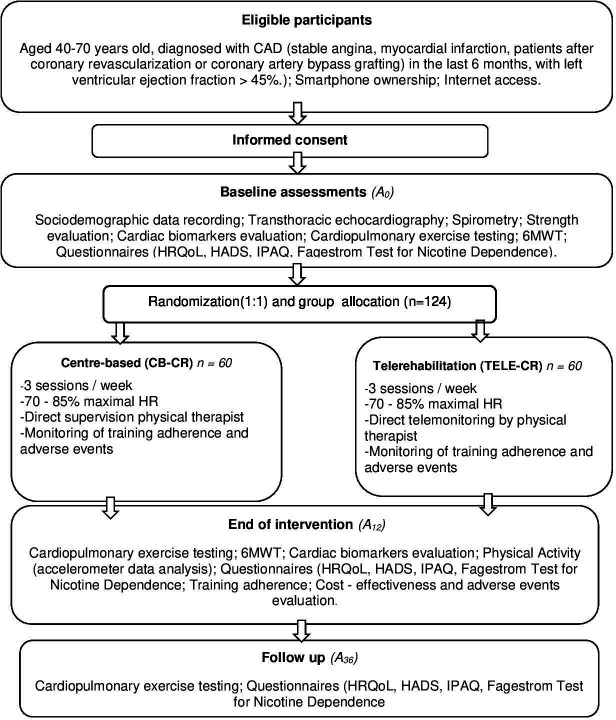
A supervised, parallel-group, single-blind randomised controlled trial will be conducted. A total of 124 patients with coronary disease will be randomised in a 1:1 ratio into two groups: intervention telerehabilitation group (TELE-CR) (n=62) and control centre-based cardiac rehabilitation group (CB-CR) (n=62). Participants will receive a 12-week exercise-based rehabilitation programme, remotely monitored for the TELE-CR group and standard supervised for the CB-CR group. All participants will perform aerobic training at 70% of their maximal heart rate, as obtained from cardiopulmonary exercise testing (CPET) for 20 min plus 20 min for strengthening and balance training, three times per week. The primary outcomes will be the assessment of cardiorespiratory fitness, expressed as peak oxygen uptake assessed by the CPET test and the 6 min walk test. Secondary outcomes will be the physical activity, the safety of the exercise intervention (number of adverse events that may occur during the exercise), the quality of life, the training adherence, the anxiety and depression levels, the nicotine dependence and cost-effectiveness. Assessments will be held at baseline, end of intervention (12 weeks) and follow-up (36 weeks).
The study protocol has been reviewed and approved by the Ethics Committee of the University of Thessaly (1108/1-12-2021) and by the Ethics Committee of the General University Hospital of Larissa (3780/31-01-2022). The results of this study will be disseminated through manuscript publications and conference presentations.
NCT05019157.
基于运动的心脏康复(CR)是心血管疾病二级预防的有益工具,但参与率较低。远程康复,将移动技术和无线传感器集成,可以提高心脏患者的依从性。本研究将调查基于客观运动远程监测和评估心肺适应能力的远程康复计划的疗效、效率、安全性和成本效益。
将进行一项有监督的、平行组、单盲随机对照试验。共 124 例冠心病患者将以 1:1 的比例随机分为两组:干预远程康复组(TELE-CR)(n=62)和基于中心的心脏康复组(CB-CR)(n=62)。参与者将接受为期 12 周的基于运动的康复计划,远程监测 TELE-CR 组,标准监督 CB-CR 组。所有参与者将在心肺运动测试(CPET)中获得的最大心率的 70%下进行有氧运动,每次 20 分钟,外加 20 分钟的强化和平衡训练,每周三次。主要结果将是心肺适能的评估,用 CPET 测试评估的峰值摄氧量和 6 分钟步行测试表示。次要结果将是身体活动、运动干预的安全性(运动过程中可能发生的不良事件数量)、生活质量、训练依从性、焦虑和抑郁水平、尼古丁依赖和成本效益。评估将在基线、干预结束(12 周)和随访(36 周)时进行。
该研究方案已由塞萨洛尼基亚里士多德大学伦理委员会(1108/1-12-2021)和拉里萨综合大学医院伦理委员会(3780/31-01-2022)审查和批准。本研究结果将通过论文发表和会议演讲传播。
NCT05019157。