Centre of Molecular and Environmental Biology (CBMA), Department of Biology, University of Minho, Campus of Gualtar, 4710-057, Braga, Portugal.
Centro de Investigação de Montanha (CIMO), Instituto Politécnico de Bragança, Campus de Santa Apolónia, 5300-253, Bragança, Portugal.
BMC Microbiol. 2022 Jun 23;22(1):163. doi: 10.1186/s12866-022-02574-2.
Soil microbiomes are important to maintain soil processes in forests and confer protection to plants against abiotic and biotic stresses. These microbiomes can be affected by environmental changes. In this work, soil microbial communities from different cork oak Portuguese forests under different edaphoclimatic conditions were described by using a metabarcoding strategy targeting ITS2 and 16S barcodes.
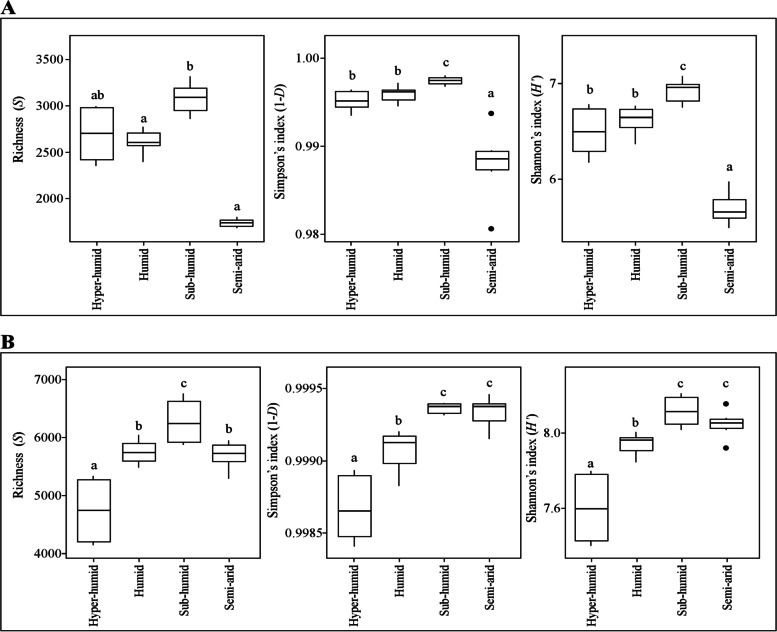
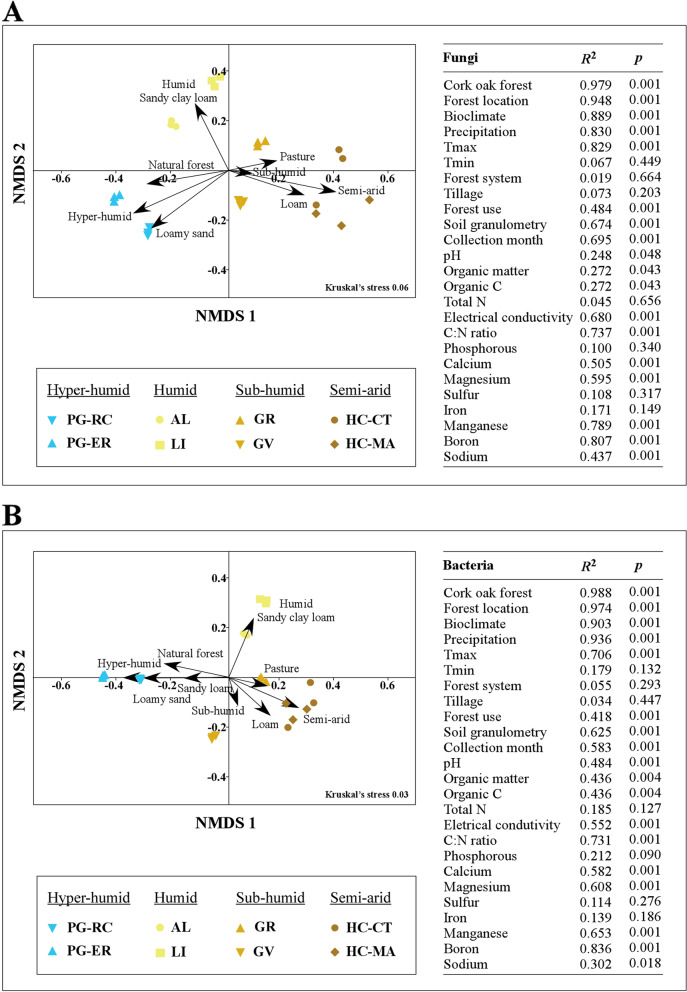
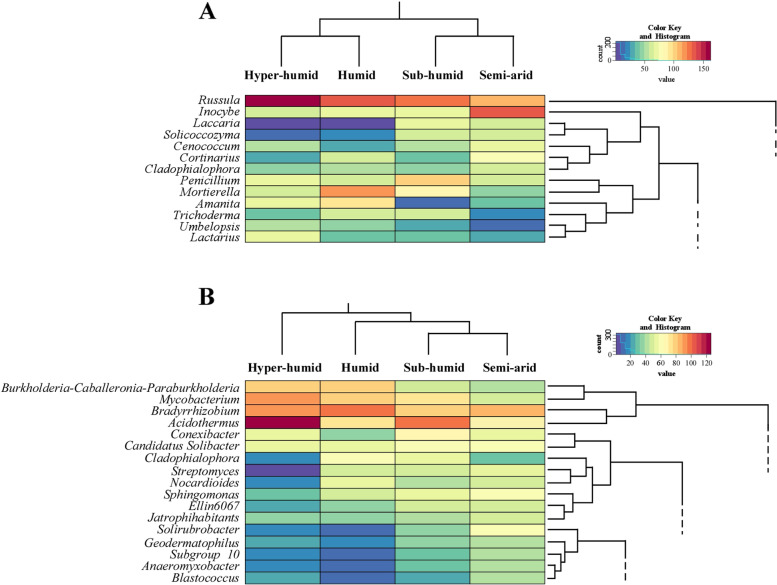
A total of 11,974 fungal and 12,010 bacterial amplicon sequence variants (ASVs) were obtained, revealing rich and diverse microbial communities associated with different cork oak forests. Bioclimate was described as the major factor influencing variability in these communities (or bioclimates/cork oak forest for fungal community), followed by boron and granulometry. Also, pH explained variation of fungal communities, while C:N ratio contributed to bacterial variation. Fungal and bacterial biomarker genera for specific bioclimates were described. Their co-occurrence network revealed the existence of a complex and delicate balance among microbial communities.
The findings revealed that bacterial communities are more likely to be affected by different edaphoclimatic conditions than fungal communities, also predicting a higher impact of climate change on bacterial communities. The integration of cork oak fungal and bacterial microbiota under different bioclimates could be further explored to provide information about useful interactions for increasing cork oak forest sustainability in a world subject to climate changes.
土壤微生物群落对于维持森林中的土壤过程以及保护植物免受非生物和生物胁迫至关重要。这些微生物群落可能会受到环境变化的影响。在这项工作中,采用靶向 ITS2 和 16S 条形码的宏条形码策略,描述了来自不同具有不同土壤气候条件的葡萄牙栓皮栎森林的土壤微生物群落。
共获得了 11974 个真菌和 12010 个细菌扩增子序列变异体(ASVs),揭示了与不同栓皮栎森林相关的丰富多样的微生物群落。生物气候被描述为影响这些群落(或生物气候/栓皮栎森林的真菌群落)变异性的主要因素,其次是硼和粒度。此外,pH 解释了真菌群落的变异,而 C:N 比则有助于细菌变异。描述了特定生物气候的真菌和细菌生物标志物属。它们的共同发生网络揭示了微生物群落之间存在着复杂而微妙的平衡。
研究结果表明,细菌群落比真菌群落更容易受到不同土壤气候条件的影响,也预示着气候变化对细菌群落的影响更大。在不同生物气候条件下,栓皮栎真菌和细菌微生物群的整合可以进一步探索,为增加适应气候变化的栓皮栎森林可持续性提供有用的相互作用信息。