Guerrero-Ochoa Patricia, Ibáñez-Pérez Raquel, Berbegal-Pinilla Germán, Aguilar Diederich, Marzo Isabel, Corzana Francisco, Minjárez-Sáenz Martha, Macías-León Javier, Conde Blanca, Raso Javier, Hurtado-Guerrero Ramón, Anel Alberto
Apoptosis, Immunity and Cancer Group, Aragón Health Research Institute (IIS-Aragón), University of Zaragoza, 50009 Zaragoza, Spain.
Department of Food Technology, Facultad de Veterinaria, Instituto Agroalimentario de Aragón-IA2, Universidad de Zaragoza-CITA, 50013 Zaragoza, Spain.
Biomedicines. 2022 May 24;10(6):1223. doi: 10.3390/biomedicines10061223.
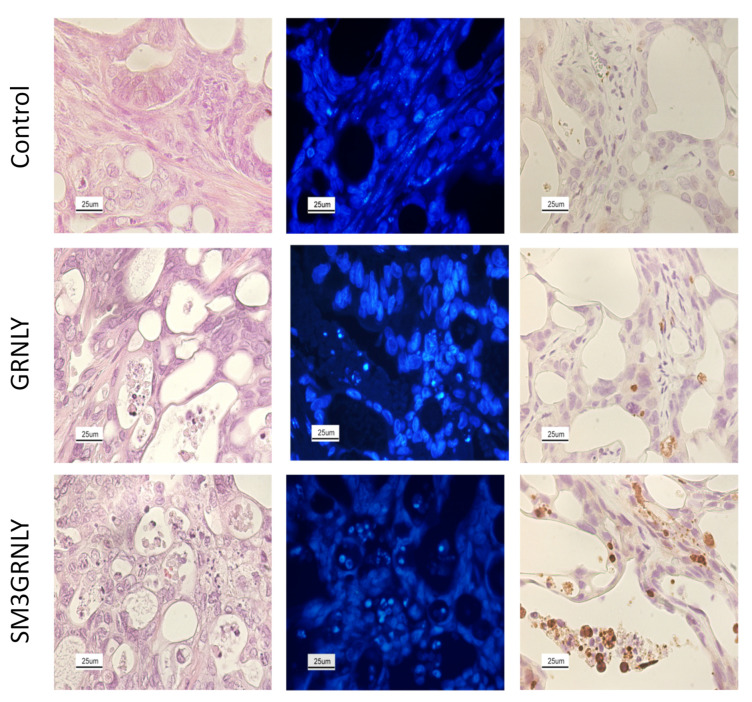
Two granulysin (GRNLY) based immunotoxins were generated, one containing the scFv of the SM3 mAb (SM3GRNLY) and the other the scFv of the AR20.5 mAb (AR20.5GRNLY). These mAb recognize different amino acid sequences of aberrantly O-glycosylated MUC1, also known as the Tn antigen, expressed in a variety of tumor cell types. We first demonstrated the affinity of these immunotoxins for their antigen using surface plasmon resonance for the purified antigen and flow cytometry for the antigen expressed on the surface of living tumor cells. The induction of cell death of tumor cell lines of different origin positive for Tn antigen expression was stronger in the cases of the immunotoxins than that induced by GRNLY alone. The mechanism of cell death induced by the immunotoxins was studied, showing that the apoptotic component demonstrated previously for GRNLY was also present, but that cell death induced by the immunotoxins included also necroptotic and necrotic components. Finally, we demonstrated the in vivo tumor targeting by the immunotoxins after systemic injection using a xenograft model of the human pancreatic adenocarcinoma CAPAN-2 in athymic mice. While GRNLY alone did not have a therapeutic effect, SM3GRNLY and AR20.5GRNLY reduced tumor volume by 42 and 60%, respectively, compared with untreated tumor-bearing mice, although the results were not statistically significant in the case of AR20.5GRNLY. Histological studies of tumors obtained from treated mice demonstrated reduced cellularity, nuclear morphology compatible with apoptosis induction and active caspase-3 detection by immunohistochemistry. Overall, our results exemplify that these immunotoxins are potential drugs to treat Tn-expressing cancers.
制备了两种基于颗粒溶素(GRNLY)的免疫毒素,一种含有SM3单克隆抗体的单链抗体片段(SM3GRNLY),另一种含有AR20.5单克隆抗体的单链抗体片段(AR20.5GRNLY)。这些单克隆抗体识别异常O-糖基化MUC1(也称为Tn抗原)的不同氨基酸序列,其在多种肿瘤细胞类型中表达。我们首先使用表面等离子体共振检测纯化抗原以及流式细胞术检测活肿瘤细胞表面表达的抗原,证明了这些免疫毒素对其抗原的亲和力。对于Tn抗原表达呈阳性的不同来源的肿瘤细胞系,免疫毒素诱导的细胞死亡比单独的GRNLY诱导的更强。研究了免疫毒素诱导细胞死亡的机制,结果表明先前已证明的GRNLY诱导的凋亡成分也存在,但免疫毒素诱导的细胞死亡还包括坏死性凋亡和坏死成分。最后,我们使用人胰腺腺癌CAPAN-2在无胸腺小鼠中的异种移植模型,证明了全身注射后免疫毒素在体内的肿瘤靶向性。虽然单独的GRNLY没有治疗效果,但与未治疗的荷瘤小鼠相比,SM3GRNLY和AR20.5GRNLY分别使肿瘤体积减少了42%和60%,尽管AR20.5GRNLY的结果在统计学上不显著。对治疗小鼠的肿瘤进行组织学研究表明,细胞密度降低,核形态与凋亡诱导相符,免疫组织化学检测到活性半胱天冬酶-3。总体而言,我们的结果表明这些免疫毒素是治疗表达Tn的癌症的潜在药物。