Gonzalez-Gronow Mario, Pizzo Salvatore Vincent
Department of Pathology, Duke University Medical Center, Durham, NC 27710, USA.
Biomedicines. 2022 May 24;10(6):1222. doi: 10.3390/biomedicines10061222.
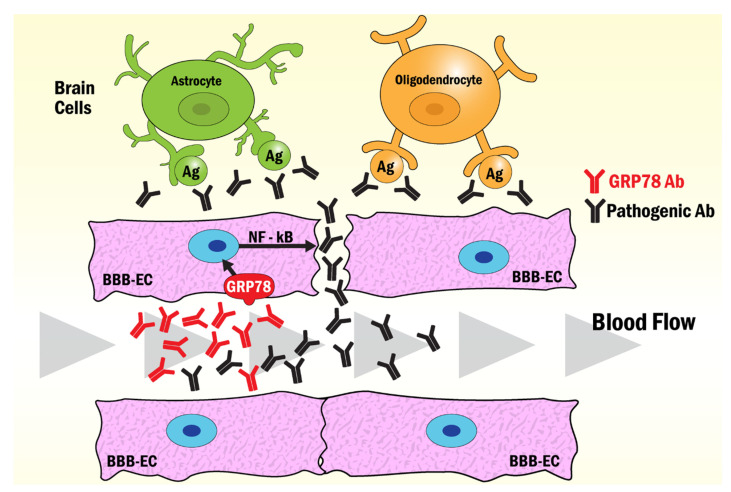
The 78 kDa glucose-regulated protein (GRP78), a member of the 70 kDa heat-shock family of molecular chaperones (HSP70), is essential for the regulation of the unfolded protein response (UPR) resulting from cellular endoplasmic reticulum (ER) stress. During ER stress, GRP78 evades retention mechanisms and is translocated to the cell surface (csGRP78) where it functions as an autoantigen. Autoantibodies to GRP78 appear in prostate, ovarian, gastric, malignant melanoma, and colorectal cancers. They are also found in autoimmune pathologies such as rheumatoid arthritis (RA), neuromyelitis optica (NMO), anti-myelin oligodendrocyte glycoprotein antibody-associated disorder (AMOGAD), Lambert-Eaton myasthenic syndrome (LEMS), multiple sclerosis (MS), neuropsychiatric systemic lupus erythematosus (NPSLE) and type 1 diabetes (T1D). In NMO, MS, and NPSLE these autoantibodies disrupt and move across the blood-brain barrier (BBB), facilitating their entry and that of other pathogenic antibodies to the brain. Although csGRP78 is common in both cancer and autoimmune diseases, there are major differences in the specificity of its autoantibodies. Here, we discuss how ER mechanisms modulate csGRP78 antigenicity and the production of autoantibodies, permitting this chaperone to function as a dual compartmentalized receptor with independent signaling pathways that promote either pro-proliferative or apoptotic signaling, depending on whether the autoantibodies bind csGRP78 N- or C-terminal regions.
78 kDa葡萄糖调节蛋白(GRP78)是70 kDa热休克分子伴侣家族(HSP70)的成员,对于调节细胞内质网(ER)应激引起的未折叠蛋白反应(UPR)至关重要。在内质网应激期间,GRP78逃避保留机制并转运至细胞表面(csGRP78),在那里它作为自身抗原发挥作用。GRP78自身抗体出现在前列腺癌、卵巢癌、胃癌、恶性黑色素瘤和结直肠癌中。它们也存在于自身免疫性疾病中,如类风湿性关节炎(RA)、视神经脊髓炎(NMO)、抗髓鞘少突胶质细胞糖蛋白抗体相关疾病(AMOGAD)、兰伯特-伊顿肌无力综合征(LEMS)、多发性硬化症(MS)、神经精神性系统性红斑狼疮(NPSLE)和1型糖尿病(T1D)。在NMO、MS和NPSLE中,这些自身抗体破坏并穿过血脑屏障(BBB),促进它们以及其他致病抗体进入大脑。尽管csGRP78在癌症和自身免疫性疾病中都很常见,但其自身抗体的特异性存在主要差异。在这里,我们讨论内质网机制如何调节csGRP78的抗原性和自身抗体的产生,使这种分子伴侣能够作为具有独立信号通路的双区室化受体发挥作用,根据自身抗体是结合csGRP78的N端还是C端区域,促进促增殖或凋亡信号传导。