Lanznaster Débora, Bruno Clément, Bourgeais Jérôme, Emond Patrick, Zemmoura Ilyess, Lefèvre Antoine, Reynier Pascal, Eymieux Sébastien, Blanchard Emmanuelle, Vourc'h Patrick, Andres Christian R, Bakkouche Salah Eddine, Herault Olivier, Favard Luc, Corcia Philippe, Blasco Hélène
UMR 1253, iBrain, Université de Tours, INSERM, 37000 Tours, France.
Service de Biochimie et Biologie Moléculaire, CHU de Tours, 37000 Tours, France.
Biomedicines. 2022 Jun 2;10(6):1307. doi: 10.3390/biomedicines10061307.
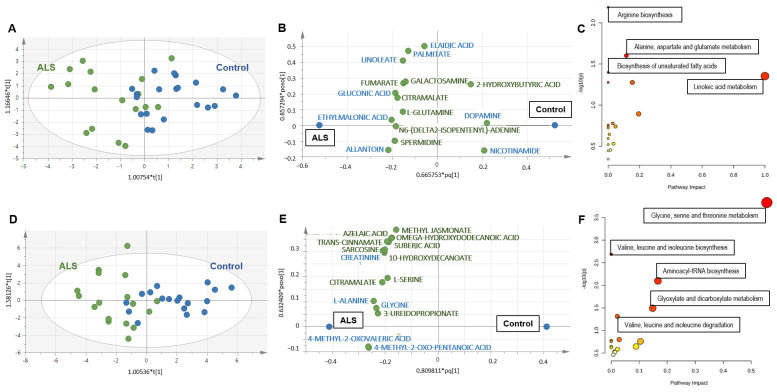
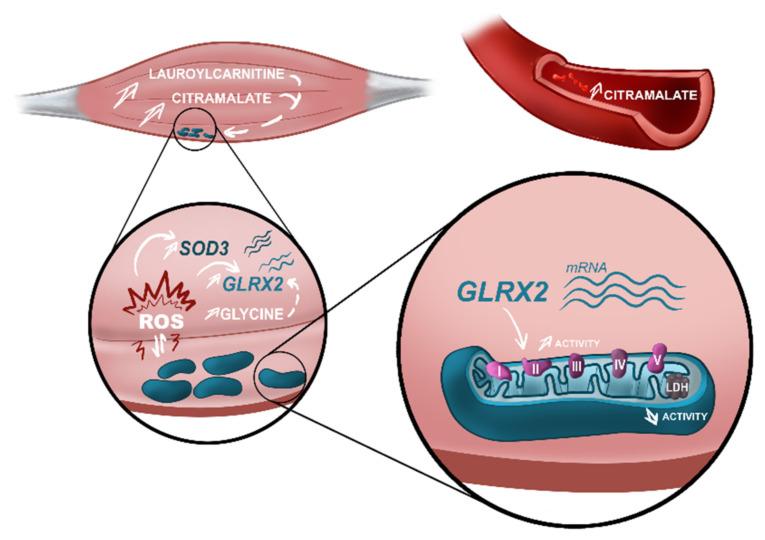
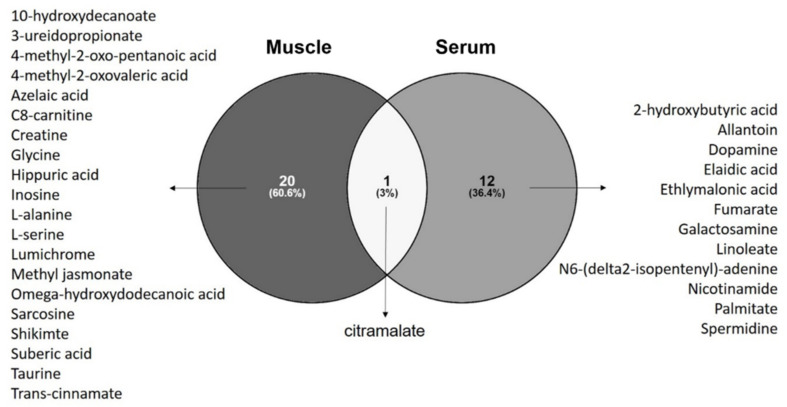
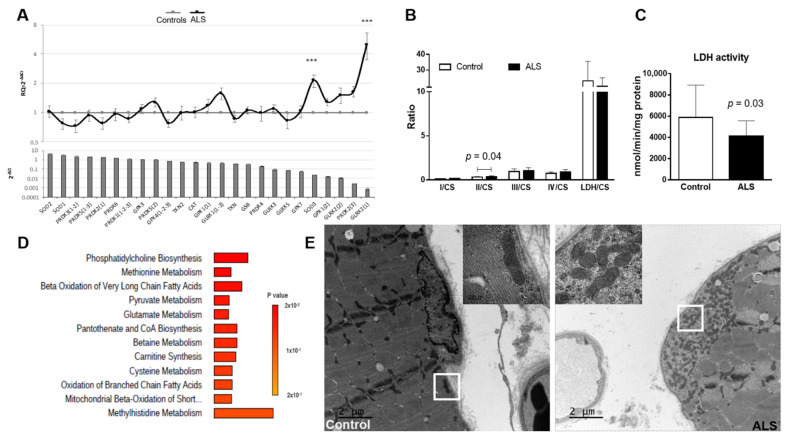
Diverse biomarkers and pathological alterations have been found in muscle of patients with Amyotrophic lateral sclerosis (ALS), but the relation between such alterations and dysfunction in energetic metabolism remains to be investigated. We established the metabolome of muscle and serum of ALS patients and correlated these findings with the clinical status and pathological alterations observed in the muscle. We obtained data from 20 controls and 17 ALS patients (disease duration: 9.4 ± 6.8 months). Multivariate metabolomics analysis identified a distinct serum metabolome for ALS compared to controls (p-CV-ANOVA < 0.035) and revealed an excellent discriminant profile for muscle metabolome (p-CV-ANOVA < 0.0012). Citramalate was discriminant for both muscle and serum. High lauroylcarnitine levels in muscle were associated with low Forced Vital Capacity. Transcriptomics analysis of key antioxidant enzymes showed an upregulation of SOD3 (p = 0.0017) and GLRX2(1) (p = 0.0022) in ALS muscle. Analysis of mitochondrial enzymatic activity in muscle revealed higher complex II/CS (p = 0.04) and lower LDH (p = 0.03) activity in ALS than in controls. Our study showed, for the first time, a global dysfunction in the muscle of early-stage ALS patients. Furthermore, we identified novel metabolites to be employed as biomarkers for diagnosis and prognosis of ALS patients.
在肌萎缩侧索硬化症(ALS)患者的肌肉中发现了多种生物标志物和病理改变,但这些改变与能量代谢功能障碍之间的关系仍有待研究。我们建立了ALS患者肌肉和血清的代谢组,并将这些发现与肌肉中观察到的临床状况和病理改变相关联。我们获取了20名对照者和17名ALS患者的数据(病程:9.4±6.8个月)。多变量代谢组学分析确定,与对照者相比,ALS患者有独特的血清代谢组(p-CV-方差分析<0.035),并揭示了肌肉代谢组出色的判别特征(p-CV-方差分析<0.0012)。柠苹酸对肌肉和血清均有判别作用。肌肉中月桂酰肉碱水平高与用力肺活量低相关。关键抗氧化酶的转录组学分析显示,ALS患者肌肉中SOD3(p=0.0017)和GLRX2(1)(p=0.0022)上调。肌肉中线粒体酶活性分析显示,与对照者相比,ALS患者肌肉中复合物II/CS活性较高(p=0.04),乳酸脱氢酶(LDH)活性较低(p=0.03)。我们的研究首次表明,早期ALS患者的肌肉存在整体功能障碍。此外,我们确定了新的代谢物可作为ALS患者诊断和预后的生物标志物。