Sepúlveda Magdalena, Arauna Diego, García Francisco, Albala Cecilia, Palomo Iván, Fuentes Eduardo
Thrombosis Research Center, Medical Technology School, Faculty of Health Sciences, Interuniversity Center for Healthy Aging, Universidad de Talca, Talca 3480094, Chile.
Department of Geriatric Medicine, Complejo Hospitalario de Toledo, 45007 Toledo, Spain.
Biomedicines. 2022 Jun 16;10(6):1426. doi: 10.3390/biomedicines10061426.
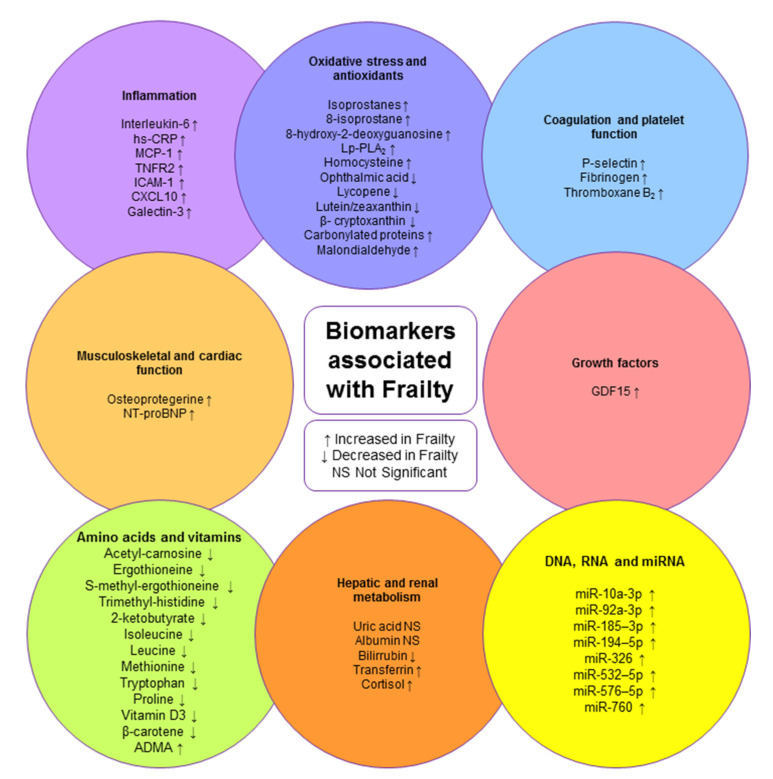
In the context of accelerated aging of the population worldwide, frailty has emerged as one of the main risk factors that can lead to loss of self-sufficiency in older people. This syndrome is defined as a reduced state of physiological reserve and functional capacity. The main diagnostic tools for frailty are based on scales that show deficits compared to their clinical application, such as the Fried frailty phenotype, among others. In this context, it is important to have one or more biomarkers with clinical applicability that can objectively and precisely determine the degree or risk of frailty in older people. The objective of this review was to analyze the biomarkers associated with frailty, classified according to the pathophysiological components of this syndrome (inflammation, coagulation, antioxidants, and liver function, among others). The evidence demonstrates that biomarkers associated with inflammation, oxidative stress, skeletal/cardiac muscle function, and platelet function represent the most promising markers of frailty due to their pathophysiological association with this syndrome. To a lesser extent but with the possibility of greater innovation, biomarkers associated with growth factors, vitamins, amino acids, and miRNAs represent alternatives as markers of this geriatric syndrome. Likewise, the incorporation of artificial intelligence represents an interesting approach to strengthening the diagnosis of frailty by biomarkers.
在全球人口加速老龄化的背景下,衰弱已成为导致老年人失去自理能力的主要风险因素之一。这种综合征被定义为生理储备和功能能力下降的状态。衰弱的主要诊断工具基于与临床应用相比存在缺陷的量表,如Fried衰弱表型等。在这种情况下,拥有一种或多种具有临床适用性的生物标志物非常重要,这些生物标志物能够客观、准确地确定老年人衰弱的程度或风险。本综述的目的是分析与衰弱相关的生物标志物,并根据该综合征的病理生理成分(炎症、凝血、抗氧化剂和肝功能等)进行分类。证据表明,与炎症、氧化应激、骨骼/心肌功能和血小板功能相关的生物标志物因其与该综合征的病理生理关联,是最有前景的衰弱标志物。与生长因子、维生素、氨基酸和微小RNA相关的生物标志物虽然创新性可能更大,但在较小程度上也可作为这种老年综合征的标志物。同样,人工智能的融入是一种有趣的方法,可加强通过生物标志物对衰弱的诊断。