Dai Dongjun, Tian Qiaoying, Yu Genhua, Shui Yongjie, Jiang Hao, Wei Qichun
Department of Radiation Oncology, The Second Affiliated Hospital, Zhejiang University School of Medicine, Hangzhou 310009, China.
Anhui Campus of the Second Affiliated Hospital, Zhejiang University School of Medicine, Bengbu 233000, China.
Cancers (Basel). 2022 Jun 20;14(12):3024. doi: 10.3390/cancers14123024.
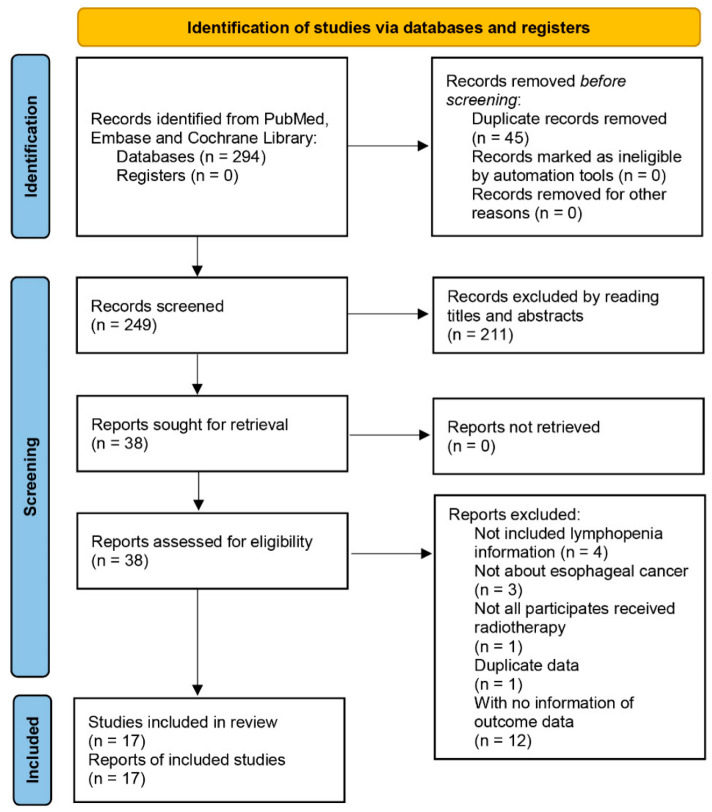
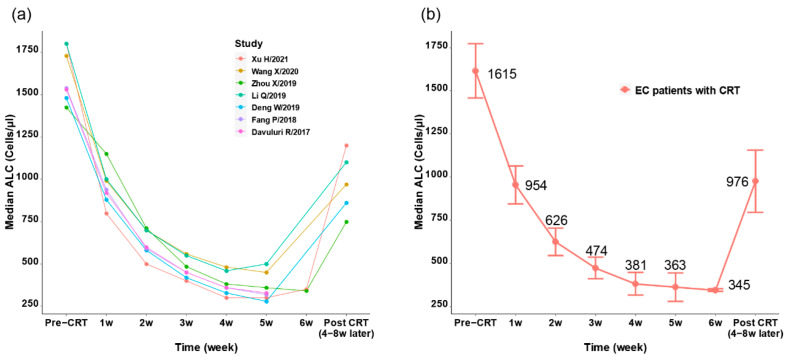
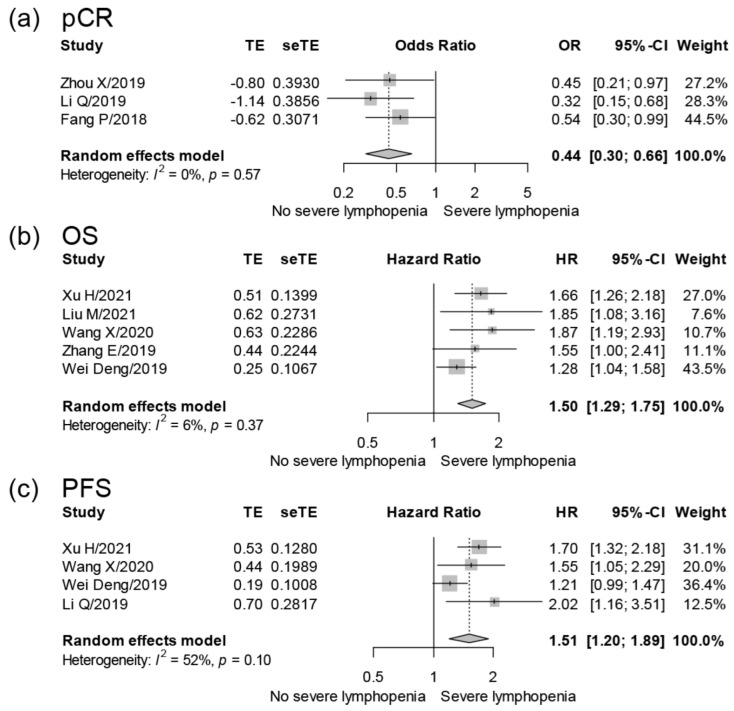
The aim of the current study was to evaluate the influence of severe radiation-induced lymphopenia (RIL) on the outcomes of esophageal cancer (EC). A systematic review and meta-analysis was performed through the PRISMA guideline. Seventeen studies were included in the current systematic review, with eight included in the meta-analyses. Meta-analyses found that severe RIL was associated with lower pathologic complete response (pCR) rate (odds ratio (OR) = 0.44, 95% confidence interval (CI) = 0.30-0.66, I = 0%), inferior overall survival (OS) (hazard ratio (HR) = 1.50, 95% CI = 1.29-1.75, I = 6%), and worse progression-free survival (PFS) (HR = 1.70, 95% CI = 1.39-2.07, I = 0%) of EC patients. The lymphocyte nadir was found during 4-6 weeks after the start of radiotherapy. The leading dosimetric factors associated with severe RIL included larger PTV, higher dose to heart and body, and higher effective dose to the immune cells (EDIC). Clinical risk factors for RIL mainly comprised lower baseline ALC, higher tumor length and clinical stage, and distal EC. In conclusion, severe RIL might be associated with a lower pCR rate and worse OS and PFS of EC patients. Minimizing the dosimetric risk factors, especially in patients with clinical risk factors, might benefit their outcomes.
本研究的目的是评估严重放射性淋巴细胞减少症(RIL)对食管癌(EC)治疗结果的影响。通过PRISMA指南进行了系统评价和荟萃分析。本系统评价纳入了17项研究,荟萃分析纳入了8项研究。荟萃分析发现,严重RIL与较低的病理完全缓解(pCR)率相关(优势比(OR)=0.44,95%置信区间(CI)=0.30-0.66,I²=0%),总体生存期(OS)较差(风险比(HR)=1.50,95%CI=1.29-1.75,I²=6%),以及食管癌患者无进展生存期(PFS)更差(HR=1.70,95%CI=1.39-2.07,I²=0%)。淋巴细胞最低点出现在放疗开始后的4-6周。与严重RIL相关的主要剂量学因素包括较大的计划靶体积(PTV)、较高的心脏和身体剂量,以及较高的免疫细胞有效剂量(EDIC)。RIL的临床危险因素主要包括较低的基线绝对淋巴细胞计数(ALC)、较长的肿瘤长度和临床分期,以及远端食管癌。总之,严重RIL可能与食管癌患者较低的pCR率以及较差的OS和PFS相关。尽量减少剂量学危险因素,尤其是临床危险因素患者,可能会改善其治疗结果。