Negrini Stefano, Tessadri Fabrizio, Negrini Francesco, Tavernaro Marta, Zonta Andrea, Zaina Fabio, Donzelli Sabrina
Department of Biomedical, Surgical and Dental Sciences, University "La Statale", 20122 Milan, Italy.
IRCCS Istituto Ortopedico Galeazzi, 20161 Milan, Italy.
Children (Basel). 2022 Jun 11;9(6):871. doi: 10.3390/children9060871.
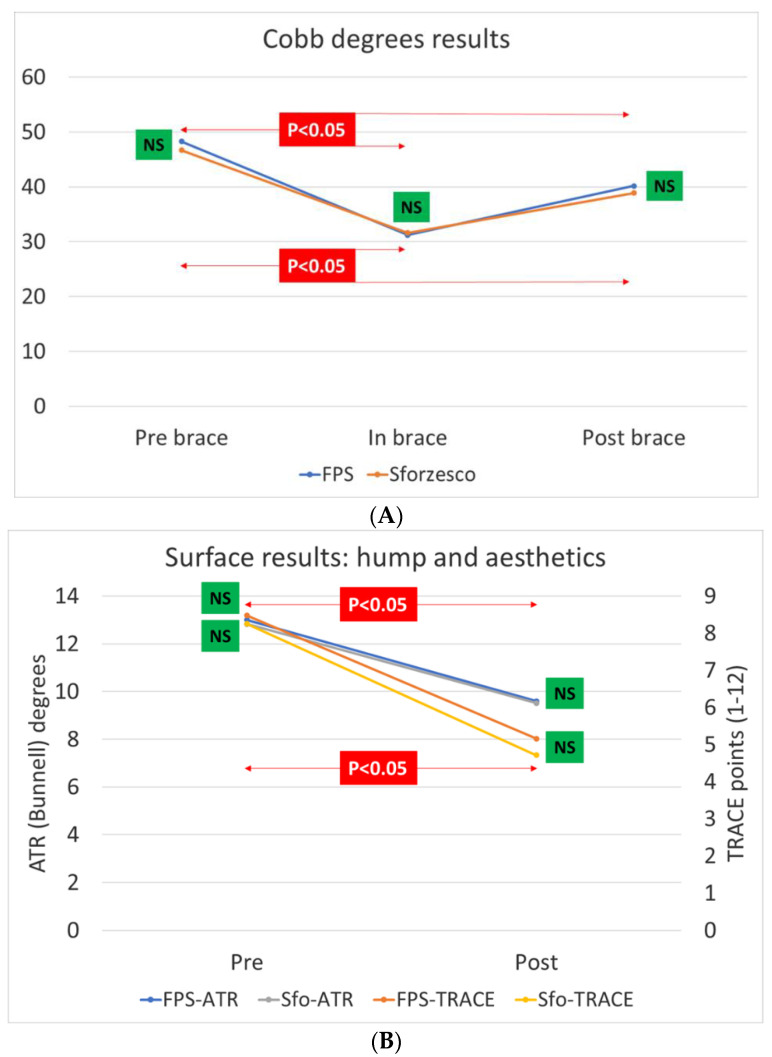
We introduced pelvis semi-rigid material (ethylene vinyl acetate) (Free-Pelvis) to improve the comfort and adaptability of very rigid braces (VRBs) for adolescents with idiopathic scoliosis (AIS), but this can also negatively impact the corrective forces on the trunk. Study Design: This was a matched retrospective cohort study. The inclusion criteria were AIS, age 10-16, VRB 23 h/day, X-rays available, primary curve 36°-65°, and angle of trunk rotation 7-23°. The cases were Sforzesco VRB with Free-Pelvis (FPB). The controls included classical Sforzesco VRB matched for Risser (range 0/4), menarche age (10/15), weight (33.5/83 kg), height (140/180 cm), BMI (13.5/29 kg/sqm), aesthetics (TRACE 4/12), plumbline distances (S1: -60/35; C7 + L3: -10/115 mm), and referred brace use (22/24 h/day). Statistics: predictors of the results have been tested with linear and logistic regression according to the outcome variable type. We performed logistic regression for improved vs. worsened. The explanatory variable was brace type. We included 777 VRB and 25 FPB, age 13 ± 1, 47° ± 8° Cobb, and 11% men. The few baseline statistical differences were not clinically relevant. We achieved in-brace corrections of 15.2° ± 7.7° and 17.4° ± 6.5° for VRB and FPB, respectively ( = 0.21); out-of-brace corrections at 5 ± 2 months were 7.8° ± 0.2° for VRB and 8.1° ± 1.3° for FPB ( = 0.83). The type of brace did not influence the Cobb angle at either time interval or affect the odds of improvement. Free-Pelvis innovation, introduced to improve comfort and adaptability, does not change the in-brace or short-term results of classical VRB and consequently can be safely applied.
我们引入了骨盆半刚性材料(乙烯-醋酸乙烯酯)(Free-Pelvis),以提高特发性脊柱侧凸(AIS)青少年使用非常刚性支具(VRB)时的舒适度和适应性,但这也可能对躯干的矫正力产生负面影响。研究设计:这是一项匹配的回顾性队列研究。纳入标准为AIS、年龄10 - 16岁、每天佩戴VRB 23小时、有X线片、主弯36° - 65°以及躯干旋转角度7 - 23°。病例组为带有Free-Pelvis(FPB)的斯福尔扎斯科VRB。对照组包括与病例组在里塞尔(范围0/4)、初潮年龄(10/15)、体重(33.5/83千克)、身高(140/180厘米)、体重指数(13.5/29千克/平方米)、美观度(TRACE 4/12)、铅垂线距离(S1:-60/35;C7 + L3:-10/115毫米)以及支具佩戴时长(22/24小时/天)方面相匹配的经典斯福尔扎斯科VRB。统计学方法:根据结果变量类型,使用线性和逻辑回归对结果的预测因素进行了检验。我们对改善与恶化情况进行了逻辑回归分析。解释变量为支具类型。我们纳入了777例VRB和25例FPB,年龄13±1岁,Cobb角47°±8°,男性占11%。少数基线统计学差异无临床相关性。VRB和FPB在支具内的矫正度数分别为15.2°±7.7°和17.4°±6.5°(P = 0.21);在5±2个月时的支具外矫正度数,VRB为7.8°±0.2°,FPB为8.1°±1.3°(P = 0.83)。支具类型在两个时间间隔均未影响Cobb角,也未影响改善的几率。为提高舒适度和适应性而引入的Free-Pelvis创新并未改变经典VRB在支具内或短期的效果,因此可以安全应用。