Neuro-SysMed, Department of Neurology, Haukeland University Hospital, 5021 Bergen, Norway.
Department of Clinical Medicine, University of Bergen, Pb 7804, 5020 Bergen, Norway.
Biomolecules. 2022 May 25;12(6):747. doi: 10.3390/biom12060747.
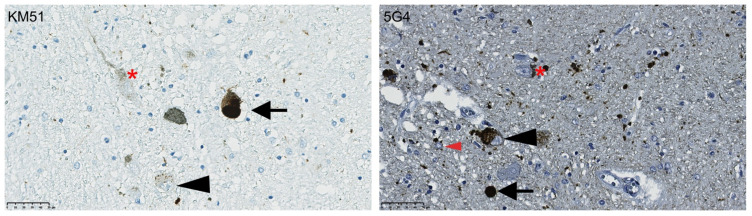
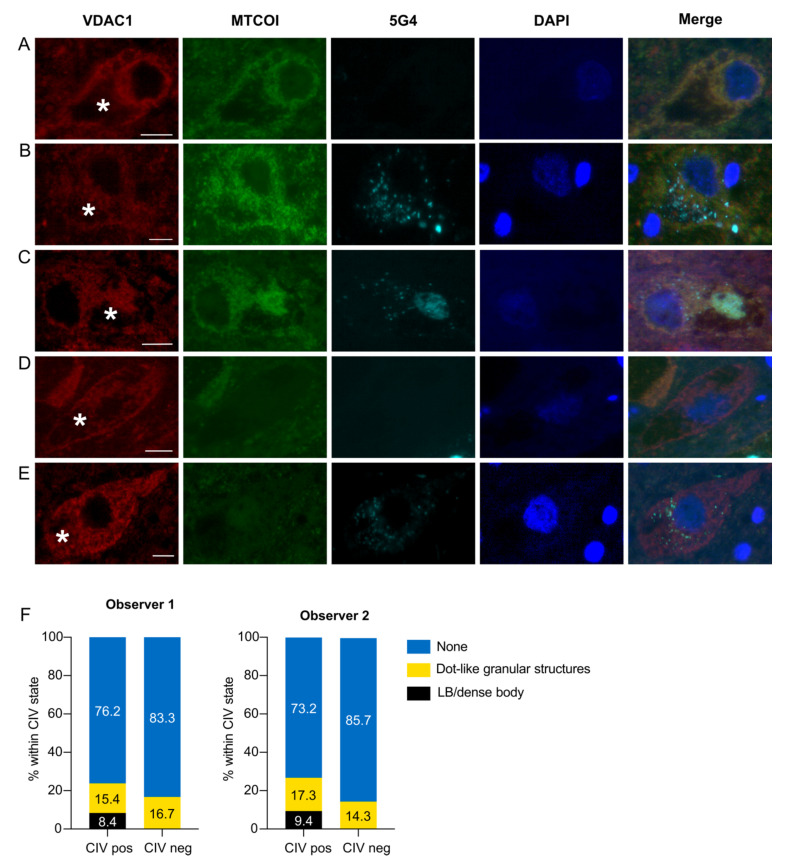
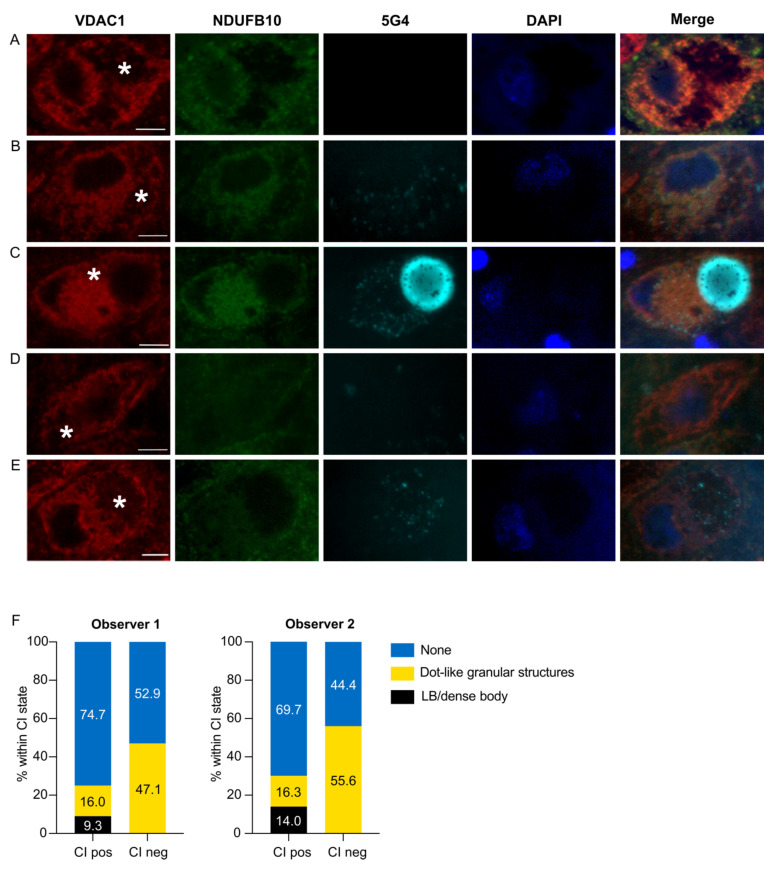
Idiopathic Parkinson's disease (iPD) is characterized by degeneration of the dopaminergic substantia nigra pars compacta (SNc), typically in the presence of Lewy pathology (LP) and mitochondrial respiratory complex I (CI) deficiency. LP is driven by α-synuclein aggregation, morphologically evolving from early punctate inclusions to Lewy bodies (LBs). The relationship between α-synuclein aggregation and CI deficiency in iPD is poorly understood. While studies in models suggest they are causally linked, observations in human SNc show that LBs preferentially occur in CI intact neurons. Since LBs are end-results of α-synuclein aggregation, we hypothesized that the relationship between LP and CI deficiency may be better reflected in neurons with early-stage α-synuclein pathology. Using quadruple immunofluorescence in SNc tissue from eight iPD subjects, we assessed the relationship between neuronal CI or CIV deficiency and early or late forms of LP. In agreement with previous findings, we did not observe CI-negative neurons with late LP. In contrast, early LP showed a significant predilection for CI-negative neurons ( = 6.3 × 10). CIV deficiency was not associated with LP. Our findings indicate that early α-syn aggregation is associated with CI deficiency in iPD, and suggest a double-hit mechanism, where neurons exhibiting both these pathologies are selectively lost.
特发性帕金森病 (iPD) 的特征是多巴胺能黑质致密部 (SNc) 的退化,通常伴有路易体病理 (LP) 和线粒体呼吸复合物 I (CI) 缺陷。LP 是由α-突触核蛋白聚集驱动的,形态上从早期点状包涵体演变为路易体 (LB)。iPD 中α-突触核蛋白聚集和 CI 缺陷之间的关系知之甚少。虽然模型研究表明它们存在因果关系,但在人类 SNc 中的观察结果表明,LB 优先出现在 CI 完整的神经元中。由于 LB 是α-突触核蛋白聚集的最终结果,我们假设 LP 和 CI 缺陷之间的关系可能在具有早期α-突触核蛋白病理的神经元中得到更好的反映。我们使用来自八位 iPD 患者的 SNc 组织的四重免疫荧光技术,评估了神经元 CI 或 CIV 缺陷与 LP 的早期或晚期形式之间的关系。与先前的发现一致,我们没有观察到具有晚期 LP 的 CI 阴性神经元。相比之下,早期 LP 明显偏爱 CI 阴性神经元(=6.3×10)。CIV 缺陷与 LP 无关。我们的研究结果表明,iPD 中的早期α-突触核蛋白聚集与 CI 缺陷有关,并提示存在双重打击机制,即同时存在这两种病理的神经元会被选择性丢失。