Feng Lijie, Wang Qinghua, Wang Jinfeng, Lin Kuo-Yi
School of Management Engineering, Zhengzhou University, Zhengzhou 450001, China.
China Institute of FTZ Supply Chain, Shanghai Maritime University, Shanghai 201306, China.
Entropy (Basel). 2022 Jun 4;24(6):787. doi: 10.3390/e24060787.
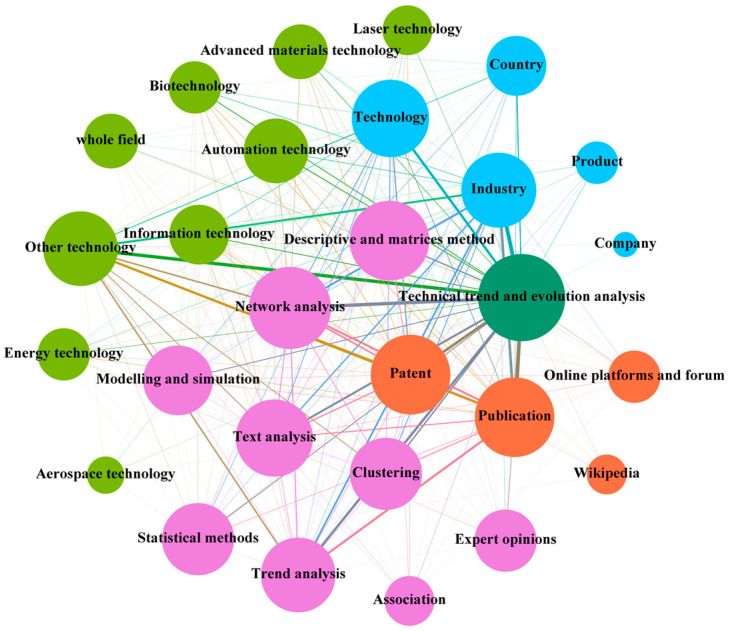
Technology forecasting (TF) is an important way to address technological innovation in fast-changing market environments and enhance the competitiveness of organizations in dynamic and complex environments. However, few studies have investigated the complex process problem of how to select the most appropriate forecasts for organizational characteristics. This paper attempts to fill this research gap by reviewing the TF literature based on a complex systems perspective. We first identify four contexts (technology opportunity identification, technology assessment, technology trend and evolutionary analysis, and others) involved in the systems of TF to indicate the research boundary of the system. Secondly, the four types of agents (field of analysis, object of analysis, data source, and approach) are explored to reveal the basic elements of the systems. Finally, the visualization of the interaction between multiple agents in full context and specific contexts is realized in the form of a network. The interaction relationship network illustrates how the subjects coordinate and cooperate to realize the TF context. Accordingly, we illustrate suggest five trends for future research: (1) refinement of the context; (2) optimization and expansion of the analysis field; (3) extension of the analysis object; (4) convergence and diversification of the data source; and (5) combination and optimization of the approach.
技术预测(TF)是应对快速变化的市场环境中的技术创新以及增强组织在动态复杂环境中的竞争力的重要途径。然而,很少有研究探讨如何针对组织特征选择最合适预测这一复杂过程问题。本文试图基于复杂系统视角回顾技术预测文献来填补这一研究空白。我们首先识别技术预测系统中涉及的四种情境(技术机会识别、技术评估、技术趋势与演化分析以及其他)以明确该系统的研究边界。其次,探究四种类型的主体(分析领域、分析对象、数据源和方法)以揭示该系统的基本要素。最后,以网络形式实现全情境和特定情境下多个主体间交互的可视化。交互关系网络阐明了各主体如何协调合作以实现技术预测情境。据此,我们提出未来研究的五个趋势:(1)情境细化;(2)分析领域的优化与拓展;(3)分析对象的扩展;(4)数据源的汇聚与多样化;(5)方法的结合与优化。