Co-Innovation Center for Sustainable Forestry in Southern China, College of Biology and the Environment, Nanjing Forestry University, Nanjing 210037, China.
Key Laboratory of State Forestry Administration on Subtropical Forest Biodiversity Conservation, Nanjing Forestry University, Nanjing 210037, China.
Int J Mol Sci. 2022 Jun 7;23(12):6368. doi: 10.3390/ijms23126368.
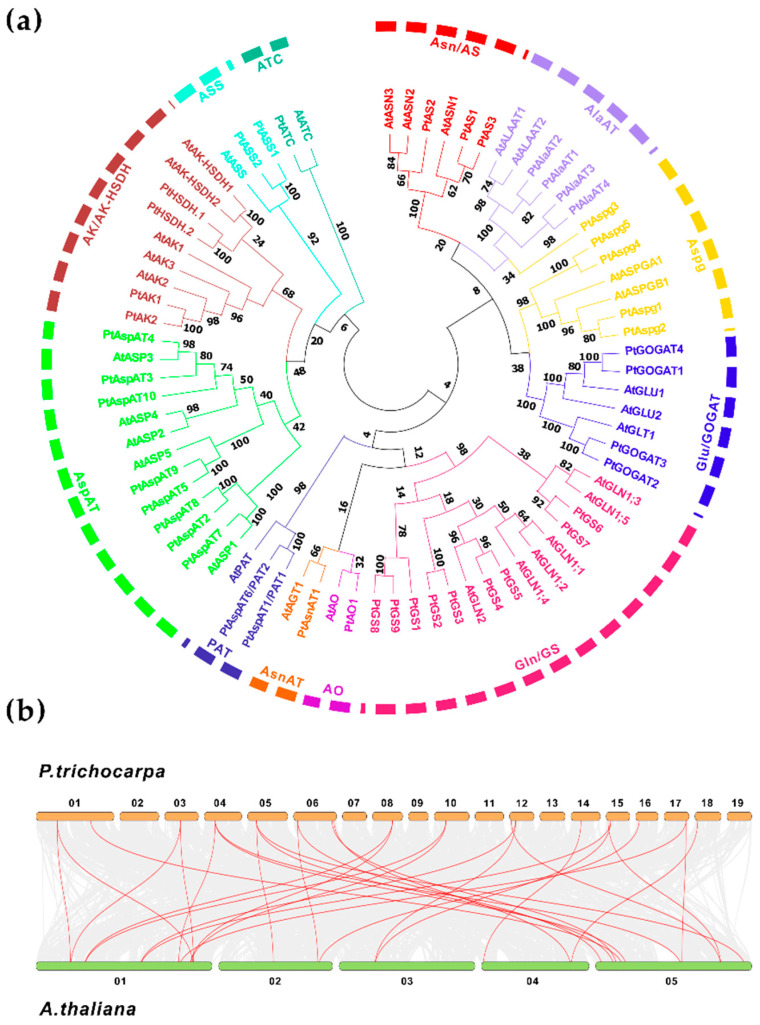
Integrating amino acid metabolic pathways into plant defense and immune systems provides the building block for stress acclimation and host-pathogen interactions. Recent progress in L-aspartate (Asp) and its deployed metabolic pathways highlighted profound roles in plant growth and defense modulation. Nevertheless, much remains unknown concerning the multiple isoenzyme families involved in Asp metabolic pathways in , a model tree species. Here, we present comprehensive features of 11 critical isoenzyme families, representing biological significance in plant development and stress adaptation. The in silico prediction of the molecular and genetic patterns, including phylogenies, genomic structures, and chromosomal distribution, identify 44 putative isoenzymes in the genome. Inspection of the tissue-specific expression demonstrated that approximately 26 isogenes were expressed, predominantly in roots. Based on the transcriptomic atlas in time-course experiments, the dynamic changes of the genes transcript were explored in roots challenged with soil-borne pathogenic (Fs). Quantitative expression evaluation prompted 12 isoenzyme genes (, /, //, , , , , and ) to show significant induction responding to the Fs infection. Using high-performance liquid chromatography (HPLC) and non-target metabolomics assay, the concurrent perturbation on levels of Asp-related metabolites led to findings of free amino acids and derivatives (e.g., Glutamate, Asp, Asparagine, Alanine, Proline, and α-/γ-aminobutyric acid), showing marked differences. The multi-omics integration of the responsive isoenzymes and differential amino acids examined facilitates Asp as a cross-talk mediator involved in metabolite biosynthesis and defense regulation. Our research provides theoretical clues for the in-depth unveiling of the defense mechanisms underlying the synergistic effect of fine-tuned Asp pathway enzymes and the linked metabolite flux in .
将氨基酸代谢途径整合到植物防御和免疫系统中,为应激适应和宿主-病原体相互作用提供了基础。最近在 L-天冬氨酸(Asp)及其部署的代谢途径方面的进展突出了其在植物生长和防御调节中的重要作用。然而,关于参与模式树种 中 Asp 代谢途径的多个同工酶家族,仍有许多未知之处。在这里,我们介绍了 11 个关键同工酶家族的综合特征,这些家族在植物发育和应激适应中具有重要的生物学意义。通过计算机预测,包括系统发育、基因组结构和染色体分布,确定了 基因组中 44 个可能的同工酶。对组织特异性表达的检查表明,大约 26 个同工基因在根中表达,主要在根中表达。根据时间过程实验的转录组图谱,研究了在根中受到土传病原 (Fs)挑战时基因转录的动态变化。定量表达评价表明,12 个同工酶基因(、/、//、、、、和)对 Fs 感染表现出显著诱导。使用高效液相色谱(HPLC)和非靶向代谢组学分析,发现 Asp 相关代谢物水平的同时扰动导致游离氨基酸及其衍生物(如谷氨酸、Asp、天冬酰胺、丙氨酸、脯氨酸和α-/γ-氨基丁酸)出现显著差异。响应同工酶和差异氨基酸的多组学整合促进了 Asp 作为参与代谢物生物合成和防御调节的交叉对话介质。我们的研究为深入揭示精细调节的 Asp 途径酶和相关代谢物通量在 中的协同防御机制提供了理论线索。