Department of Medicine, MetroWest Medical Center, Framingham, MA 01702, USA.
Department of Sport Science, Korea Institute of Sport Science, Seoul 01794, Korea.
Medicina (Kaunas). 2022 Jun 12;58(6):789. doi: 10.3390/medicina58060789.
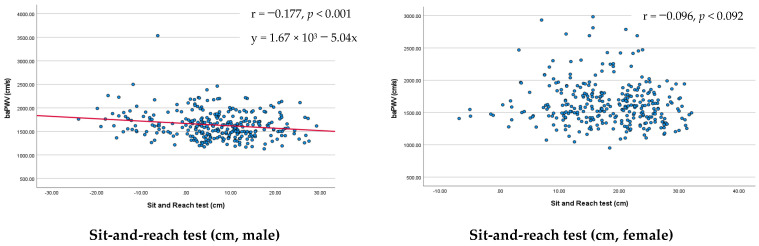
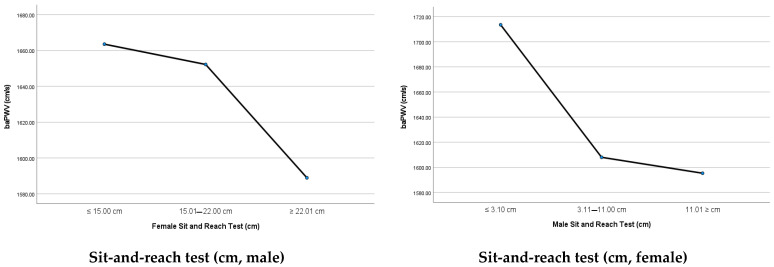
: Flexibility is one of the most important physical fitness parameters in the geriatric population. Brachial-ankle pulse wave velocity (baPWV) is a measure of systemic arterial stiffness. However, data on the association between flexibility and arterial stiffness in the older adult population are limited. Therefore, we aim to investigate this association by using the sit-and-reach test (SRT) and measuring baPWV. : We reviewed data from the 2014-2015 Korean Institute of Sports Science Fitness Standards Project. Individuals older than 65 years with SRT and baPWV data were included. A generalized linear regression analysis was conducted to assess the association between flexibility and arterial stiffness. Multiple relevant confounding factors were adjusted. : A total of 615 individuals were included in the analysis. The mean age of the male and female participants was 71.44 ± 4.42 and 70.64 ± 4.13 years, respectively. The mean SRT result was 6.58 ± 9.97 and 18.04 ± 7.48 cm, respectively. After multivariable adjustment among the male participants, the higher SRT result tertiles were inversely associated with baPWV (β (95% confidence interval): 3.11-11.00 cm, -74.45 (-140.93, -8.55); ≥11.01 cm, -108.17 (-177.65, -38.70)) in comparison with the lowest tertile. The female participants did not show any significant correlation between the SRT result and baPWV. : Our results suggest an inverse association between trunk flexibility and systemic arterial stiffness, expressed as the SRT result and baPWV, respectively, in older Korean men but no association in older Korean women. Sex differences might influence the association between flexibility and arterial stiffness in the older adult population.
灵活性是老年人群体中最重要的身体适应能力参数之一。肱踝脉搏波速度(baPWV)是衡量系统性动脉僵硬程度的指标。然而,关于老年人灵活性与动脉僵硬之间关联的数据有限。因此,我们旨在通过使用坐立前伸测试(SRT)和测量 baPWV 来研究这种关联。
我们回顾了 2014-2015 年韩国运动科学研究所健身标准项目的数据。纳入了具有 SRT 和 baPWV 数据的年龄大于 65 岁的个体。进行了广义线性回归分析,以评估灵活性与动脉僵硬之间的关联。调整了多个相关的混杂因素。
共有 615 人纳入分析。男性和女性参与者的平均年龄分别为 71.44 ± 4.42 岁和 70.64 ± 4.13 岁。男性参与者的平均 SRT 结果为 6.58 ± 9.97cm,女性参与者的平均 SRT 结果为 18.04 ± 7.48cm。在男性参与者中进行多变量调整后,较高的 SRT 结果三分位组与 baPWV 呈负相关(β(95%置信区间):3.11-11.00cm,-74.45(-140.93,-8.55);≥11.01cm,-108.17(-177.65,-38.70)),与最低三分位组相比。女性参与者的 SRT 结果与 baPWV 之间没有显示出任何显著的相关性。
我们的结果表明,在韩国老年男性中,躯干灵活性与系统性动脉僵硬之间存在负相关,分别表现为 SRT 结果和 baPWV,但在老年韩国女性中没有关联。性别差异可能会影响老年人群体中灵活性与动脉僵硬之间的关联。