Cugno Massimo, Meroni Pier Luigi, Consonni Dario, Griffini Samantha, Grovetti Elena, Novembrino Cristina, Torri Adriana, Griffante Gloria, Gariglio Marisa, Varani Luca, Peyvandi Flora
Department of Pathophysiology and Transplantation, Università degli Studi di Milano, 20122 Milan, Italy.
UOC Medicina Generale-Emostasi e Trombosi, Department of Internal Medicine, Fondazione IRCCS Ca' Granda, Ospedale Maggiore Policlinico, 20122 Milan, Italy.
Microorganisms. 2022 Jun 10;10(6):1191. doi: 10.3390/microorganisms10061191.
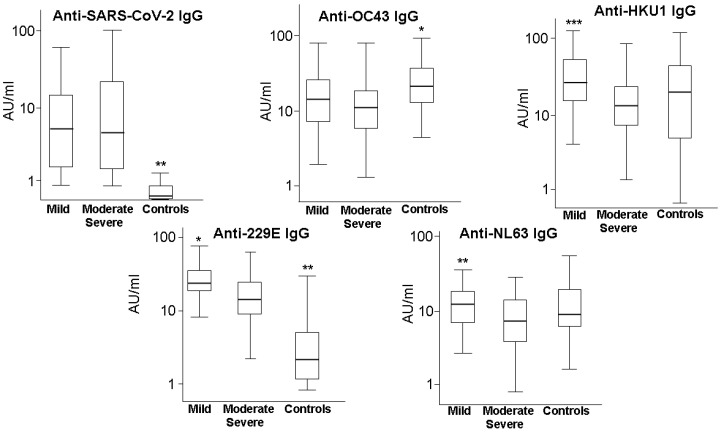
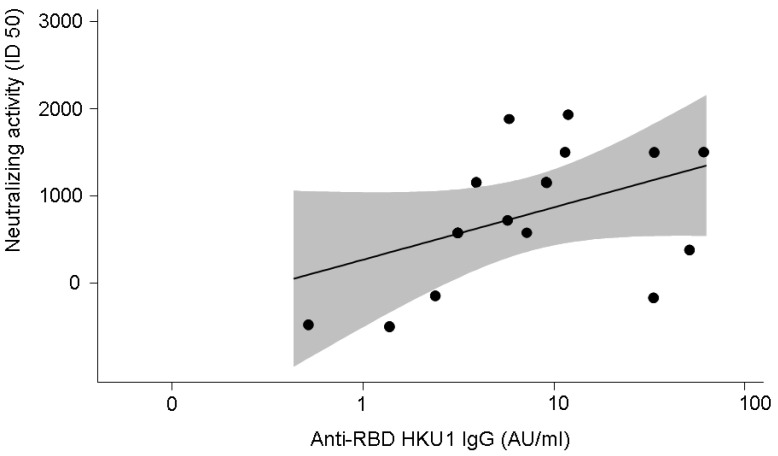
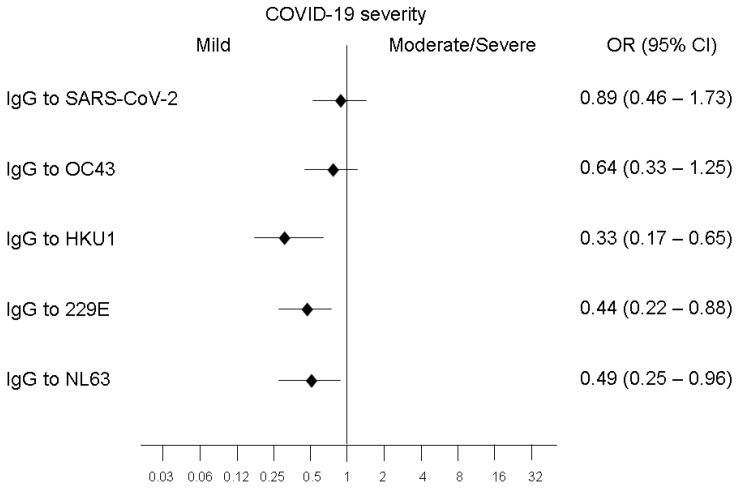
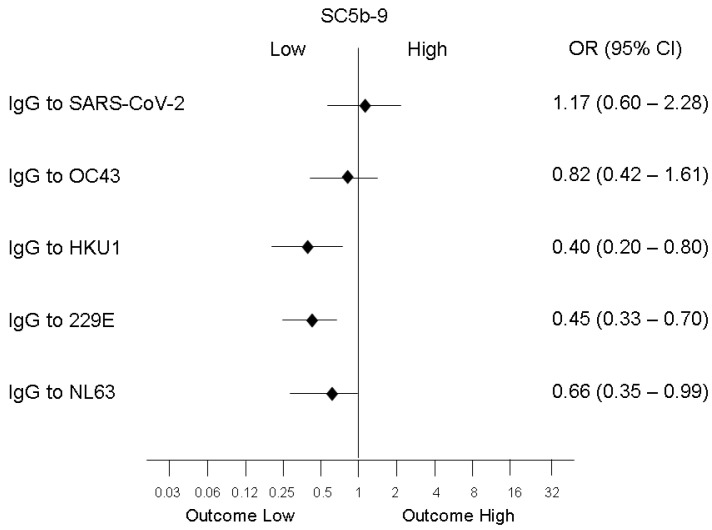
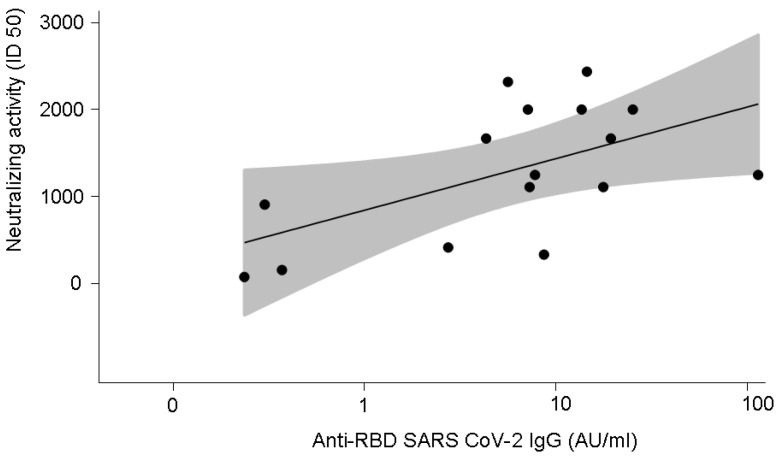
The severity of coronavirus disease 2019 (COVID-19) may be influenced by pre-existing immune responses against endemic coronaviruses, but conflicting data have been reported. We studied 148 patients who were hospitalised because of a confirmed diagnosis of COVID-19, classified mild in 58, moderate in 44, and severe in 46. The controls were 27 healthy subjects. At admission, blood samples were collected for the measurement of biomarkers of disease severity and levels of the IgG against the receptor-binding domain (RBD) of severe acute respiratory syndrome coronavirus-2 (SARS-CoV-2) and pre-existing coronaviruses OC43, HKU1, NL63 and 229E. Higher levels of IgG antibodies against the RBD of pre-existing coronavirus (with the highest significance for anti-HKU1 IgG, = 0.01) were found in patients with mild disease, compared with those with moderate or severe disease. Multivariable logistic regression confirmed the association of high levels of antibodies to pre-existing coronavirus with mild disease and showed their associations with low levels of the complement activation marker SC5b-9 ( range = 0.007-0.05). High levels of anti-NL63 antibodies were associated with low levels of the coagulation activation marker D-dimer ( = 0.04), while high levels of IgG against 229E were associated with low levels of the endothelial activation marker von Willebrand factor ( = 0.05). Anti-SARS-CoV-2-neutralising activity of plasma positively correlated with anti-SARS-CoV-2 IgG (r = 0.53, = 0.04) and with anti-HKU1 IgG (r = 0.51, = 0.05). In hospitalised patients with COVID-19, high levels of antibodies to pre-existing coronaviruses are associated with mild disease, suggesting that their measurement could be useful in predicting the severity of the disease.
2019冠状病毒病(COVID-19)的严重程度可能受既往针对地方性冠状病毒的免疫反应影响,但已有相互矛盾的数据报道。我们研究了148例因确诊COVID-19住院的患者,其中58例为轻症,44例为中症,46例为重症。对照组为27名健康受试者。入院时,采集血样以检测疾病严重程度的生物标志物以及针对严重急性呼吸综合征冠状病毒2(SARS-CoV-2)受体结合域(RBD)和既往冠状病毒OC43、HKU1、NL63及229E的IgG水平。与中症或重症患者相比,轻症患者体内针对既往冠状病毒RBD的IgG抗体水平更高(抗HKU1 IgG的意义最为显著,P = 0.01)。多变量逻辑回归证实,高水平的既往冠状病毒抗体与轻症相关,并显示它们与补体激活标志物SC5b-9的低水平相关(P范围 = 0.007 - 0.05)。高水平的抗NL63抗体与凝血激活标志物D-二聚体水平低相关(P = 0.04),而高水平的抗229E IgG与内皮激活标志物血管性血友病因子水平低相关(P = 0.05)。血浆的抗SARS-CoV-2中和活性与抗SARS-CoV-2 IgG呈正相关(r = 0.53,P = 0.04),与抗HKU1 IgG也呈正相关(r = 0.51,P = 0.05)。在住院的COVID-19患者中,高水平的既往冠状病毒抗体与轻症相关,这表明检测这些抗体可能有助于预测疾病的严重程度。