Jahan Sadaf, Redhu Neeru Singh, Siddiqui Arif Jamal, Iqbal Danish, Khan Johra, Banawas Saeed, Alaidarous Mohammed, Alshehri Bader, Mir Shabir Ahmad, Adnan Mohd, Pant Aditya Bhushan
Department of Medical Laboratory Sciences, College of Applied Medical Sciences, Majmaah University, Al-Majmaah 11952, Saudi Arabia.
Department of Molecular Biology, Biotechnology and Bioinformatics, Chaudhary Charan Singh Haryana Agricultural University, Hisar 125004, Haryana, India.
Pharmaceutics. 2022 May 25;14(6):1123. doi: 10.3390/pharmaceutics14061123.
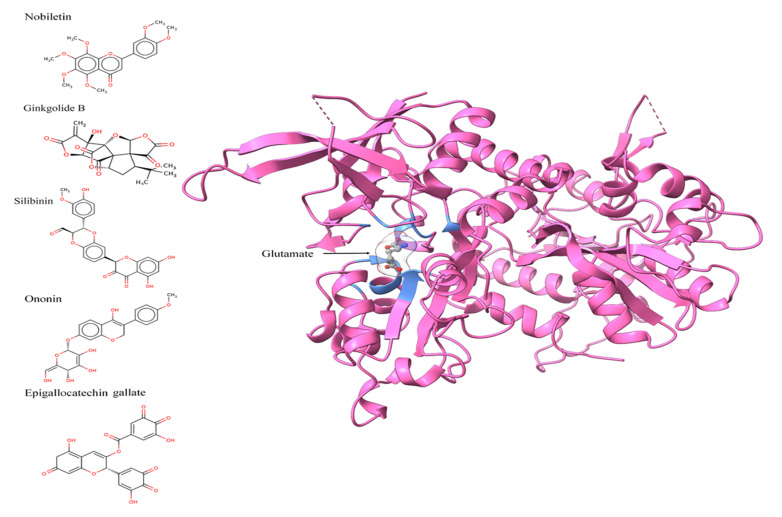
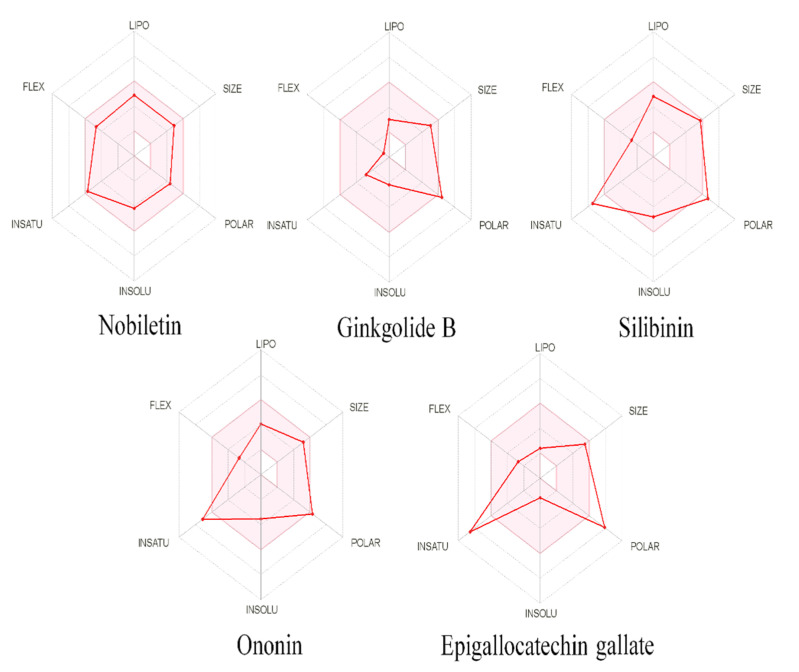
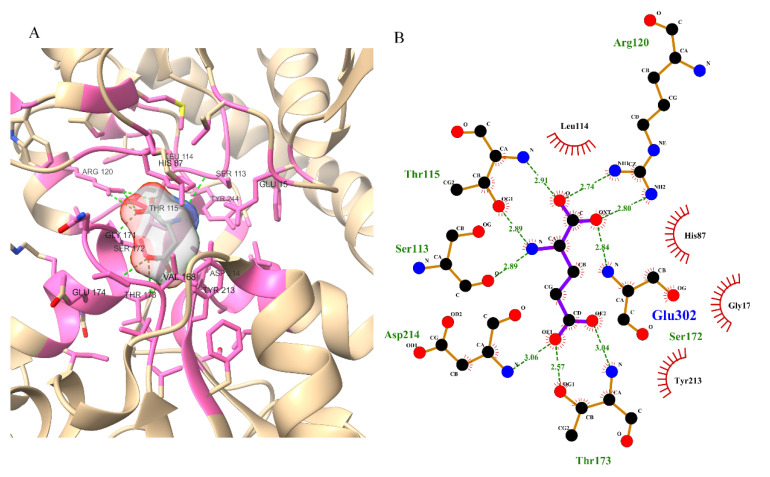
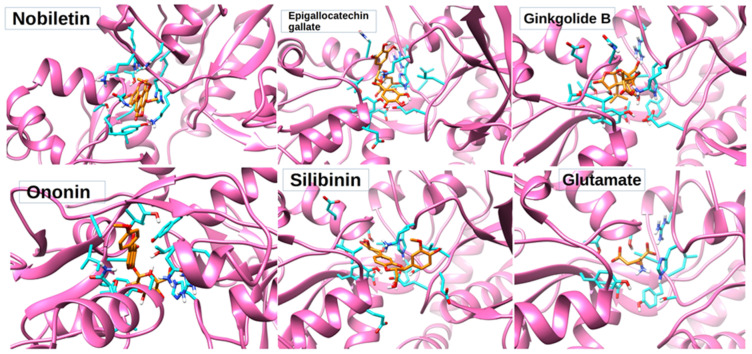
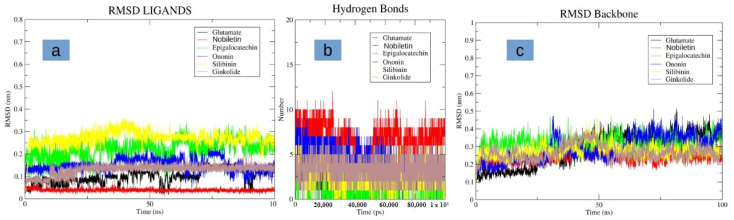
Excitotoxicity is a type of neurodegenerative disorder. It caused by excessive glutamate receptor activation, which leads to neuronal malfunction and fatality. The N-methyl-D-aspartate (NMDA) receptors are found in glutamatergic neurons, and their excessive activation is primarily responsible for excitotoxicity. They are activated by both glutamate binding and postsynaptic depolarization, facilitating Ca entry upon activation. Therefore, they are now widely acknowledged as being essential targets for excitotoxicity issues. Molecular docking and molecular dynamics (MD) simulation analyses have demonstrated that nobiletin efficiently targets the binding pocket of the NMDA receptor protein and exhibits stable dynamic behavior at the binding site. In this study, five potential neuroprotectants, nobiletin, silibinin, ononin, ginkgolide B, and epigallocatechin gallate (EGCG), were screened against the glutamate NMDA receptors in humans via computational methods. An in silico ADMET study was also performed, to predict the pharmacokinetics and toxicity profile for the expression of good drug-like behavior and a non-toxic nature. It was revealed that nobiletin fulfills the criteria for all of the drug-likeness rules (Veber, Lipinski, Ghose, Muegge, and Egan) and has neither PAINS nor structural alerts (Brenks). In conclusion, nobiletin demonstrated a possible promising neuroprotectant activities compared to other selected phytochemicals. Further, it can be evaluated in the laboratory for promising therapeutic approaches for in vitro and in vivo studies.
兴奋性毒性是一种神经退行性疾病。它由谷氨酸受体过度激活引起,导致神经元功能障碍和死亡。N-甲基-D-天冬氨酸(NMDA)受体存在于谷氨酸能神经元中,其过度激活是兴奋性毒性的主要原因。它们通过谷氨酸结合和突触后去极化而被激活,激活后促进钙离子内流。因此,它们现在被广泛认为是兴奋性毒性问题的重要靶点。分子对接和分子动力学(MD)模拟分析表明,川陈皮素有效地靶向NMDA受体蛋白的结合口袋,并在结合位点表现出稳定的动态行为。在本研究中,通过计算方法筛选了五种潜在的神经保护剂,即川陈皮素、水飞蓟宾、芒柄花素、银杏内酯B和表没食子儿茶素没食子酸酯(EGCG),以对抗人类的谷氨酸NMDA受体。还进行了计算机辅助的ADMET研究,以预测其药代动力学和毒性特征,以表现出良好的类药物行为和无毒性质。结果表明,川陈皮素符合所有类药物规则(Veber、Lipinski、Ghose、Muegge和Egan)的标准,既没有PAINS也没有结构警报(Brenks)。总之,与其他选定的植物化学物质相比,川陈皮素表现出可能有前景的神经保护活性。此外,它可以在实验室中进行评估,以用于体外和体内研究的有前景的治疗方法。