Alshammari Basheer A, Wilkinson Arthur N, AlOtaibi Bandar M, Alotibi Mohammed F
Material Science Research Institute, King Abdulaziz City for Science and Technology, P.O. Box 6086, Riyadh 11442, Saudi Arabia.
North West Composites Centre, Department of Materials, The University of Manchester, Manchester M13 9PL, UK.
Polymers (Basel). 2022 Jun 16;14(12):2440. doi: 10.3390/polym14122440.
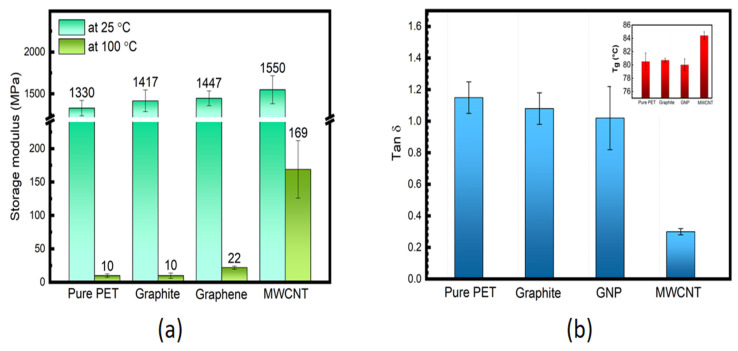
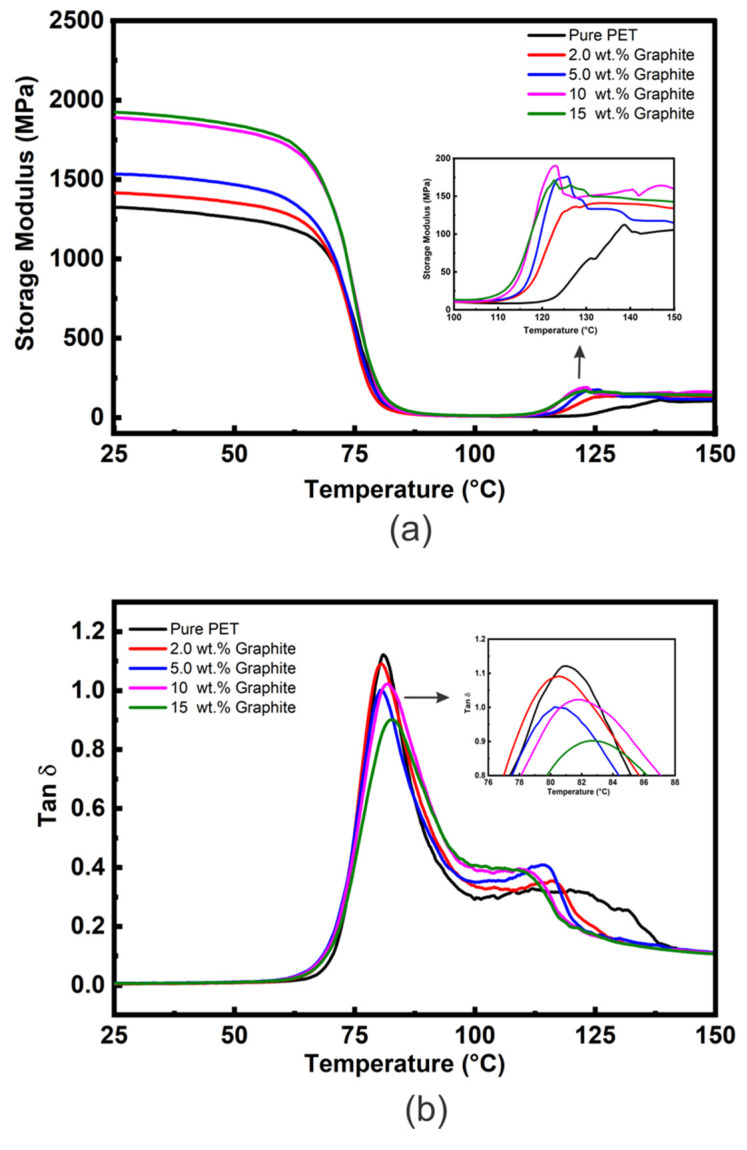
In this research study, three carbon fillers of varying dimensionality in the form of graphite (3D), graphite nano-platelets (2D), and multiwall carbon nanotubes (1D) were incorporated into a matrix of poly (ethylene terephthalate), forming carbon-reinforced polymer composites. Melt compounding was followed by compression moulding and then a quenching process for some of the samples to inhibit crystallization. The samples were analysed using dynamic mechanical thermal analysis (DMTA) and scanning electron microscopy (SEM), considering the dimensionality and loading of the carbon fillers. The dynamic mechanical analysis revealed a similar decline of storage moduli for all composites during the glassy to rubbery transition. However, storage moduli values at room temperature increased with higher loading of nano-fillers but only to a certain level; followed by a reduction attributed to the formation of agglomerates of nanotubes and/or rolled up of nano-platelets, as observed by SEM. Much greater reinforcement was observed for the carbon nanotubes compared to the graphite and or the graphite nano-platelets. The quenched PET samples showed significant changes in their dynamic mechanical properties due to both filler addition and to cold crystallization during the DMTA heating cycle. The magnitude of changes due to filler dimensionality was found to follow the order: 1D > 2D > 3D, this carbon filler with lower dimensionality have a more significant effect on the viscoelastic properties of polymer composite materials.
在本研究中,将三种不同维度的碳填料,即石墨(三维)、石墨纳米片(二维)和多壁碳纳米管(一维),掺入聚对苯二甲酸乙二酯基体中,形成碳增强聚合物复合材料。先进行熔融共混,然后进行压缩成型,部分样品再经过淬火处理以抑制结晶。考虑到碳填料的维度和负载量,使用动态热机械分析(DMTA)和扫描电子显微镜(SEM)对样品进行分析。动态力学分析表明,在从玻璃态到橡胶态的转变过程中,所有复合材料的储能模量都有类似的下降。然而,室温下的储能模量值随着纳米填料负载量的增加而升高,但仅到一定程度;随后由于纳米管团聚体的形成和/或纳米片的卷曲,储能模量值下降,这一点通过SEM观察到。与石墨和/或石墨纳米片相比,碳纳米管的增强效果要大得多。由于在DMTA加热循环过程中添加了填料以及发生了冷结晶,淬火后的PET样品的动态力学性能发生了显著变化。发现由于填料维度导致的变化幅度遵循以下顺序:一维>二维>三维,这种较低维度的碳填料对聚合物复合材料的粘弹性性能有更显著的影响。