Department of Epidemiology and Biostatistics, School of Public Health, Peking University, Beijing 100191, China.
Institute for Global Health and Development, Peking University, Beijing 100871, China.
Viruses. 2022 May 28;14(6):1180. doi: 10.3390/v14061180.
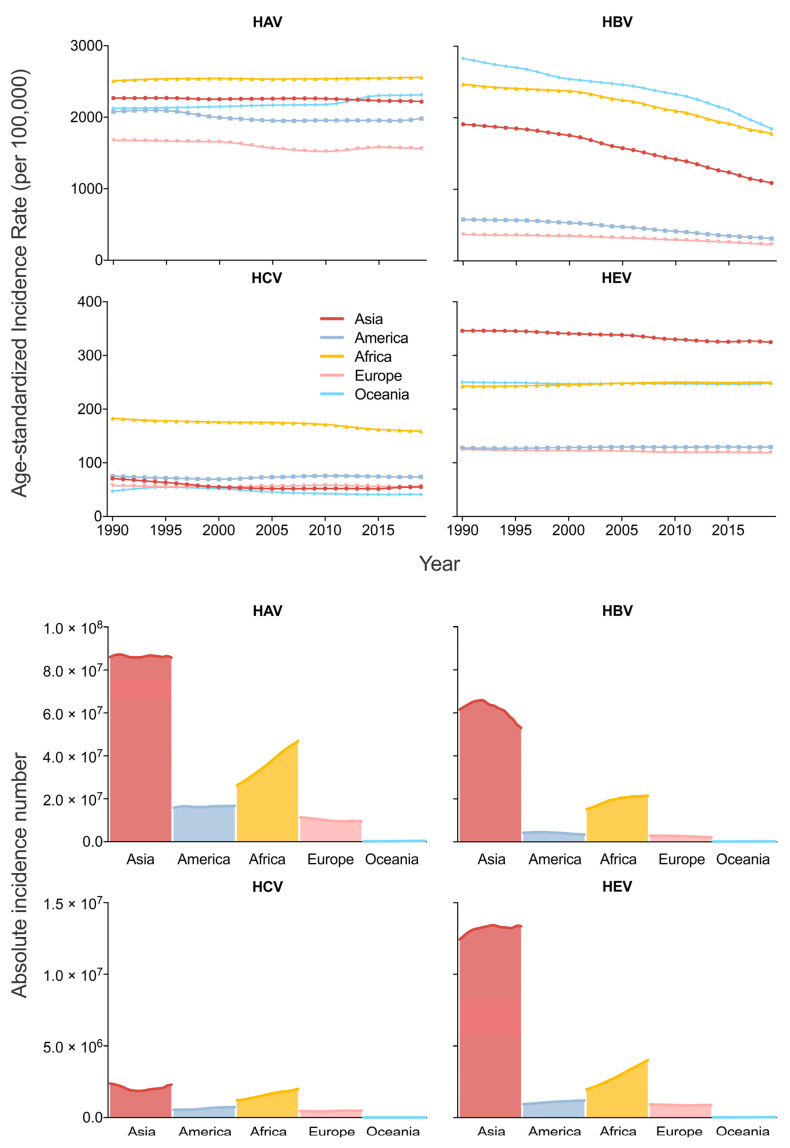
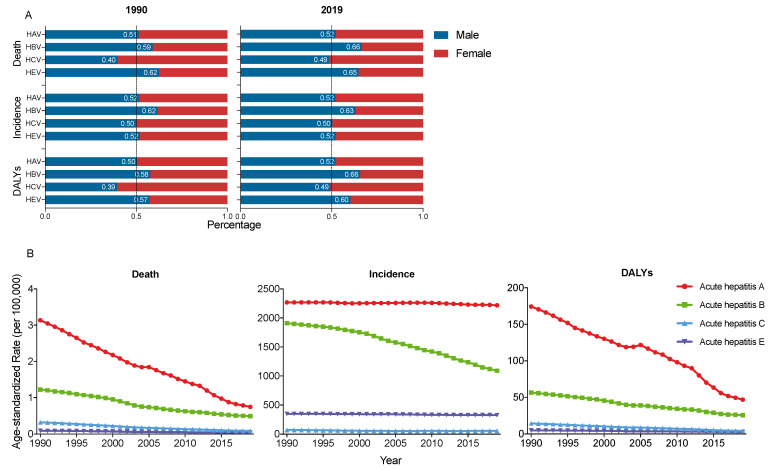
Asia has a very high burden of acute hepatitis; thus, a comprehensive study of the current burden and long-term trends of acute hepatitis in Asia is needed. We aimed to assess the current status and trends from 1990 to 2019 of acute hepatitis burden in Asia, using the data from the Global Burden of Diseases Study 2019 (GBD 2019) results. We used the data from the GBD 2019. Absolute death, incidence, and disability adjusted life years (DALY) number and rate of acute hepatitis in Asia were derived from the database from 1990 to 2019. Age-standardized mortality, incidence and DALY rates (ASMR, ASIR and ASDR) were used to compare populations in different regions and times. The estimated annual percentage change (EAPC) in the rates quantified the trends of the acute hepatitis burden. From 1990 to 2019, the ASMR and ASDR of acute hepatitis decreased significantly at different paces, with the largest decrease in acute hepatitis C and the smallest in acute hepatitis E. The ASIR of acute hepatitis decreased relatively slowly, by an average of 0.06% (95% CI, 0.05-0.08%) per year in acute hepatitis A, 0.91% (0.64-1.18%) per year in acute hepatitis C and 0.26% (0.24-0.28%) per year in acute hepatitis E; while the ASIR of acute hepatitis B decreased by an average of 1.95% (1.08-2.11) per year. From 1990 to 2019, the incidence rate of acute hepatitis A increased in most age groups (from the age of 5 to 70), with the 50-55 years group having the fastest increase by an average of 1.81% (95% CI, 1.67-1.95%) per year. In 2019, Afghanistan had the highest ASMR (10.44 per 100,000) and ASDR (357.85 per 100,000) of acute hepatitis, and the highest ASIR was in Mongolia (4703.14 per 100,000). In Asia, the burden of acute viral hepatitis was at a relatively high level, compared with the other four continents. International cooperation and multifaceted and multisectoral actions are needed for Asian countries to eliminate viral hepatitis and to contribute to the global elimination of viral hepatitis.
亚洲地区急性肝炎负担非常沉重;因此,需要对亚洲地区目前的急性肝炎负担和长期趋势进行全面研究。本研究旨在利用 2019 年全球疾病负担研究(GBD 2019)的数据评估 1990 年至 2019 年亚洲地区急性肝炎负担的现状和趋势。我们使用了 GBD 2019 中的数据。通过数据库,我们获取了亚洲地区 1990 年至 2019 年急性肝炎的绝对死亡人数、发病率和伤残调整生命年(DALY)数量和比率。年龄标准化死亡率、发病率和 DALY 率(ASMR、ASIR 和 ASDR)用于比较不同地区和时间的人群。急性肝炎负担变化的年度百分比变化(EAPC)用于量化趋势。1990 年至 2019 年,不同地区急性肝炎的 ASMR 和 ASDR 以不同的速度显著下降,其中急性丙型肝炎的下降幅度最大,急性戊型肝炎的下降幅度最小。急性肝炎 A 的 ASIR 相对下降较慢,平均每年下降 0.06%(95%CI,0.05-0.08%),急性丙型肝炎每年下降 0.91%(0.64-1.18%),急性戊型肝炎每年下降 0.26%(0.24-0.28%);而急性乙型肝炎的 ASIR 平均每年下降 1.95%(1.08-2.11%)。1990 年至 2019 年,大多数年龄组(5 岁至 70 岁)的急性肝炎发病率均有所增加,其中 50-55 岁年龄组的发病率以平均每年 1.81%(95%CI,1.67-1.95%)的速度增长最快。2019 年,阿富汗的急性肝炎 ASMR(每 10 万人 10.44 人)和 ASDR(每 10 万人 357.85 人)最高,蒙古的急性肝炎 ASIR 最高(每 10 万人 4703.14 人)。与其他四大洲相比,亚洲地区急性病毒性肝炎负担处于较高水平。亚洲各国需要开展国际合作,并采取多方面、多部门行动,以消除病毒性肝炎,为全球消除病毒性肝炎做出贡献。