Department of Epidemiology and Biostatistics, School of Public Health, Peking University, Haidian District, No. 38 Xueyuan Road, Beijing, 100191, China.
Hepatol Int. 2021 Oct;15(5):1068-1082. doi: 10.1007/s12072-021-10232-4. Epub 2021 Aug 3.
Despite decades of improved sanitation and hygiene measures and vaccine introduction, hepatitis A has been spread through numerous outbreaks globally. We used data from the Global Burden of Disease (GBD) study to quantify hepatitis A burden at the global, regional and national levels.
Annual incident cases, deaths, age-standardized incidence rates (ASIRs), and age-standardized mortality rates (ASMRs) of hepatitis A between 1990 and 2019 were derived from the GBD study 2019. Percentage changes of cases and deaths, and estimated annual percentage changes (EAPCs) of ASIRs and ASMRs were calculated to quantify their temporal trends.
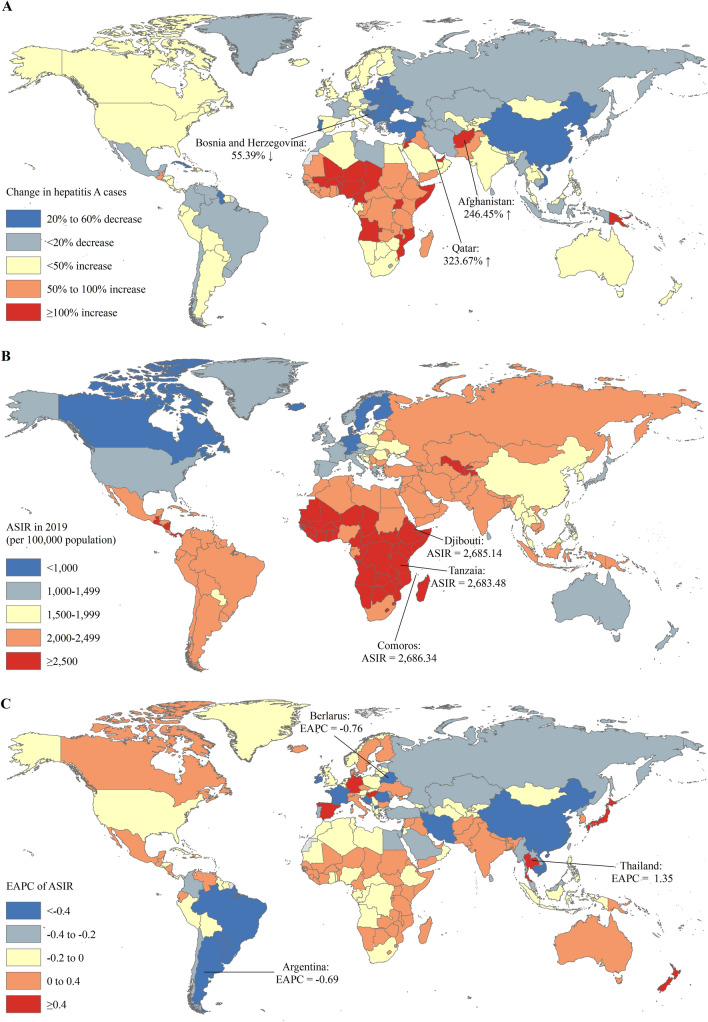
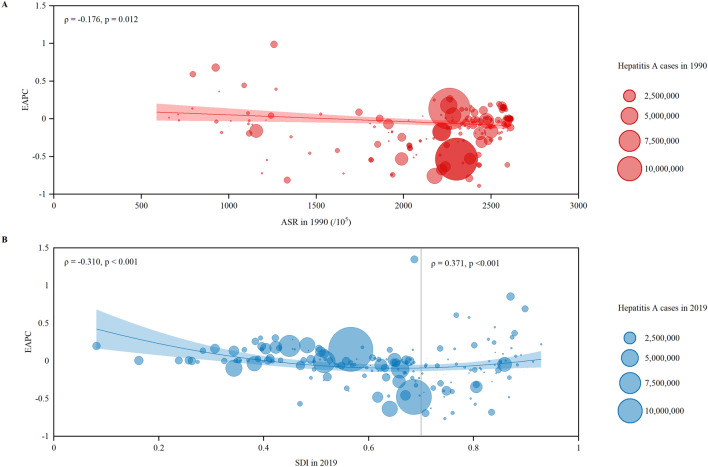
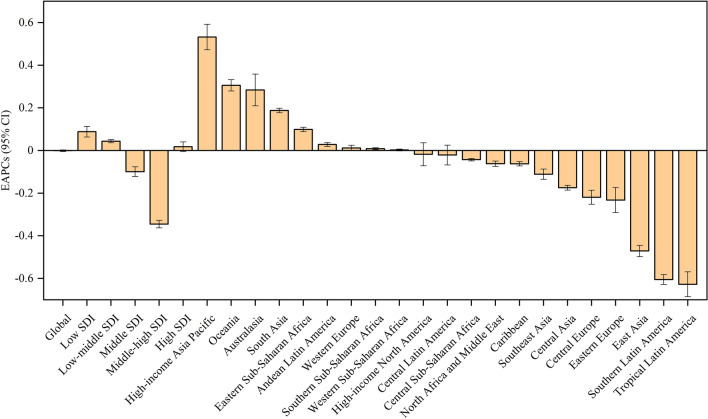
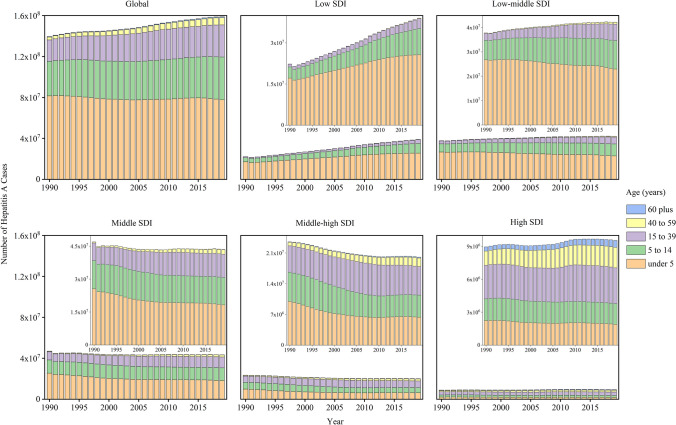
Global hepatitis A incident cases increased by 13.90% from 139.54 million in 1990 to 158.94 million in 2019. ASIR of hepatitis A remained stable (EAPC = 0.00, 95% CI -0.01 to 0.01), whereas ASMR decreased (EAPC = -4.63, 95% CI -4.94 to -4.32) between 1990 and 2019. ASIR increased in low (EAPC = 0.09, 95% CI 0.04 to 0.14) and low-middle (EAPC = 0.04, 95% CI 0.03 to 0.06) socio-demographic index (SDI) regions. For GBD regions, the most significant increases of ASIR were detected in high-income Asia Pacific (EAPC = 0.53, 95% CI 0.41 to 0.66), Oceania (EAPC = 0.31, 95% CI 0.25 to 0.36), and Australasia (EAPC = 0.28, 95% CI 0.13 to 0.44). EAPC of ASIR was positively associated with SDI value in countries and territories with SDI value ≥ 0.7 (ρ = -0.310, p < 0.001).
There is an unfavorable trend that hepatitis A is still pending in hyperendemic regions and is emerging in low endemic regions. These highlight the need of targeted and specific strategies to eliminate hepatitis A, such as sanitation measures and a comprehensive plan for surveillance and vaccination against hepatitis A.
尽管几十年来卫生和卫生措施有所改善,疫苗也已问世,但甲型肝炎仍在全球范围内多次爆发。我们利用全球疾病负担(GBD)研究的数据,在全球、区域和国家各级量化了甲型肝炎的负担。
我们从 GBD 研究 2019 年中获得了 1990 年至 2019 年期间甲型肝炎的年度发病病例、死亡人数、年龄标准化发病率(ASIR)和年龄标准化死亡率(ASMR)。为了量化其时间趋势,我们计算了病例和死亡人数的百分比变化以及 ASIR 和 ASMR 的估计年百分比变化(EAPC)。
全球甲型肝炎发病病例从 1990 年的 1.3954 亿例增加到 2019 年的 1.5894 亿例,增长了 13.90%。甲型肝炎的 ASIR 保持稳定(EAPC=0.00,95%CI-0.01 至 0.01),而 ASMR 在 1990 年至 2019 年间下降(EAPC=-4.63,95%CI-4.94 至-4.32)。低(EAPC=0.09,95%CI0.04 至 0.14)和中低(EAPC=0.04,95%CI0.03 至 0.06)社会人口指数(SDI)地区的 ASIR 有所增加。在全球疾病负担区域中,ASIR 增长最显著的是高收入亚太地区(EAPC=0.53,95%CI0.41 至 0.66)、大洋洲(EAPC=0.31,95%CI0.25 至 0.36)和澳大拉西亚(EAPC=0.28,95%CI0.13 至 0.44)。ASIR 的 EAPC 与 SDI 值呈正相关,在 SDI 值≥0.7 的国家和地区中(ρ=-0.310,p<0.001)。
甲型肝炎在高度流行地区仍然存在,在低流行地区也有出现,这表明需要采取有针对性和具体的策略来消除甲型肝炎,例如卫生措施和全面的甲型肝炎监测和疫苗接种计划。