Ezuma Chimere O, Lu Yining, Pareek Ayoosh, Wilbur Ryan, Krych Aaron J, Forsythe Brian, Camp Christopher L
School of Medicine, Vagelos Columbia College of Physicians and Surgeons, New York, New York.
Department of Orthopedic Surgery, Mayo Clinic, and Rochester, Minnesota.
Arthrosc Sports Med Rehabil. 2022 May 24;4(3):e1103-e1110. doi: 10.1016/j.asmr.2022.03.009. eCollection 2022 Jun.
To determine whether conventional logistic regression or machine learning algorithms were more precise in identifying the risk factors for unplanned overnight admission after medial patellofemoral ligament (MPFL) reconstruction.
A retrospective review of the prospectively collected National Surgical Quality Improvement Program database was performed to identify patients who underwent outpatient MPFL reconstruction from 2006-2018. Patients admitted overnight were identified as those with length of stay of 1 or more days. Models were generated using random forest, extreme gradient boosting, adaptive boosting, or elastic net penalized logistic regression, and an additional model was produced as a weighted ensemble of the 4 final algorithms. The predictive capacity of these models was compared to that of logistic regression.
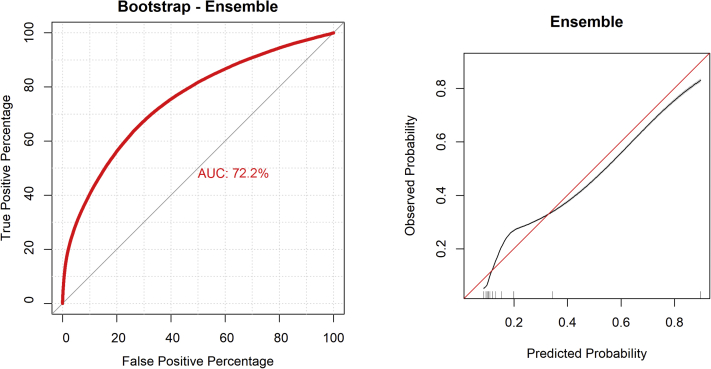
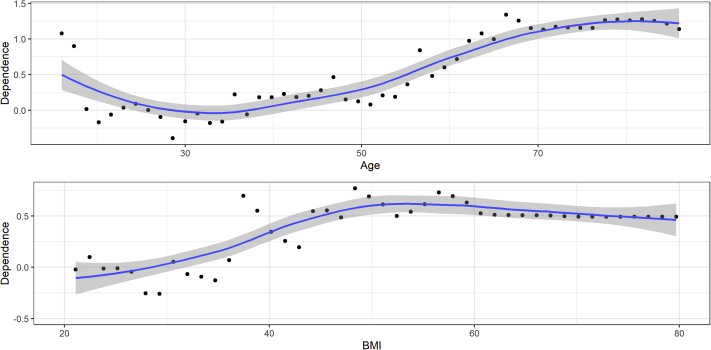
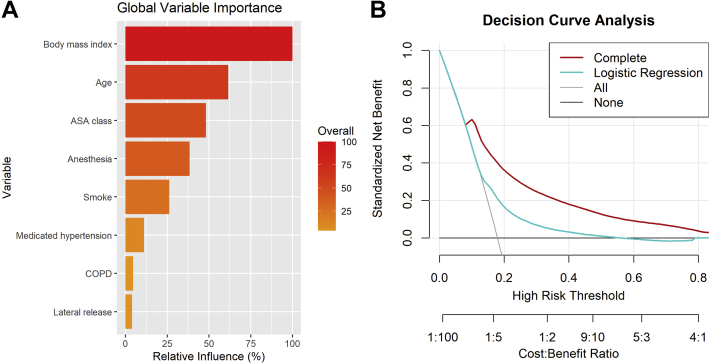
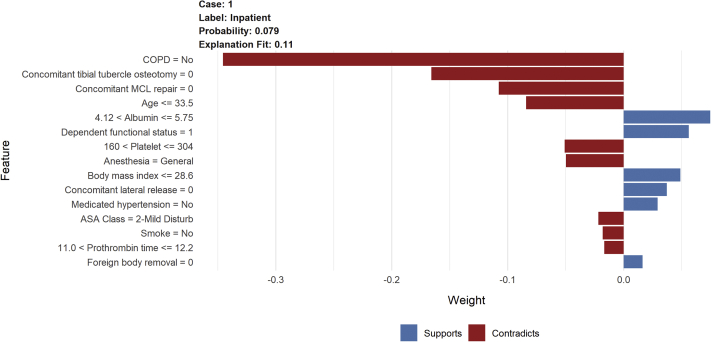
Of the 1307 patients identified, 221 (16.9%) required at least one overnight stay after MPFL reconstruction. Multivariate logistic regression found the following variables to be predictors of inpatient admission: age (odds ratio [OR] = 1.03 [95% confidence interval {CI} 1.02-1.04]; <.001), spinal anesthesia (OR = 3.42 [95% CI 1.98-6.08]; < .001), American Society of Anesthesiologists (ASA) class 3/4 (OR = 1.96 [95% CI 1.25-3.06]; < .001), history of chronic obstructive pulmonary disease (COPD) (OR = 6.44 [95% CI 1.58-26.17]; = .02), and body mass index (BMI) (OR = 1.03 [95% CI 1.01-1.05]; < .001). The ensemble model achieved the best performance based on discrimination assessed via internal validation (area under the curve = 0.722). The variables determined most important by the ensemble model were increasing BMI, increasing age, ASA class, anesthesia, smoking, hypertension, lateral release, and history of COPD.
An internally validated machine learning algorithm outperformed logistic regression modeling in predicting the need for unplanned overnight hospitalization after MPFL reconstruction. In this model, the most significant risk factors for admission were age, BMI, ASA class, smoking status, hypertension, lateral release, and history of COPD. This tool can be deployed to augment provider assessment to identify high-risk candidates and appropriately set postoperative expectations for patients.
Identifying and mitigating patient risk factors to prevent adverse surgical outcomes and hospitalizations is one of our primary goals. There may be a key role for machine learning algorithms to help successfully and efficiently risk stratify patients to decrease costs, appropriately set postoperative expectations, and increase the quality of delivered care.
确定传统逻辑回归或机器学习算法在识别髌股内侧韧带(MPFL)重建术后非计划过夜住院风险因素方面是否更精确。
对前瞻性收集的国家外科质量改进计划数据库进行回顾性分析,以识别2006年至2018年接受门诊MPFL重建的患者。过夜住院的患者被定义为住院时间为1天或更长时间的患者。使用随机森林、极端梯度提升、自适应提升或弹性网惩罚逻辑回归生成模型,并将4种最终算法的加权集成作为附加模型。将这些模型的预测能力与逻辑回归的预测能力进行比较。
在1307名确定的患者中,221名(16.9%)在MPFL重建后需要至少一次过夜住院。多变量逻辑回归发现以下变量是住院的预测因素:年龄(比值比[OR]=1.03[95%置信区间{CI}1.02 - 1.04];P<.001)、脊髓麻醉(OR = 3.42[95%CI 1.98 - 6.08];P<.001)、美国麻醉医师协会(ASA)3/4级(OR = 1.96[95%CI 1.25 - 3.06];P<.001)、慢性阻塞性肺疾病(COPD)病史(OR = 6.44[95%CI 1.58 - 26.17];P = .02)和体重指数(BMI)(OR = 1.03[95%CI 1.01 - 1.05];P<.001)。基于通过内部验证评估的辨别力,集成模型表现最佳(曲线下面积 = 0.722)。集成模型确定的最重要变量是BMI增加、年龄增加、ASA分级、麻醉、吸烟、高血压、外侧松解和COPD病史。
在预测MPFL重建术后非计划过夜住院需求方面,经过内部验证的机器学习算法优于逻辑回归建模。在该模型中,住院的最显著风险因素是年龄、BMI、ASA分级、吸烟状况、高血压、外侧松解和COPD病史。该工具可用于增强医疗服务提供者的评估,以识别高危患者并为患者适当地设定术后预期。
识别和减轻患者风险因素以预防不良手术结果和住院是我们的主要目标之一。机器学习算法可能在帮助成功且高效地对患者进行风险分层以降低成本、适当地设定术后预期并提高所提供护理的质量方面发挥关键作用。