Khoury Anthony N, Krupp Maxwell J, Matuska Andrea M, Friedman Darren J
Arthrex, Naples, Florida.
New York Presbyterian Lower Manhattan Hospital, New York, New York, U.S.A.
Arthrosc Sports Med Rehabil. 2022 Apr 11;4(3):e1067-e1073. doi: 10.1016/j.asmr.2022.03.002. eCollection 2022 Jun.
To evaluate the depth of penetration of manufacturer-recommended bipolar radiofrequency (BRF) output in healthy hyaline cartilage.
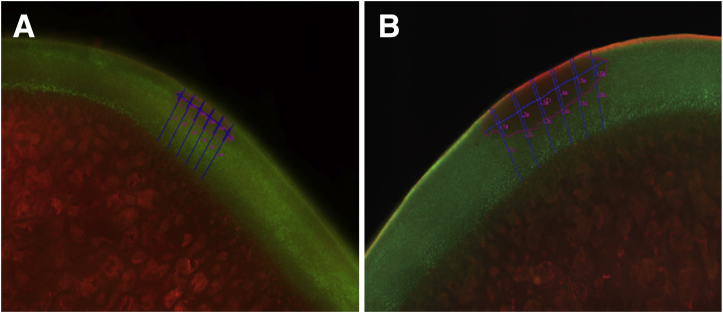
Two matched knees from a bovine specimen were harvested for immediate testing. BRF probes were used to treat the articular cartilage in a hydrated noncontact technique employing a 1-mm spacer on patellar, condylar, and trochlear surfaces. Two manufacturer-recommended ablate power settings were evaluated to analyze the effect of varying power outputs on the depth of penetration. Surfaces were randomized and treated with BRF ablate setting 3 (AB-3), 4 (AB-4), or left untreated as a control (12 grids each). Slices were extracted from treatment zones and subjected to fluorescein diacetate and propidium iodide viability stains and analyzed with confocal light microscopy. A general linear model was used to determine whether variables such as ablation setting, cartilage location, and side significantly influenced depth of penetration (DoP) and cartilage thickness (Minitab 19, Chicago, IL). When significance was noted ( < .05), a post hoc-Tukey test was used to investigate specific differences.
AB-3 had a 50.9% lower mean DoP than AB-4 ( = .006). The mean DoP was 237.9 ± 140.6 μm for AB-3 and 484.1 ± 267.0 μm for AB-4. Median DoP values were 243.2 ± 149.5 μm for AB-3, 51.2% lower than the 498.4 ± 286.0 μm for AB-4. The mean maximum DoP for AB-3 was 302.4 ± 167.8 μm, 50.6% lower than AB-4 value of 611.6 ± 299.1 μm. Analysis of the cartilage thickness confirmed there was no difference in overall cartilage thickness used for AB-3 versus AB-4 testing ( = .953).
The RF probe ablate power setting AB-3 demonstrated significantly less articular cartilage depth of penetration than the AB-4 setting in a healthy bovine model.
Debridement of chondral lesions with plasma BRF is of clinical interest. The presented study adds basic science information for those considering performing this technique.
评估制造商推荐的双极射频(BRF)输出在健康透明软骨中的穿透深度。
从一个牛标本上获取两个匹配的膝关节用于即时测试。使用BRF探头,采用水合非接触技术,在髌骨、髁和滑车表面使用1毫米间隔物来治疗关节软骨。评估两种制造商推荐的消融功率设置,以分析不同功率输出对穿透深度的影响。对表面进行随机分组,分别用BRF消融设置3(AB - 3)、4(AB - 4)进行治疗,或不进行治疗作为对照(每组12个网格)。从治疗区域提取切片,进行荧光素二乙酸酯和碘化丙啶活力染色,并通过共聚焦光学显微镜进行分析。使用一般线性模型来确定诸如消融设置、软骨位置和侧面等变量是否显著影响穿透深度(DoP)和软骨厚度(Minitab 19,伊利诺伊州芝加哥)。当发现有显著性差异(<0.05)时,使用事后Tukey检验来研究具体差异。
AB - 3的平均DoP比AB - 4低50.9%(P = 0.006)。AB - 3的平均DoP为237.9±140.6μm,AB - 4为484.1±267.0μm。AB - 3的DoP中位数为243.2±149.5μm,比AB - 4的498.4±286.0μm低51.2%。AB - 3的平均最大DoP为302.4±167.8μm,比AB - 4的6