Department of Sports Medicine, the First Affiliated Hospital of Shenzhen University, Shenzhen Second People's Hospital, Shenzhen, 518035, Guangdong, China.
Shenzhen Key Laboratory of Tissue Engineering, the First Affiliated Hospital of Shenzhen University, Shenzhen Second People's Hospital, Shenzhen, 518035, Guangdong, China.
J Orthop Surg Res. 2020 Mar 12;15(1):106. doi: 10.1186/s13018-020-01626-5.
The purpose of this study was to compare the effect of bipolar radiofrequency energy (bRFE) on chondroplasty at the different time durations in an in vitro experiment that simulated an arthroscopic procedure.
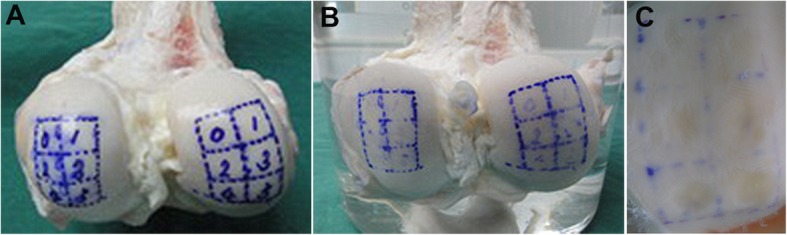
Six fresh bovine knees were used in our study. Six squares were marked on both the medical and lateral femoral condyles of each femur. Each square was respectively treated with bRFE for 0 s, 10 s, 20 s, 30 s, 40 s and 50 s. Full-thickness articular cartilage specimens were harvested from the treatment areas. Each specimen was divided into three distinct parts: one for hematoxylin/eosin staining histology, another for cartilage surface contouring assessment via scanning electron microscopy (SEM), and the last one for glycosaminoglycan (GAG) content measurement.
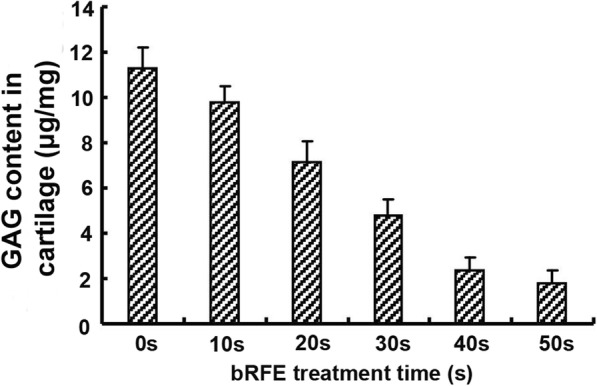
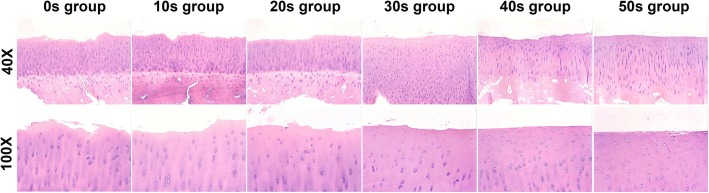
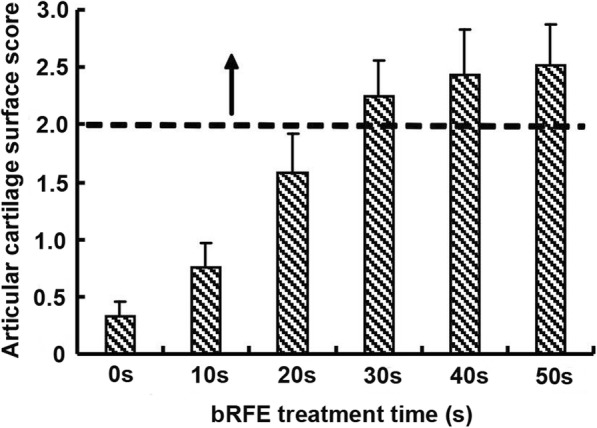
bRFE caused time-correlated damage to chondrocytes, and GAG content in the cartilage was negatively correlated to exposure time. bRFE caused time-correlated damage to chondrocytes. The GAG content in the cartilage negatively correlated with the exposure time. The sealing effect positively correlated with the exposure time. Additionally, it took at least 20 s of radiofrequency exposure to render a smooth cartilage surface and a score of 2 (normal) in the scoring system used.
bRFE usage in chondroplasty could effectively trim and polish the cartilage lesion area; however, it induces a dose-dependent detrimental effect on chondrocytes and metabolic activity that negatively correlated with the treatment time. Therefore, cautions should be taken in the use of bRFE for treatment of articular cartilage injury.
本研究旨在通过体外实验模拟关节镜手术,比较双极射频能量(bRFE)在不同时间持续时间下对软骨成形术的影响。
本研究使用了 6 个新鲜的牛膝关节。在每个股骨的内侧和外侧股骨髁上标记了 6 个方块。每个方块分别用 bRFE 处理 0s、10s、20s、30s、40s 和 50s。从治疗区域采集全层关节软骨标本。每个标本分为三个不同部分:一部分用于苏木精/伊红染色组织学,另一部分用于通过扫描电子显微镜(SEM)评估软骨表面轮廓,最后一部分用于测量糖胺聚糖(GAG)含量。
bRFE 导致软骨细胞的时间相关性损伤,并且软骨中的 GAG 含量与暴露时间呈负相关。bRFE 导致软骨细胞的时间相关性损伤。软骨中的 GAG 含量与暴露时间呈负相关。密封效果与暴露时间呈正相关。此外,至少需要 20s 的射频暴露才能使软骨表面光滑,并在使用的评分系统中获得 2(正常)的评分。
bRFE 在软骨成形术中的使用可以有效地修整和抛光软骨损伤区域;然而,它对软骨细胞和代谢活性产生了剂量依赖性的有害影响,与治疗时间呈负相关。因此,在治疗关节软骨损伤时应谨慎使用 bRFE。