Singh Vanya, Prasad Amber, Panda Prasan Kumar, Totaganti Manjunath, Tyagi Amit Kumar, Thaduri Abhinav, Rao Shalinee, Bairwa Mukesh, Singh Ashok Kumar
Department of Microbiology, All India Institute of Medical Sciences, Rishikesh, Uttarakhand, India.
Department of Internal Medicine, All India Institute of Medical Sciences, Rishikesh, Uttarakhand, India.
Curr Med Mycol. 2021 Dec;7(4):19-27. doi: 10.18502/cmm.7.4.8407.
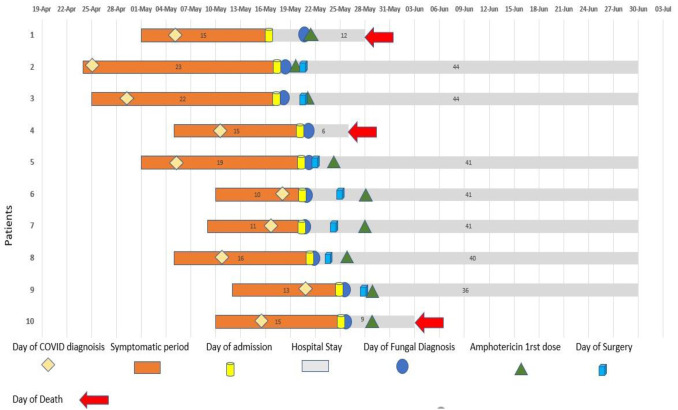
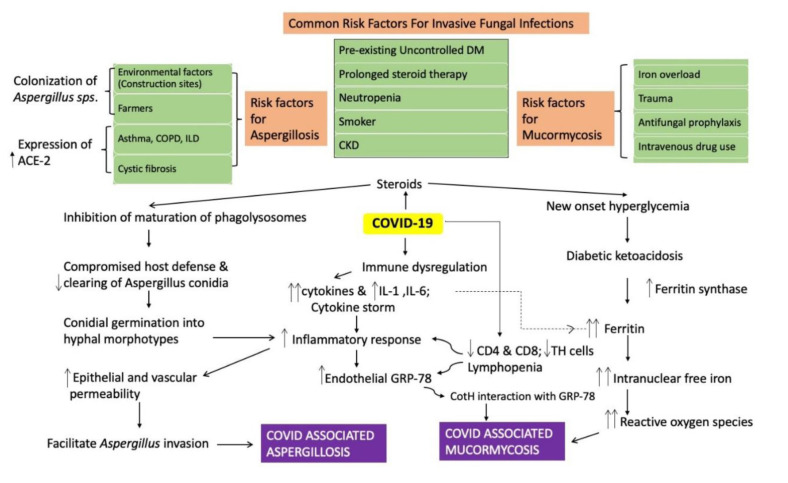
The healthcare system in India collapsed during the second wave of the COVID-19 pandemic. A fungal epidemic was announced amid the pandemic with several cases of COVID-associated mucormycosis and pulmonary aspergillosis being reported. However, there is limited data regarding mixed fungal infections in COVID-19 patients. Therefore, we present a series of ten consecutive COVID-19 patients with mixed invasive fungal infections (MIFIs).
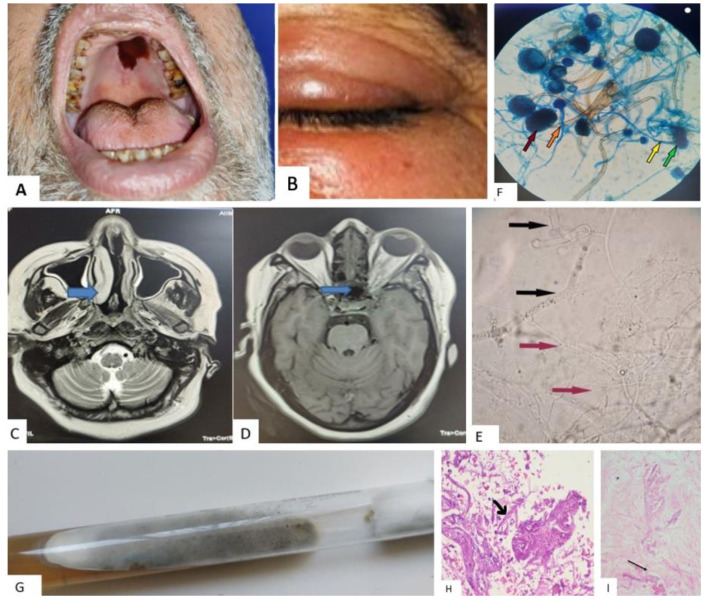
Among COVID-19 patients hospitalized in May 2021 at a tertiary care center in North India, 10 cases of microbiologically confirmed COVID-19-associated mucormycosis-aspergillosis (CAMA) were evaluated.
All patients had diabetes and the majority of them were infected with severe COVID-19 pneumonia (6/10, 60%) either on admission or in the past month while two were each of moderate (20%) and mild (20%) categories of COVID-19; and were treated with steroid and cocktail therapy. The patients were managed with amphotericin-B along with surgical intervention. In total, 70% of all CAMA patients ( with in seven and complex in three patients) survived.
The study findings reflected the critical importance of a high index of clinical suspicion and accurate microbiological diagnosis in managing invasive dual molds and better understanding of the risk and progression of MIFIs among COVID-19 patients. Careful scrutiny and identification of MIFIs play a key role in the implementation of effective management strategies.
在新冠疫情第二波期间,印度的医疗系统崩溃。疫情期间宣布了一场真菌疫情,报告了多例与新冠相关的毛霉病和肺曲霉病病例。然而,关于新冠患者混合真菌感染的数据有限。因此,我们报告了连续10例患有混合侵袭性真菌感染(MIFI)的新冠患者。
在2021年5月于印度北部一家三级护理中心住院的新冠患者中,对10例经微生物学确诊的新冠相关毛霉病-曲霉病(CAMA)病例进行了评估。
所有患者均患有糖尿病,大多数患者在入院时或过去一个月内感染了重症新冠肺炎(6/10,60%),而另外两名患者分别为中度(20%)和轻度(20%)新冠;并接受了类固醇和联合疗法治疗。患者接受了两性霉素B治疗并辅以手术干预。所有CAMA患者中,70%(7例简单型和3例复杂型患者)存活。
研究结果反映了在管理侵袭性双霉菌感染时临床高度怀疑指数和准确微生物诊断的至关重要性,以及对新冠患者中MIFI风险和进展的更好理解。仔细审查和识别MIFI在实施有效管理策略中起着关键作用。