Department of Radiology, Hallym University Dongtan Sacred Heart Hospital, Hwaseong, Korea.
Department of Radiology and Research Institute of Radiology, University of Ulsan College of Medicine, Asan Medical Center, Seoul, Korea.
Yonsei Med J. 2022 Jul;63(7):683-691. doi: 10.3349/ymj.2022.63.7.683.
To evaluate the applicability of Greulich-Pyle (GP) standards to bone age (BA) assessment in healthy Korean children using manual and deep learning-based methods.
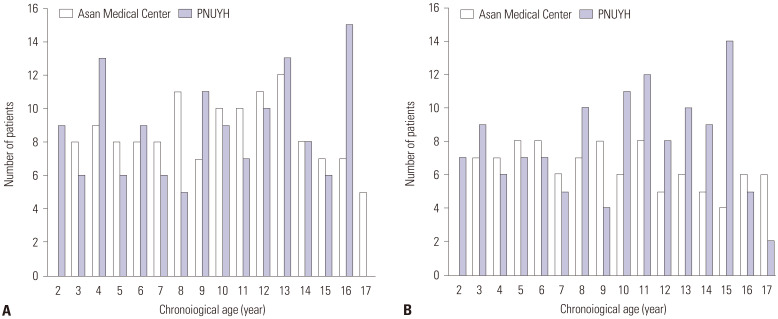
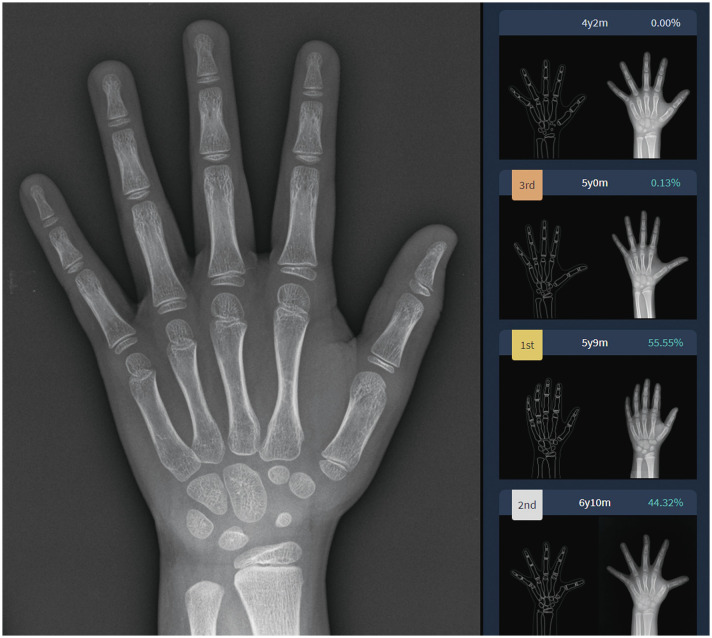
We collected 485 hand radiographs of healthy children aged 2-17 years (262 boys) between 2008 and 2017. Based on GP method, BA was assessed manually by two radiologists and automatically by two deep learning-based BA assessment (DLBAA), which estimated GP-assigned (original model) and optimal (modified model) BAs. Estimated BA was compared to chronological age (CA) using intraclass correlation (ICC), Bland-Altman analysis, linear regression, mean absolute error, and root mean square error. The proportion of children showing a difference >12 months between the estimated BA and CA was calculated.
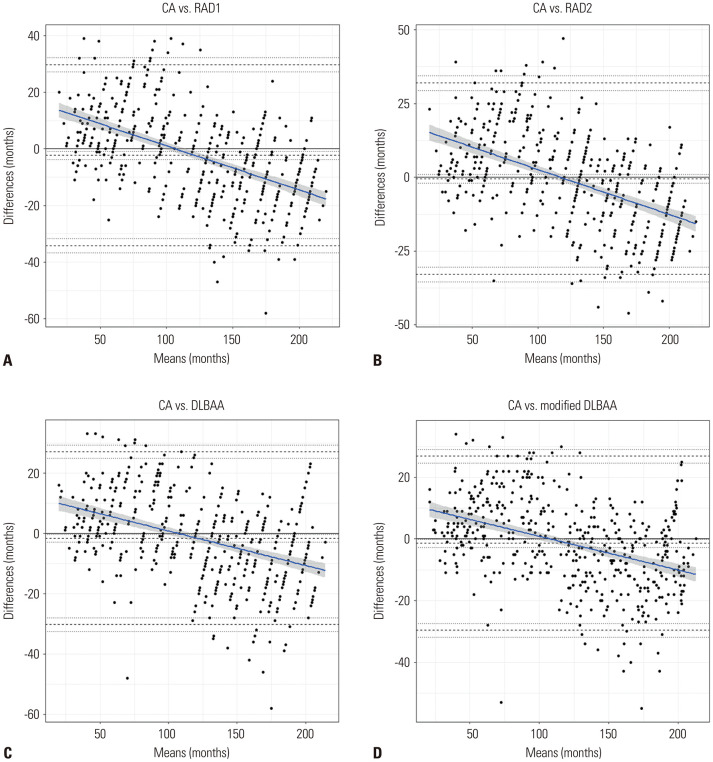
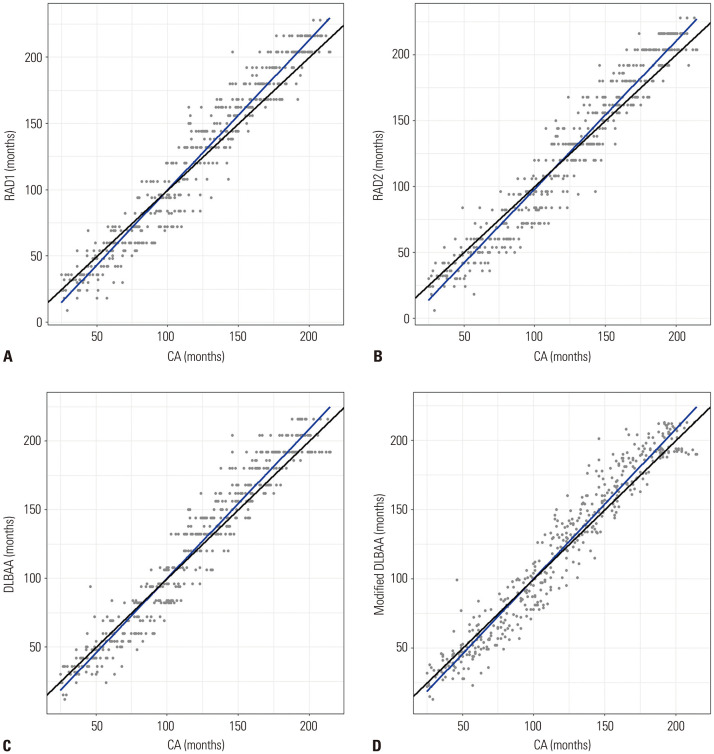
CA and all estimated BA showed excellent agreement (ICC ≥0.978, <0.001) and significant positive linear correlations (R²≥0.935, <0.001). The estimated BA of all methods showed systematic bias and tended to be lower than CA in younger patients, and higher than CA in older patients (regression slopes ≤-0.11, <0.001). The mean absolute error of radiologist 1, radiologist 2, original, and modified DLBAA models were 13.09, 13.12, 11.52, and 11.31 months, respectively. The difference between estimated BA and CA was >12 months in 44.3%, 44.5%, 39.2%, and 36.1% for radiologist 1, radiologist 2, original, and modified DLBAA models, respectively.
Contemporary healthy Korean children showed different rates of skeletal development than GP standard-BA, and systemic bias should be considered when determining children's skeletal maturation.
使用手动和基于深度学习的方法评估 Greulich-Pyle(GP)标准在韩国健康儿童骨龄(BA)评估中的适用性。
我们收集了 2008 年至 2017 年间 485 名 2-17 岁(262 名男性)健康儿童的手部 X 光片。根据 GP 方法,两名放射科医生进行了手动 BA 评估,两名基于深度学习的 BA 评估(DLBAA)自动评估了 BA,这两种方法分别估计了 GP 分配的(原始模型)和最佳(修正模型)BA。通过组内相关系数(ICC)、Bland-Altman 分析、线性回归、平均绝对误差和均方根误差比较估算 BA 与实际年龄(CA)之间的差异。计算了估计 BA 与 CA 之间差异>12 个月的儿童比例。
CA 和所有估算 BA 之间具有极好的一致性(ICC≥0.978,<0.001),且存在显著的正线性相关(R²≥0.935,<0.001)。所有方法的估算 BA 均存在系统偏差,且在年龄较小的患者中倾向于低于 CA,而在年龄较大的患者中则高于 CA(回归斜率≤-0.11,<0.001)。放射科医生 1、放射科医生 2、原始和修正 DLBAA 模型的平均绝对误差分别为 13.09、13.12、11.52 和 11.31 个月。对于放射科医生 1、放射科医生 2、原始和修正 DLBAA 模型,分别有 44.3%、44.5%、39.2%和 36.1%的患者估算 BA 与 CA 之间的差异>12 个月。
当代韩国健康儿童的骨骼发育率与 GP 标准 BA 不同,在确定儿童骨骼成熟度时应考虑系统偏差。