Geriatric Research, Education and Clinical Center, Veterans Affairs Pittsburgh Health Care System, Pittsburgh, Pennsylvania, USA.
Pittsburgh Institute of Brain Disorders & Recovery and Department of Neurology, University of Pittsburgh, Pittsburgh, Pennsylvania, USA.
CNS Neurosci Ther. 2022 Sep;28(9):1279-1293. doi: 10.1111/cns.13899. Epub 2022 Jun 25.
Phagocytosis is the cellular digestion of extracellular particles, such as pathogens and dying cells, and is a key element in the evolution of central nervous system (CNS) disorders. Microglia and macrophages are the professional phagocytes of the CNS. By clearing toxic cellular debris and reshaping the extracellular matrix, microglia/macrophages help pilot the brain repair and functional recovery process. However, CNS resident and invading immune cells can also magnify tissue damage by igniting runaway inflammation and phagocytosing stressed-but viable-neurons.
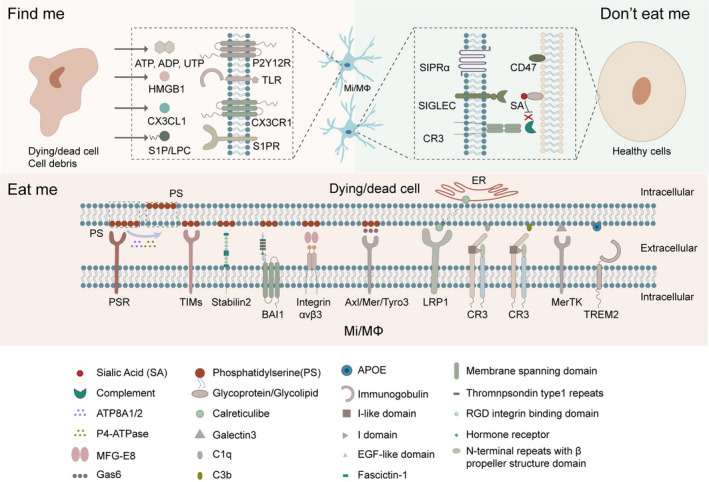
Microglia/macrophages help mediate intercellular communication and react quickly to the "find-me" signals expressed by dead/dying neurons. The activated microglia/macrophages then migrate to the injury site to initiate the phagocytic process upon encountering "eat-me" signals on the surfaces of endangered cells. Thus, healthy cells attempt to avoid inappropriate engulfment by expressing "do not-eat-me" signals. Microglia/macrophages also have the capacity to phagocytose immune cells that invade the injured brain (e.g., neutrophils) and to regulate their pro-inflammatory properties. During brain recovery, microglia/macrophages engulf myelin debris, initiate synaptogenesis and neurogenesis, and sculpt a favorable extracellular matrix to support network rewiring, among other favorable roles. Here, we review the multilayered nature of phagocytotic microglia/macrophages, including the molecular and cellular mechanisms that govern microglia/macrophage-induced phagocytosis in acute brain injury, and discuss strategies that tap into the therapeutic potential of this engulfment process.
Identification of biological targets that can temper neuroinflammation after brain injury without hindering the essential phagocytic functions of microglia/macrophages will expedite better medical management of the stroke recovery stage.
吞噬作用是细胞对细胞外颗粒(如病原体和死亡细胞)的消化,是中枢神经系统(CNS)疾病演变的关键因素。小胶质细胞和巨噬细胞是 CNS 的专业吞噬细胞。通过清除毒性细胞碎片和重塑细胞外基质,小胶质细胞/巨噬细胞有助于引导大脑修复和功能恢复过程。然而,中枢神经系统固有和入侵的免疫细胞也可以通过引发失控的炎症和吞噬应激但存活的神经元来放大组织损伤。
小胶质细胞/巨噬细胞有助于介导细胞间通讯,并迅速对死亡/垂死神经元表达的“找我”信号做出反应。然后,激活的小胶质细胞/巨噬细胞迁移到损伤部位,一旦遇到濒死细胞表面的“吃我”信号,就开始吞噬过程。因此,健康细胞通过表达“不要吃我”信号来避免不适当的吞噬。小胶质细胞/巨噬细胞还具有吞噬入侵受伤大脑的免疫细胞(如中性粒细胞)的能力,并调节其促炎特性。在大脑恢复过程中,小胶质细胞/巨噬细胞吞噬髓鞘碎片,启动突触形成和神经发生,并塑造有利的细胞外基质,以支持网络重新布线等有利作用。在这里,我们回顾了吞噬性小胶质细胞/巨噬细胞的多层次性质,包括控制急性脑损伤中小胶质细胞/巨噬细胞诱导吞噬作用的分子和细胞机制,并讨论了利用这种吞噬过程治疗潜力的策略。
确定在脑损伤后可以调节神经炎症而不阻碍小胶质细胞/巨噬细胞必需吞噬功能的生物学靶点,将加快更好地管理中风恢复阶段的医疗管理。