Department of Urology, Laboratory for Urologic Oncology and Stem Cell Therapy, University Hospital Zürich, Wagistrasse 21, 8952, Schlieren, Switzerland.
J Cancer Res Clin Oncol. 2022 Dec;148(12):3351-3360. doi: 10.1007/s00432-022-04059-1. Epub 2022 Jun 25.
Apalutamide (APA) is a next-generation androgen receptor antagonist for the treatment of advanced prostate cancer. We have previously shown that upregulation of autophagy is one of the mechanisms by which prostate cancer (PC) cells survive APA anti-tumor treatment in vitro. Therefore, we investigated the characteristics of the autophagic response to APA treatment, alone and in combination with autophagy inhibition, in an in vivo model.
Tumor cells were injected into previously castrated nude mice. Four groups of mice bearing LNCaP xenografts were treated with daily intraperitoneal (i.p.) injections of vehicle (control), APA (10 mg/kg), APA (10 mg/kg) + Chl (Chloroquine, 10 mg/kg) or Chl (10 mg/kg). The animals of each treatment group (3/treatment) were kept for the duration of 2 and 3 weeks. At the end of the experiments, the animals were sacrificed and all samples assessed for tumor weight and size, histological analysis, immunoblotting (WES) and immunofluorescence.
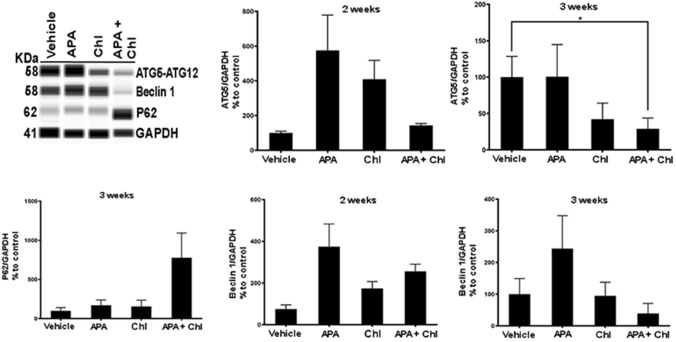
The tumor weight was significantly reduced in mice treated with APA + Chl (203.2 ± 5.0, SEM, P = 0.0066) compared to vehicle control (380.4 ± 37.0). Importantly, the combined treatment showed a higher impact on tumor weight than APA (320.4 ± 45.5) or Chl (337.9 ± 35) alone. The mice treated with the combination of APA + Chl exhibited a reduced expression of ATG5 (autophagy-related five protein), Beclin 1 and LC3 punctuations and an increase in P62 as visualized by immunofluorescence and WES. In addition, Ki-67 nuclear staining was detected in all samples however reduced in APA + Chl (58%) compared to vehicle control (100%). The reduction in Ki-67 protein was associated with an increase in caspase 3 and endothelial CD31 protein expression.
These data demonstrate that a treatment with APA + Chl leads to reduced autophagy levels and to tumor suppression compared to the APA monotherapy. Hence, the increased antitumor effect of APA in combination with autophagy inhibitors might provide a new therapeutic approach potentially translatable to patients.
阿帕鲁胺(APA)是一种用于治疗晚期前列腺癌的新一代雄激素受体拮抗剂。我们之前已经表明,自噬的上调是前列腺癌细胞(PC)在体外抵抗 APA 抗肿瘤治疗的机制之一。因此,我们在体内模型中研究了自噬对 APA 治疗的反应特征,单独使用和与自噬抑制联合使用。
将肿瘤细胞注射到先前去势的裸鼠中。将携带 LNCaP 异种移植物的四组小鼠分别用每日腹腔内(i.p.)注射载体(对照)、APA(10mg/kg)、APA(10mg/kg)+Chl(氯喹,10mg/kg)或 Chl(10mg/kg)治疗。每组动物(3/治疗)的动物在实验结束时被处死,并评估所有样本的肿瘤重量和大小、组织学分析、免疫印迹(WES)和免疫荧光。
与对照组(380.4±37.0)相比,用 APA+Chl(203.2±5.0,SEM,P=0.0066)治疗的小鼠肿瘤重量显著降低。重要的是,联合治疗对肿瘤重量的影响高于 APA(320.4±45.5)或 Chl(337.9±35)单独治疗。用 APA+Chl 联合治疗的小鼠表现出 ATG5(自噬相关蛋白 5)、Beclin 1 和 LC3 点状表达减少,P62 增加,免疫荧光和 WES 显示。此外,所有样本均检测到 Ki-67 核染色,但与对照组(100%)相比,APA+Chl 组(58%)减少。Ki-67 蛋白的减少与 caspase 3 和内皮 CD31 蛋白表达的增加有关。
这些数据表明,与 APA 单药治疗相比,用 APA+Chl 治疗可导致自噬水平降低和肿瘤抑制。因此,APA 与自噬抑制剂联合使用可能会增加抗肿瘤作用,为患者提供一种新的潜在治疗方法。