College of Health, Medicine and Wellbeing, The University of Newcastle (UON), University Drive, Callaghan, NSW, 2308, Australia.
Registry of Senior Australians (ROSA), South Australian Health and Medical Research Institute (SAHMRI), North Terrace, Adelaide, SA, 5000, Australia.
Sci Rep. 2022 Jun 25;12(1):10808. doi: 10.1038/s41598-022-15064-2.
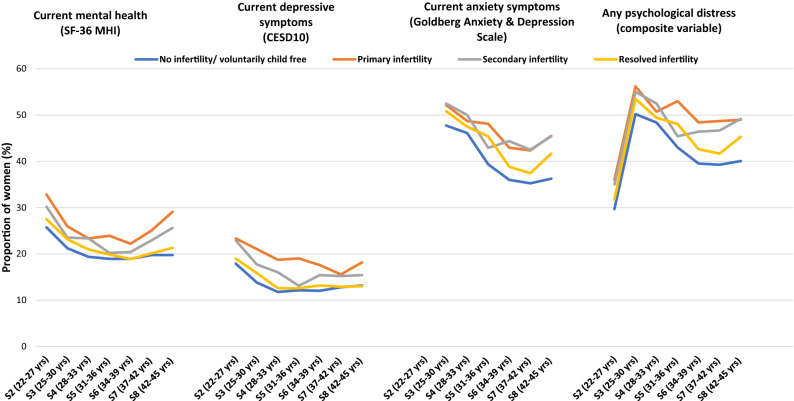
Infertility affects millions of people globally. Although an estimated 1 in 6 couples in Australia are unable to conceive without medical intervention, little is known about the mental health impacts of infertility. This study investigated how infertility impacts the mental health of women. The study used nationally representative Australian Longitudinal Study on Women's Health (ALSWH) data. We analysed data from survey periods 2-8 conducted every three years between 2000 and 2018 for 6582 women born in 1973-78. We used a Generalised Equation Modelling (GEE) method to investigate the association of primary, secondary and resolved fertility status and psychological distress over time. Multiple measures were used to measure psychological distress: the (1) the mental health index subscale of the 36-item short form survey (SF-36), (2) the Center for Epidemiological Studies Depression Scale (CESD-10), (3) the Goldberg Anxiety and Depression Scale (GADanx) anxiety subscale; and a (4) composite psychological distress variable. About a third (30%) of women reported infertility at any of the survey rounds; a steady increase over 18 years from 1.7% at round 2 to 19.3% at round 8. Half of the women reporting primary or secondary infertility reported psychological distress, with the odds of having psychological distress was higher in women reporting primary (odds ratio (OR) 1.24, 95% confidence interval (CI) 1.06-1.45), secondary (OR 1.27, 95% CI 1.10-1.46) or resolved infertility (OR 1.15, 95% CI 1.05-1.26) compared to women reporting normal fertility status. Women with partners, underweight or higher BMI, smoking, and high-risk alcohol use had higher odds of psychological distress, whereas women in paid work had significantly lower odds of psychological distress (p < 0.001). Diabetes, high blood pressure, asthma, and other chronic physical illness were independently associated with higher odds of psychological distress. Infertility has a significant impact on mental health even after it is resolved. Frequent mental health assessment and a holistic approach to address the lifestyle factors should be undertaken during the treatment of infertility.
全球有数百万人受到不孕不育的影响。尽管澳大利亚估计有 1/6 的夫妇在没有医学干预的情况下无法怀孕,但人们对不孕不育对心理健康的影响知之甚少。本研究调查了不孕不育对女性心理健康的影响。该研究使用了具有全国代表性的澳大利亚妇女健康纵向研究(ALSWH)数据。我们分析了 2000 年至 2018 年期间每三年进行一次的 2-8 次调查期间,来自 1973-78 年出生的 6582 名女性的数据。我们使用广义方程模型(GEE)方法来研究原发性、继发性和解决性生育状况与随时间推移的心理困扰之间的关联。我们使用了多种措施来衡量心理困扰:(1)36 项简短形式调查(SF-36)的心理健康指数子量表,(2)流行病学研究抑郁量表(CESD-10),(3)戈德堡焦虑和抑郁量表(GADanx)焦虑子量表;和(4)综合心理困扰变量。大约三分之一(30%)的女性在任何一轮调查中都报告了不孕不育;18 年来,这一比例稳步上升,从第 2 轮的 1.7%上升到第 8 轮的 19.3%。报告原发性或继发性不孕不育的女性中有一半报告存在心理困扰,与报告正常生育状况的女性相比,报告原发性(比值比(OR)1.24,95%置信区间(CI)1.06-1.45)、继发性(OR 1.27,95%CI 1.10-1.46)或解决性不孕不育(OR 1.15,95%CI 1.05-1.26)的女性发生心理困扰的几率更高。有伴侣、体重过轻或体重指数较高、吸烟和高危饮酒的女性发生心理困扰的几率更高,而有薪工作的女性发生心理困扰的几率明显较低(p<0.001)。糖尿病、高血压、哮喘和其他慢性躯体疾病与发生心理困扰的几率较高独立相关。即使在不孕不育得到解决后,它对心理健康仍有重大影响。在治疗不孕不育期间,应经常进行心理健康评估,并采取整体方法解决生活方式因素。