Department of Social and Preventive Medicine, École de Santé Publique de Université de Montréal, Montreal, QC, Canada.
Women and Children's Infectious Diseases Center, CHU Sainte-Justine Research Center, Montreal, QC, Canada.
Syst Rev. 2022 Jun 27;11(1):131. doi: 10.1186/s13643-022-02004-4.
Cytomegalovirus (CMV) is transmitted by direct contact with body fluids from infected individuals. Transmission of CMV in households, particularly those with young children, contributes significantly to CMV infection in the general population. However, little is known about the contribution of occupational healthcare or childcare exposure to risk of CMV infection.
To determine CMV seroprevalence, incidence of primary infection, and associated risk factors in healthcare and childcare workers.
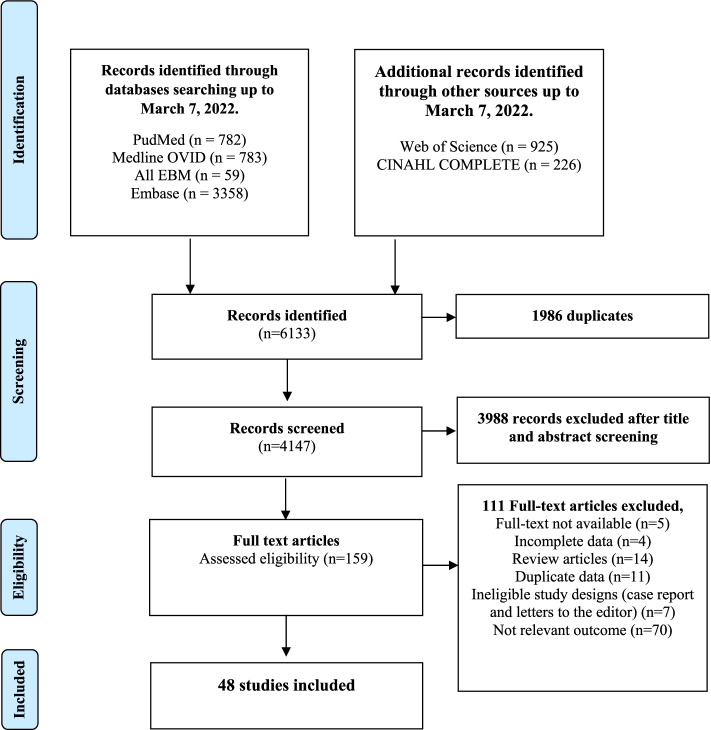
Six electronic databases were searched systematically for publications on CMV infection in healthcare and childcare workers until March 7, 2022. Two authors independently evaluated the literature for quality and inclusion in our analyses. The pooled results for seroprevalence, incidence, and relative risk (RR) were determined using a random effects model. Heterogeneity among studies was quantified and further investigated in subgroup analysis and meta-regression. Publication bias was assessed using funnel plot. Statistical analyses were preformed using R version 4.05.
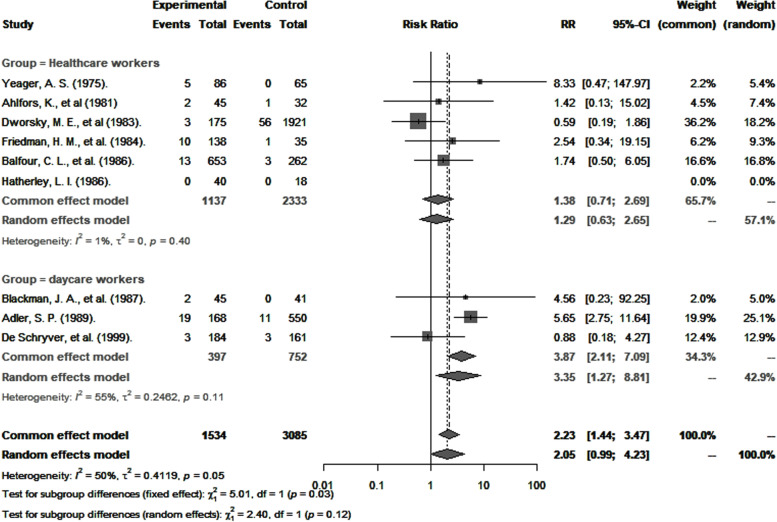
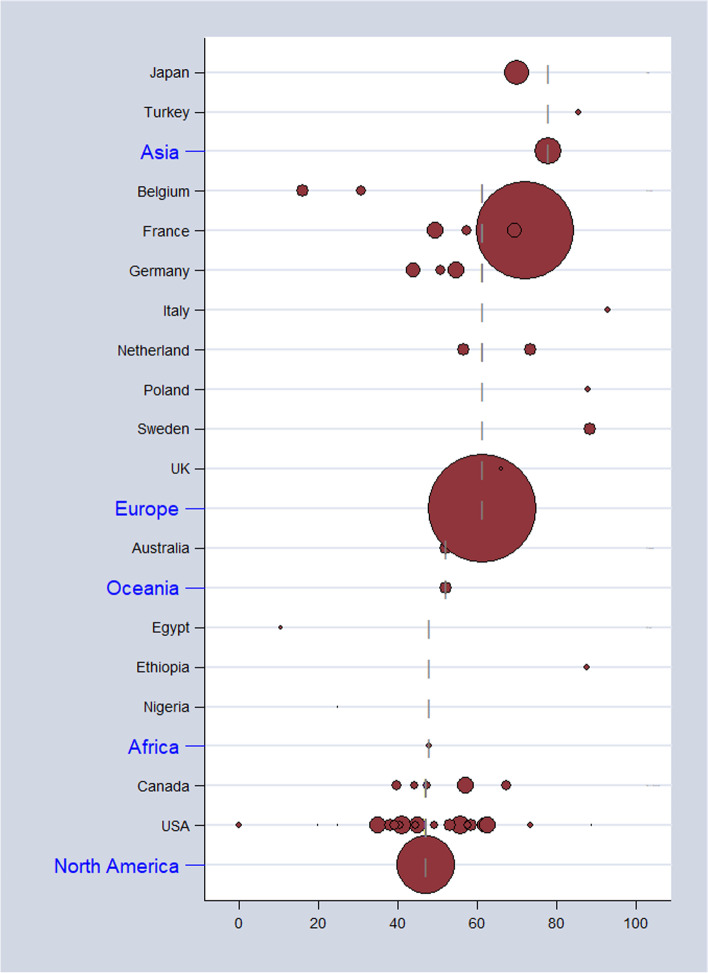
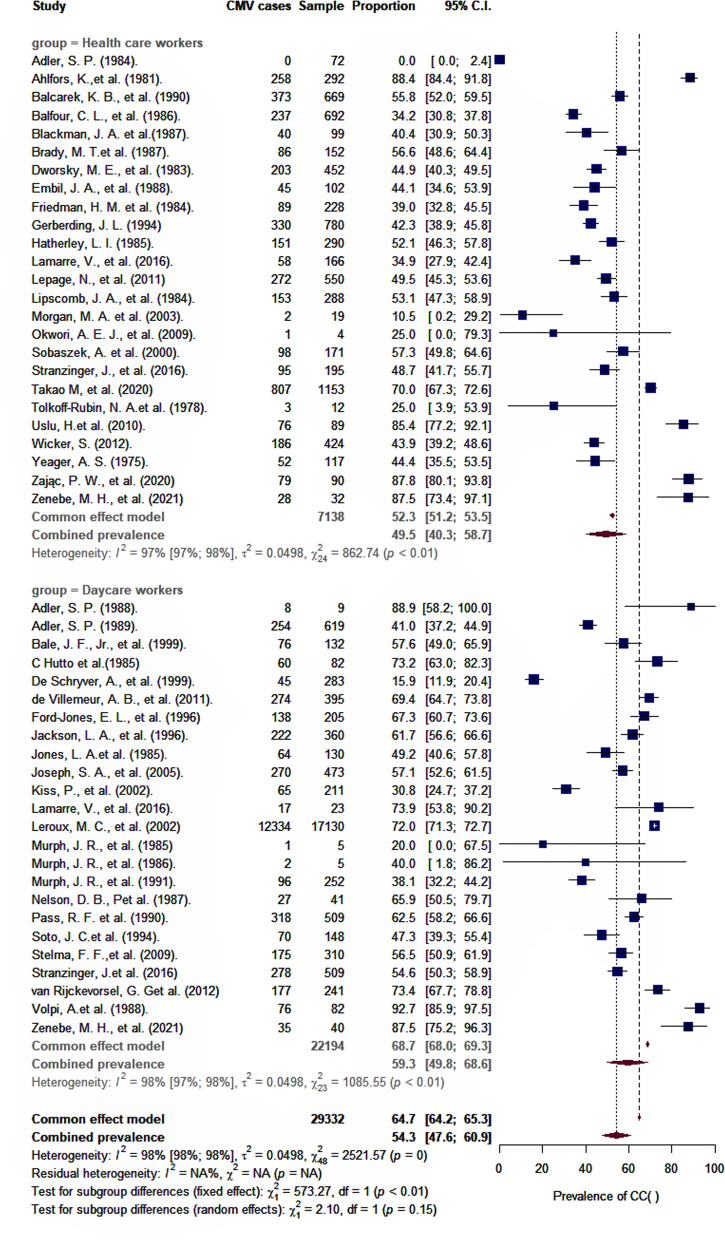
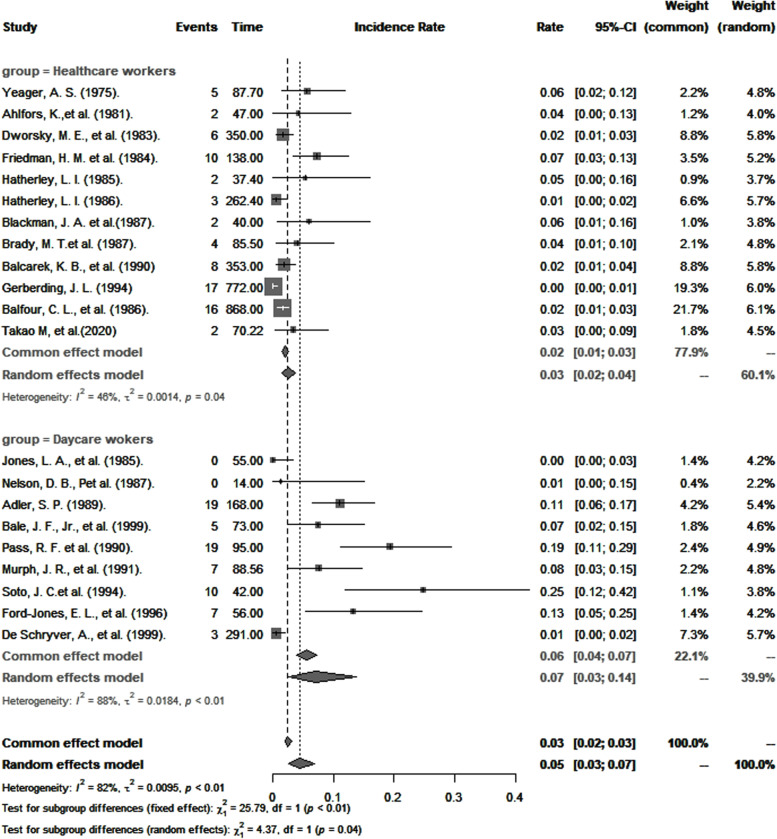
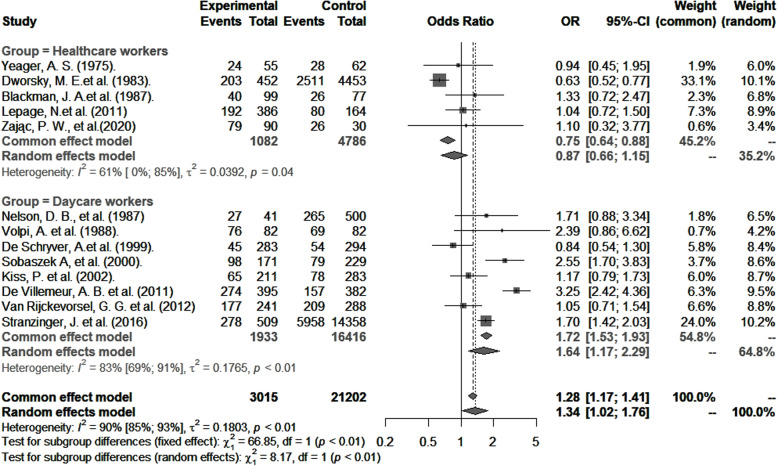
Forty-eight articles were included in this meta-analysis (quality assessment: 18 good, 14 fair, and 16 poor). Pooled CMV seroprevalence was 59.3% (95% CI: 49.8-68.6) among childcare workers and 49.5% (95% CI: 40.3-58.7) among healthcare workers, and pooled incidences of primary CMV infection per 100 person-years were respectively 7.4 (95% CI: 3.9-11.8) and 3.1 (95% CI: 1.3-5.6). RR for primary infection compared to controls were 3.4 (95% CI: 1.3-8.8) and 1.3 (95% CI: 0.6-2.7) for healthcare and childcare workers, respectively. The odds of CMV seropositivity were 1.6 (95% CI: 1.2-2.3) times higher for childcare workers compared to controls, but not significantly different between healthcare workers and controls (0.9; 95% CI: 0.6-1.2). CMV seropositivity in both groups was significantly associated with having one or more children residing at home, marital status, ethnicity, and age.
Childcare workers, but not healthcare workers, have an increased risk of prevalent and incident CMV infection, a risk that is further increased with the presence of at least one child living at home. These findings suggest that enforcing simple, conventional hygienic measures in childcare settings could help reduce transmission of CMV, and that special precautionary measures for preventing CMV infection may not be required for pregnant healthcare workers.
PROSPERO CRD42020139756.
巨细胞病毒(CMV)通过与感染者的体液直接接触传播。家庭中 CMV 的传播,特别是有年幼子女的家庭,是导致普通人群 CMV 感染的重要原因。然而,对于职业保健或儿童保育接触对 CMV 感染风险的贡献,人们知之甚少。
确定医疗保健和儿童保育工作者中 CMV 的血清流行率、原发性感染发生率和相关危险因素。
系统检索截至 2022 年 3 月 7 日关于医疗保健和儿童保育工作者中 CMV 感染的 6 个电子数据库中的出版物。两位作者独立评估文献的质量并纳入我们的分析。使用随机效应模型确定血清流行率、发病率和相对风险(RR)的汇总结果。使用亚组分析和荟萃回归进一步量化和调查研究间的异质性。使用漏斗图评估发表偏倚。使用 R 版本 4.05 进行统计分析。
这项荟萃分析纳入了 48 篇文章(质量评估:18 篇良好、14 篇中等、16 篇较差)。儿童保育工作者的 CMV 血清流行率为 59.3%(95%CI:49.8-68.6),医疗保健工作者为 49.5%(95%CI:40.3-58.7),每 100 人年原发性 CMV 感染发生率分别为 7.4(95%CI:3.9-11.8)和 3.1(95%CI:1.3-5.6)。与对照组相比,原发性感染的 RR 分别为 3.4(95%CI:1.3-8.8)和 1.3(95%CI:0.6-2.7),分别为医疗保健和儿童保育工作者。与对照组相比,儿童保育工作者 CMV 血清阳性的可能性高 1.6 倍(95%CI:1.2-2.3),但与对照组相比,医疗保健工作者的差异无统计学意义(0.9;95%CI:0.6-1.2)。两组 CMV 血清阳性均与家中有一个或多个子女居住、婚姻状况、种族和年龄显著相关。
儿童保育工作者而非医疗保健工作者存在 CMV 显性和隐性感染的风险增加,而这种风险因家中至少有一个子女居住而进一步增加。这些发现表明,在儿童保育环境中实施简单的常规卫生措施可能有助于减少 CMV 的传播,并且对于孕妇医疗保健工作者,可能不需要采取特殊的预防 CMV 感染措施。
PROSPERO CRD42020139756。