Department of Breast and Endocrine Surgery, Kumamoto University Hospital, Kumamoto, Japan.
Department of Breast Oncology, Aichi Cancer Center Hospital, Nagoya, Japan.
Cancer Sci. 2022 Sep;113(9):3169-3179. doi: 10.1111/cas.15474. Epub 2022 Jul 23.
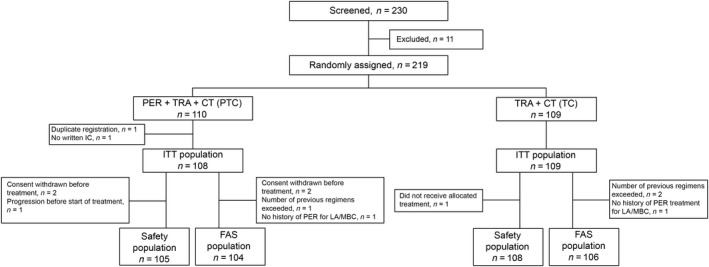
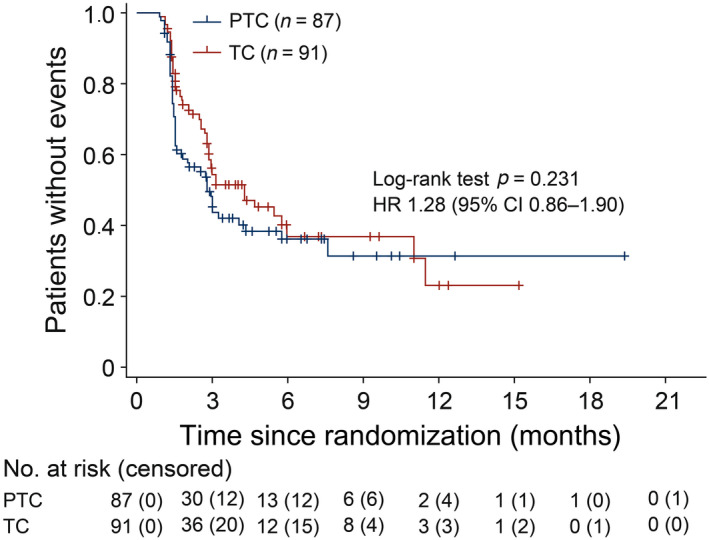
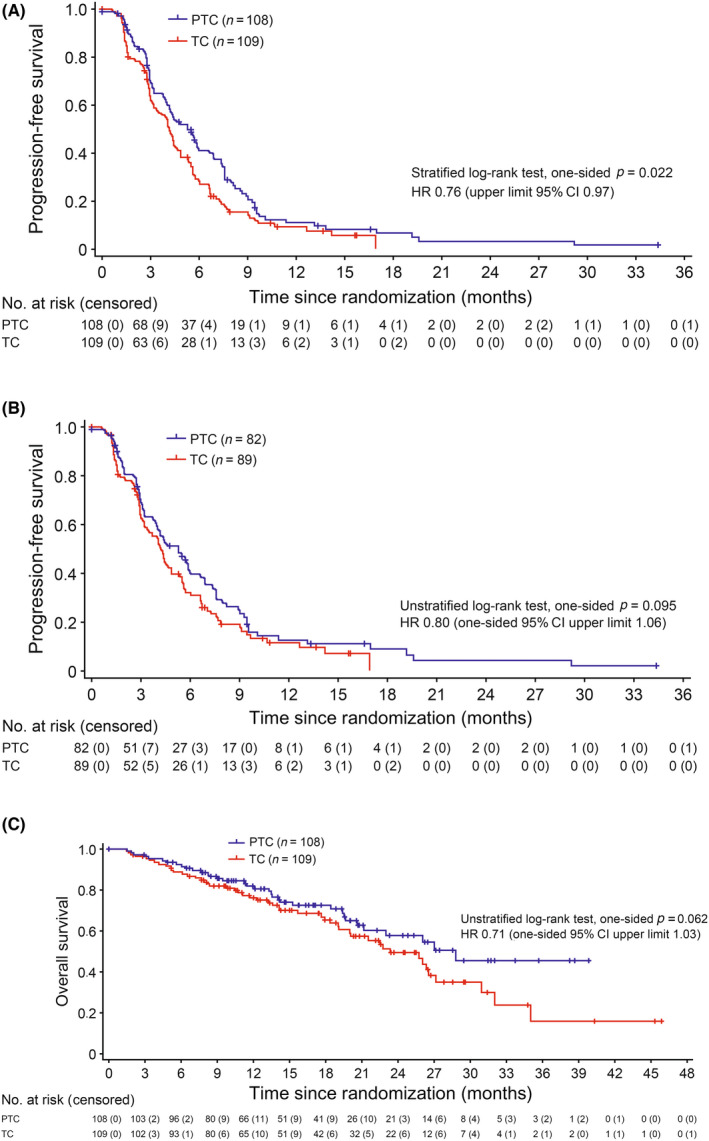
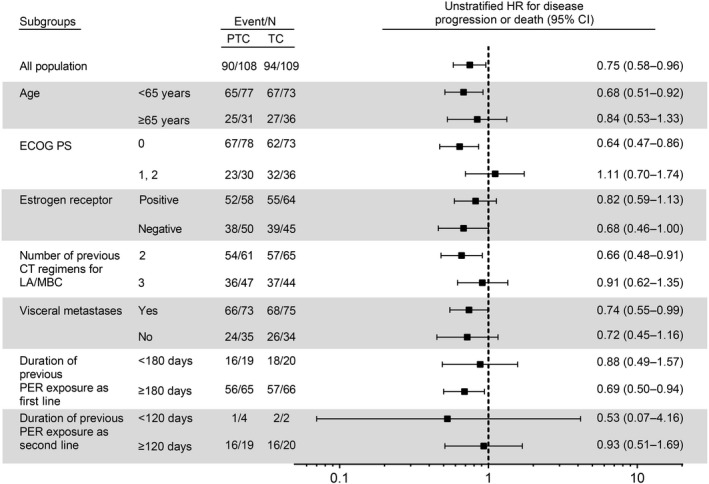
No standard options existed for human epidermal growth factor receptor 2 (HER2)-positive advanced breast cancer that progresses after second-line trastuzumab emtansine therapy before 2020. The purpose of this study was to examine the efficacy of pertuzumab retreatment after disease progression following pertuzumab-containing therapy for HER2-positive locally advanced or metastatic breast cancer for the first time. This randomized, open-label, multicenter phase III trial was undertaken in 93 sites in Japan. Eligible patients with HER2-positive breast cancer who had received pertuzumab, trastuzumab, and chemotherapy as first- and/or second-line therapy were randomly assigned (1:1) to: (i) pertuzumab, trastuzumab, and physician's choice chemotherapy (PTC), or (ii) trastuzumab and physician's choice chemotherapy (TC). The primary end-point was investigator-assessed progression-free survival (PFS). Between August 1, 2015 and December 31, 2018, 219 patients were randomized to PTC (n = 110) or TC (n = 109). Median follow-up was 14.2 months (interquartile range, 9.0-22.2), and median PFS was 5.3 months (95% confidence interval [CI], 4.0-6.6) with PTC and 4.2 months (95% CI, 3.2-4.8) with TC (stratified hazard ratio 0.76 [95% CI upper limit 0.967]; p = 0.022). Progression-free survival was improved by adding pertuzumab in all prespecified subgroups. The PTC arm showed a trend towards better overall survival and duration of response, but similar objective response and health-related quality of life. The incidence of treatment-related adverse events was similar between groups except for diarrhea. Pertuzumab retreatment contributes to disease control for HER2-positive locally advanced or metastatic breast cancer previously treated with pertuzumab-containing regimens.
在 2020 年之前,对于曲妥珠单抗-恩美曲妥珠单抗治疗二线进展后的人表皮生长因子受体 2(HER2)阳性晚期乳腺癌,尚无标准治疗选择。本研究的目的是首次评估曲妥珠单抗治疗后进展的 HER2 阳性局部晚期或转移性乳腺癌患者再次使用帕妥珠单抗治疗的疗效。这是一项在日本 93 个地点开展的、随机、开放标签、多中心 III 期临床试验。纳入标准为:接受过曲妥珠单抗、帕妥珠单抗和化疗作为一线和/或二线治疗的 HER2 阳性乳腺癌患者,随机(1:1)分配至:(i)帕妥珠单抗、曲妥珠单抗和医生选择的化疗(PTC)组,或(ii)曲妥珠单抗和医生选择的化疗(TC)组。主要终点为研究者评估的无进展生存期(PFS)。2015 年 8 月 1 日至 2018 年 12 月 31 日,219 例患者被随机分配至 PTC 组(n=110)或 TC 组(n=109)。中位随访时间为 14.2 个月(四分位距,9.0-22.2),PTC 组和 TC 组的中位 PFS 分别为 5.3 个月(95%置信区间 [CI],4.0-6.6)和 4.2 个月(95% CI,3.2-4.8)(分层风险比 0.76 [95% CI 上限 0.967];p=0.022)。在所有预设亚组中,添加帕妥珠单抗均改善了无进展生存期。PTC 组的总生存期和缓解持续时间有改善趋势,但客观缓解率和健康相关生活质量相似。两组间治疗相关不良事件发生率除腹泻外相似。对于先前接受过曲妥珠单抗为基础治疗方案的 HER2 阳性局部晚期或转移性乳腺癌,再次使用帕妥珠单抗治疗有助于控制疾病。