Zhou Yan, Tian Qi, Gao Huan, Zhu Lizhe, Yang Jiao, Zhang Juan, Yang Jin
Department of Medical Oncology, The First Affiliated Hospital of Xi'an Jiaotong University, Xi'an, China.
Department of Breast Surgery, The First Affiliated Hospital of Xi'an Jiaotong University, Xi'an, China.
Front Genet. 2022 Jun 8;13:905617. doi: 10.3389/fgene.2022.905617. eCollection 2022.
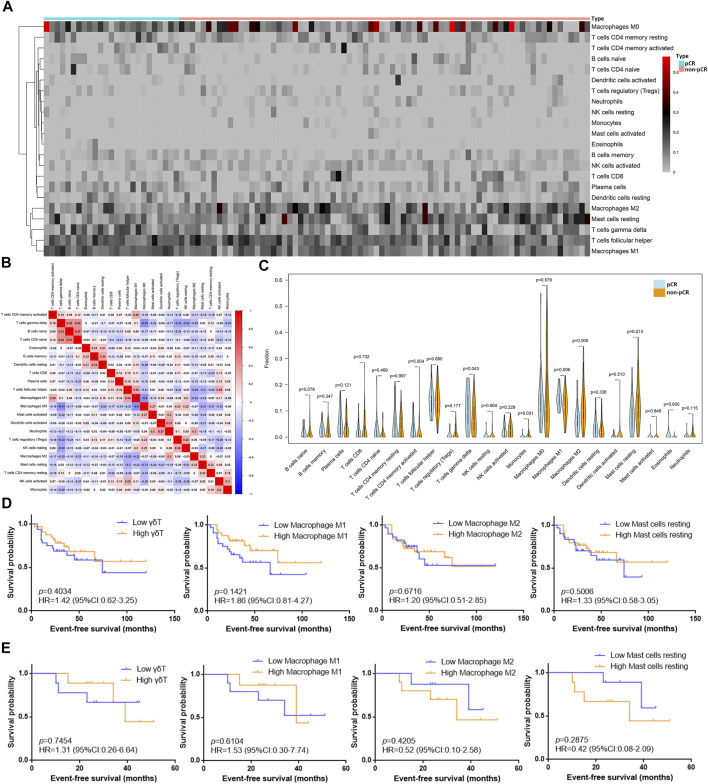
In the absence of targeted therapy or clear clinically relevant biomarkers, neoadjuvant chemotherapy (NAC) is still the standard neoadjuvant systemic therapy for breast cancer. Among the many biomarkers predicting the efficacy of NAC, immune-related biomarkers, such as immune-related genes and tumor-infiltrating lymphocytes (TILs), play a key role. We analyzed gene expression from several datasets in the Gene Expression Omnibus (GEO) database and evaluated the relative proportion of immune cells using the CIBERSORT method. In addition, mIHC/IF detection was performed on clinical surgical specimens of triple-negative breast cancer patients after NAC. We obtained seven immune-related genes, namely, , , , , , and with higher expression in the pathological complete response (pCR) group than in the non-pCR group. In the pCR group, the levels of M1 and γδT macrophages were higher, while those of the M2 macrophages and mast cells were lower. After NAC, the proportions of M1, γδT cells, and resting CD4 memory T cells were increased, while the proportions of natural killer cells and dendritic cells were decreased with downregulated immune-related genes. The results of mIHC/IF detection and the prognostic information of corresponding clinical surgical specimens showed the correlation of proportions of natural killer cells, CD8-positive T cells, and macrophages with different disease-free survival outcomes. The immune-related genes and immune cells of different subtypes in the tumor microenvironment are correlated with the response to NAC in breast cancer, and the interaction between TILs and NAC highlights the significance of combining NAC with immunotherapy to achieve better clinical benefits.
在缺乏靶向治疗或明确的临床相关生物标志物的情况下,新辅助化疗(NAC)仍然是乳腺癌的标准新辅助全身治疗方法。在众多预测NAC疗效的生物标志物中,免疫相关生物标志物,如免疫相关基因和肿瘤浸润淋巴细胞(TILs),起着关键作用。我们分析了基因表达综合数据库(GEO)中几个数据集的基因表达,并使用CIBERSORT方法评估免疫细胞的相对比例。此外,对NAC后三阴性乳腺癌患者的临床手术标本进行了多重免疫组化/免疫荧光(mIHC/IF)检测。我们获得了7个免疫相关基因,即 、 、 、 、 、 和 ,其在病理完全缓解(pCR)组中的表达高于非pCR组。在pCR组中,M1和γδT巨噬细胞水平较高,而M2巨噬细胞和肥大细胞水平较低。NAC后,M1、γδT细胞和静息CD4记忆T细胞的比例增加,而自然杀伤细胞和树突状细胞的比例降低,免疫相关基因表达下调。mIHC/IF检测结果及相应临床手术标本的预后信息显示,自然杀伤细胞、CD8阳性T细胞和巨噬细胞的比例与不同的无病生存结果相关。肿瘤微环境中不同亚型的免疫相关基因和免疫细胞与乳腺癌对NAC的反应相关,TILs与NAC之间的相互作用突出了将NAC与免疫治疗相结合以获得更好临床益处的重要性。