Liu Chang, Liu Jian, Wu Daihong, Luo Shaoling, Li Weijie, Chen Lushan, Liu Zhen, Yu Bingbo
Department of Cardiology, Guangzhou First People's Hospital, School of Medicine, South China University of Technology, Guangzhou, China.
Department of Cardiology, Guangzhou First People's Hospital, Guangzhou Medical University, Guangzhou, China.
Front Genet. 2022 Jun 8;13:882324. doi: 10.3389/fgene.2022.882324. eCollection 2022.
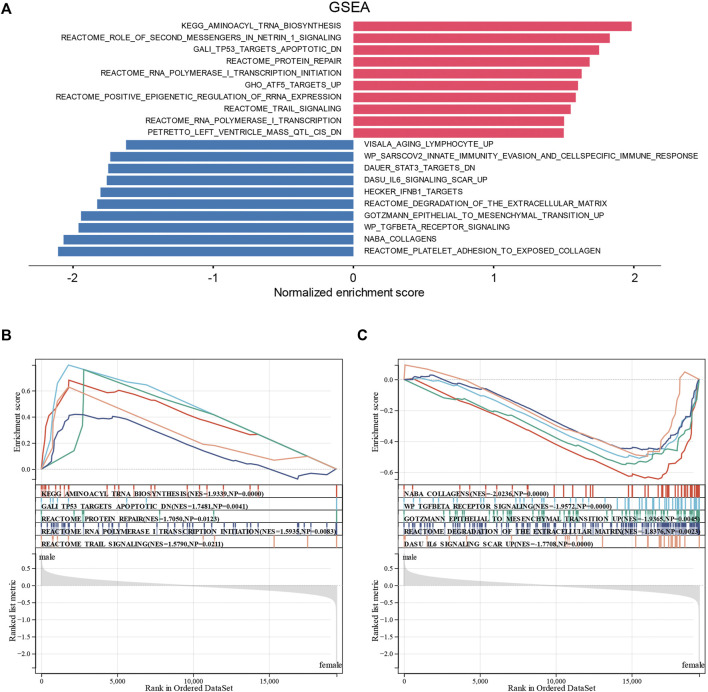
Immune targeted therapy has become an attractive therapeutic approach for patients with dilated cardiomyopathy (DCM) recently. Genetic predisposition and gender play a critical role in immune-related responses of DCM. This study aimed to perform a bioinformatics analysis of molecular differences between male and female samples and identify immune-related ceRNA network in DCM. The gene expression microarray and clinical features dataset of GSE19303 was downloaded from the GEO. The raw data were preprocessed, followed by identification of differentially expressed genes (DEGs) between male and female DCM samples. Crucial functions and pathway enrichment analysis of DEGs were investigated through GO analysis and KEGG pathway analysis, respectively. A lncRNA-miRNA-mRNA network was constructed and a central module was extracted from the ceRNA network. Compared with the female group, the male group benefits more from IA/IgG immunotherapy. Male patients of DCM had a significant positive correlation with the abundance of inflammatory cells (B cells, memory B cells, CD8 Tem cells, and NK cells). Sex difference DEGs had a widespread impact on the signaling transduction, transcriptional regulation, and metabolism in DCM. Subsequently, we constructed an immune-related ceRNA network based on sex differences in DCM, including five lncRNAs, six miRNAs, and 29 mRNAs. Furthermore, we extracted a central module from the ceRNA network, including two lncRNAs (XIST and LINC00632), three miRNAs (miR-1-3p, miR-17-5p, and miR-22-3p), and six mRNAs (CBL, CXCL12, ESR1, IGF1R, IL6ST, and STC1). Among these DEGs, CBL, CXCL12, and IL6ST expression was considered to be associated with inflammatory cell infiltration in DCM. The identified ceRNA network and their enriched pathways may provide genetic insights into the phenotypic diversity of female and male patients with DCM and may provide a basis for development of sex-related individualization of immunotherapy.
免疫靶向治疗最近已成为扩张型心肌病(DCM)患者一种有吸引力的治疗方法。遗传易感性和性别在DCM的免疫相关反应中起关键作用。本研究旨在对男性和女性样本之间的分子差异进行生物信息学分析,并识别DCM中与免疫相关的ceRNA网络。从GEO下载了GSE19303的基因表达微阵列和临床特征数据集。对原始数据进行预处理,随后鉴定男性和女性DCM样本之间的差异表达基因(DEG)。分别通过GO分析和KEGG通路分析对DEG进行关键功能和通路富集分析。构建lncRNA-miRNA-mRNA网络,并从ceRNA网络中提取一个核心模块。与女性组相比,男性组从IA/IgG免疫治疗中获益更多。DCM男性患者与炎症细胞(B细胞、记忆B细胞、CD8 Tem细胞和NK细胞)的丰度呈显著正相关。性别差异DEG对DCM中的信号转导、转录调控和代谢有广泛影响。随后,我们基于DCM中的性别差异构建了一个与免疫相关的ceRNA网络,包括5个lncRNA、6个miRNA和29个mRNA。此外,我们从ceRNA网络中提取了一个核心模块,包括2个lncRNA(XIST和LINC00632)、3个miRNA(miR-1-3p、miR-17-5p和miR-22-3p)和6个mRNA(CBL、CXCL12、ESR1、IGF1R、IL6ST和STC1)。在这些DEG中,CBL、CXCL12和IL6ST的表达被认为与DCM中的炎症细胞浸润有关。所识别的ceRNA网络及其富集的通路可能为DCM女性和男性患者的表型多样性提供遗传学见解,并可能为开发与性别相关的免疫治疗个体化提供依据。