Tampe Désirée, Kopp Sarah Birgit, Baier Eva, Hakroush Samy, Tampe Björn
Department of Nephrology and Rheumatology, University Medical Center Göttingen, Göttingen, Germany.
Institute of Pathology, University Medical Center Göttingen, Göttingen, Germany.
Front Med (Lausanne). 2022 Jun 9;9:902256. doi: 10.3389/fmed.2022.902256. eCollection 2022.
Due to advances in cancer therapy, immune checkpoint inhibitors (ICIs) are new classes of drugs targeting programmed cell death protein 1-ligand 1 (PD-L1) or its receptor (PD-1) used in many cancer therapies. Acute interstitial nephritis (AIN) is a potential and deleterious immune-related adverse events (irAE) and the most common biopsy-proven diagnosis in ICI-related nephrotoxicity. AIN in patients receiving ICIs is was only seen in cases with tubular PD-L1 positivity, while PD-1 expression is limited to inflammatory cells and also observed in injured kidneys independent of ICI therapy. We have previously described that PD-L1 positivity can also be detected in glomerular and endothelial compartments. We here aimed to describe compartmentalization of renal PD-L1 expression specifically in injured kidneys with confirmed nephrotoxicity related to ICIs, its association with presence of PD-1, and clinical findings.
We included human kidney samples with AIN related to ICI therapy to describe PD-L1 and PD-1 expression localized to different renal compartments in association with clinical and laboratory parameters.
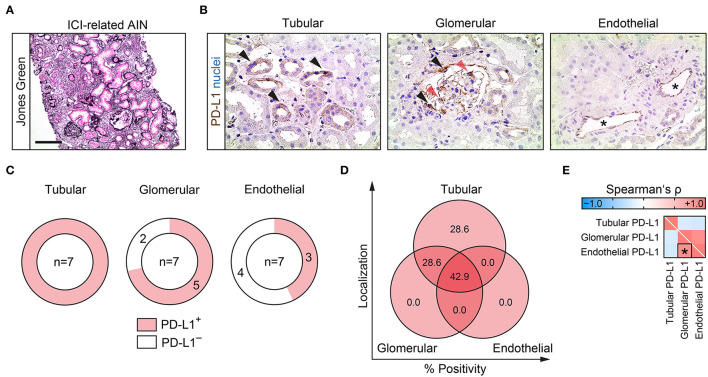
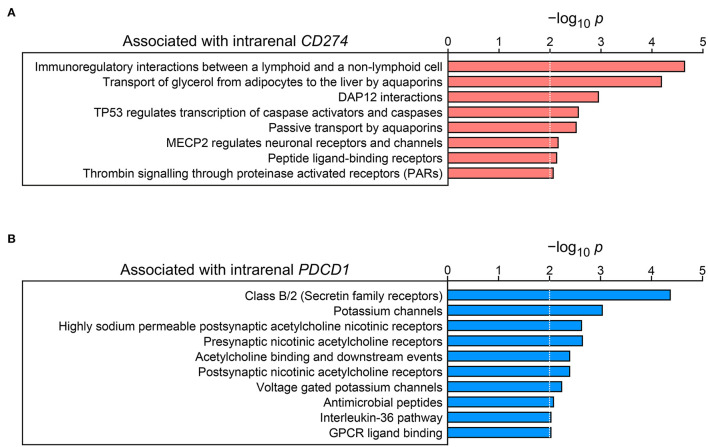
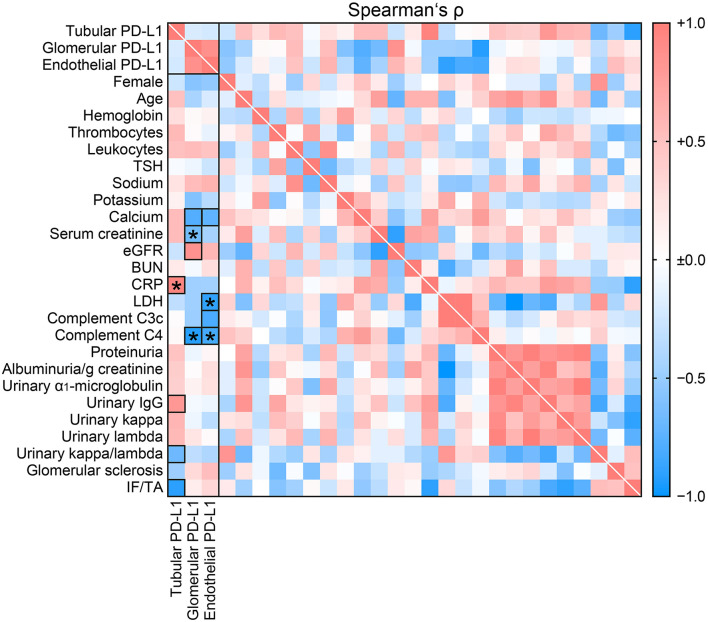
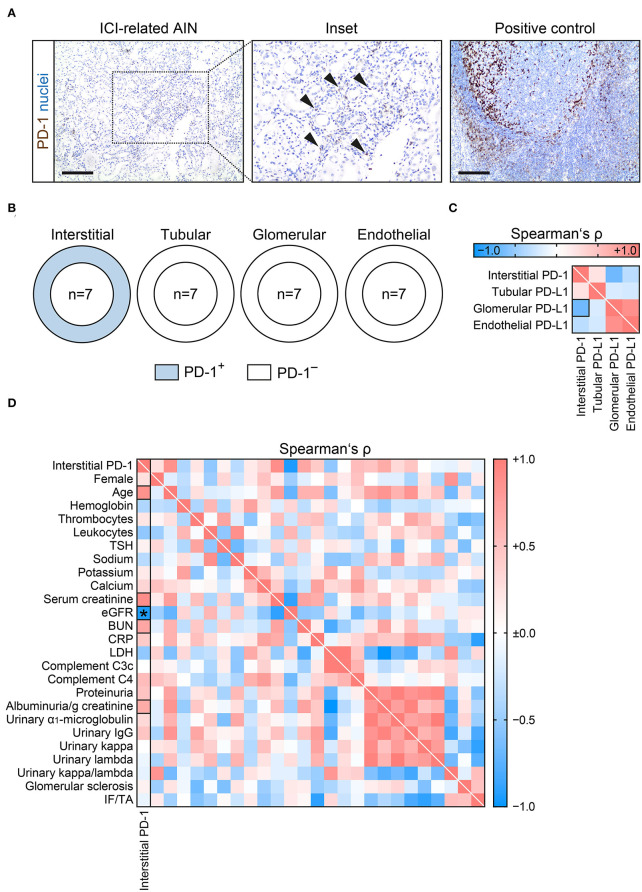
We herein report compartmentalization of PD-L1 with tubular positivity in all cases, partially overlapping with glomerular and endothelial PD-L1 positivity. Furthermore, we provide evidence that tubular PD-L1 in ICI-related nephrotoxicity correlates with levels of C-reactive protein (CRP), while glomerular and endothelial PD-L1 positivity with lower serum levels of complement component C4. Interestingly, glomerular PD-L1 correlated with kidney function, while interstitial cell PD-1 positivity specifically with severity of kidney injury. Finally, we provide evidence for signaling pathways associated with intrarenal PD-L1/PD-1 expression.
Our findings implicate that that AIN related to ICI therapy requires presence of interstitial cells positive for PD-1, and that blocking PD-L1/PD-1 signaling may contribute to nephrotoxicity specifically related to these agents.
由于癌症治疗的进展,免疫检查点抑制剂(ICIs)是一类新型药物,靶向程序性细胞死亡蛋白1配体1(PD-L1)或其受体(PD-1),用于多种癌症治疗。急性间质性肾炎(AIN)是一种潜在的有害免疫相关不良事件(irAE),也是ICI相关肾毒性中最常见的经活检证实的诊断。接受ICIs治疗的患者中,AIN仅在肾小管PD-L1阳性的病例中出现,而PD-1表达仅限于炎症细胞,并且在与ICI治疗无关的受损肾脏中也有观察到。我们之前曾描述过,在肾小球和内皮细胞区室中也可检测到PD-L1阳性。我们在此旨在描述与ICI相关肾毒性确诊的受损肾脏中肾PD-L1表达的区室化、其与PD-1存在的关联以及临床发现。
我们纳入了与ICI治疗相关的AIN的人肾样本,以描述与临床和实验室参数相关的定位于不同肾区室的PD-L1和PD-1表达。
我们在此报告,所有病例中PD-L1均存在肾小管阳性的区室化,部分与肾小球和内皮细胞PD-L1阳性重叠。此外,我们提供证据表明,ICI相关肾毒性中的肾小管PD-L1与C反应蛋白(CRP)水平相关,而肾小球和内皮细胞PD-L1阳性与较低的血清补体成分C4水平相关。有趣的是,肾小球PD-L1与肾功能相关,而间质细胞PD-1阳性则与肾损伤的严重程度具体相关。最后,我们提供了与肾内PD-L1/PD-1表达相关的信号通路的证据。
我们的研究结果表明,与ICI治疗相关的AIN需要存在PD-1阳性的间质细胞,并且阻断PD-L1/PD-1信号通路可能导致与这些药物特异性相关的肾毒性。