
构建一种具有传输微波辐射能力的用于细胞培养的二氧化碳培养箱。
Construction a CO2 Incubator for Cell Culture with Capability of Transmitting Microwave Radiation.
作者信息
Tayebi-Khorami Mansour, Chegeni Nahid, Birgani Maryam Tahmasebi, Danyaei Amir, Fardid Reza, Zafari Jaber
机构信息
Department of Medical Physics, Ahvaz Jundishapur University of Medical Sciences, Ahvaz, Iran.
Genetics, Faculty of Medicine, Ahvaz Jundishapur University of Medical Sciences, Ahvaz, Iran.
出版信息
J Med Signals Sens. 2022 May 12;12(2):127-132. doi: 10.4103/jmss.jmss_113_21. eCollection 2022 Apr-Jun.
BACKGROUND
The objective of this study was to design and construct a CO2 incubator with nonmetallic walls and to investigate the viability of the cells and microwave irradiance inside this incubator.
METHODS
Because the walls of conventional incubators are made of metal, this causes scattering, reflection, and absorption of electromagnetic waves. We decided to build a nonmetallic wall incubator to examine cells under microwave radiation. Incubator walls were made using polyvinyl chloride and Plexiglas and then temperature, CO2 pressure, and humidity sensors were placed in it. Atmel® ATmega1284, a low-power CMOS 8-bit microcontroller, collects and analyzes the sensor information, and if the values are less or more than the specified limits, the command to cut off or connect the electric current to the heater or CO2 solenoid valve is sent. Using a fan inside the incubator chamber, temperature and CO2 are uniforms. The temperature of the points where the cell culture plates are placed was measured, and the temperature difference was compared. Ovarian cancer cells (A2780) were cultured in the hand-made and commercial incubators at different times, and cell viability was compared by the MTT method. Microwave radiation in the incubator was also investigated using a spectrum analyzer. The survival of cells after microwave irradiation in the incubator was measured and compared with control cells.
RESULTS
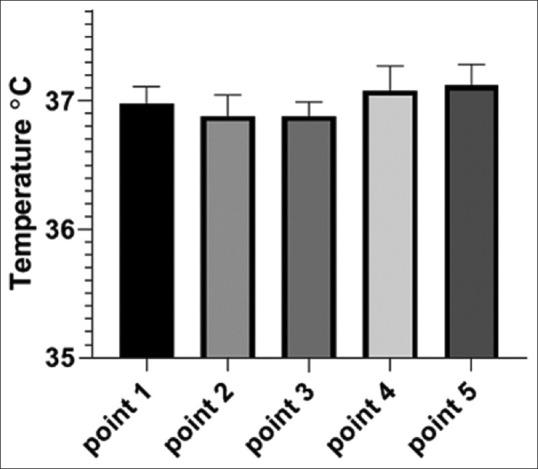
The data showed that there was no significant difference in temperature of different points in hand-made incubator and also there was no significant difference between the viability of cells cultured in the hand-made and commercial incubators. The survival of irradiated cells in the incubator was reduced compared to control cells, but this reduction was not significant.
CONCLUSION
This incubator has the ability to maintain cells and study the effects of electromagnetic radiations on the desired cells, which becomes possible by using this device.
背景
本研究的目的是设计并构建一个具有非金属壁的二氧化碳培养箱,并研究该培养箱内细胞的活力以及微波辐照度。
方法
由于传统培养箱的壁由金属制成,这会导致电磁波的散射、反射和吸收。我们决定构建一个非金属壁培养箱,以在微波辐射下检测细胞。培养箱壁使用聚氯乙烯和有机玻璃制成,然后在其中放置温度、二氧化碳压力和湿度传感器。Atmel® ATmega1284,一种低功耗CMOS 8位微控制器,收集并分析传感器信息,如果数值低于或高于指定极限,则发送切断或接通加热器或二氧化碳电磁阀电流的指令。通过在培养箱腔内使用风扇,使温度和二氧化碳均匀分布。测量放置细胞培养板处的温度,并比较温度差异。在不同时间将卵巢癌细胞(A2780)在自制培养箱和商用培养箱中培养,并通过MTT法比较细胞活力。还使用频谱分析仪研究了培养箱内的微波辐射。测量了培养箱内微波辐照后细胞的存活率,并与对照细胞进行比较。
结果
数据显示,自制培养箱中不同点的温度没有显著差异,并且在自制培养箱和商用培养箱中培养的细胞活力之间也没有显著差异。与对照细胞相比,培养箱中辐照细胞的存活率降低,但这种降低并不显著。
结论
该培养箱具有维持细胞并研究电磁辐射对所需细胞影响的能力,通过使用该装置这成为可能。



 Zotero 插件