Dashti Sarah, Prakash Edmond, Navarro-Newball Andres Adolfo, Hussain Fiaz, Carroll Fiona
Cardiff Metropolitan University, Cardiff, UK.
University for the Creative Arts, Farnham, UK.
Vis Comput. 2022;38(12):4035-4055. doi: 10.1007/s00371-022-02521-2. Epub 2022 Jun 20.
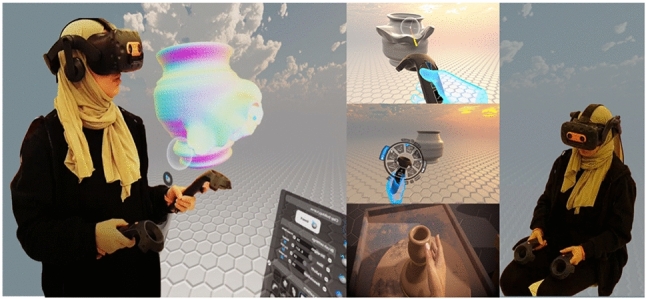
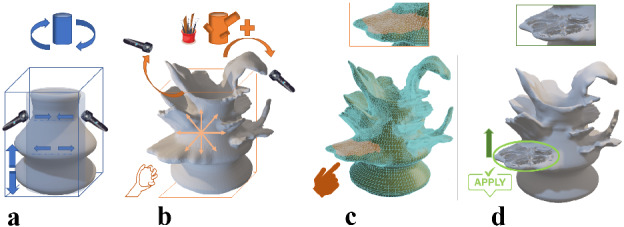
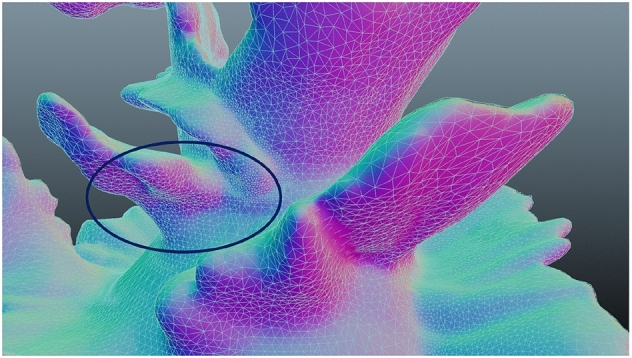
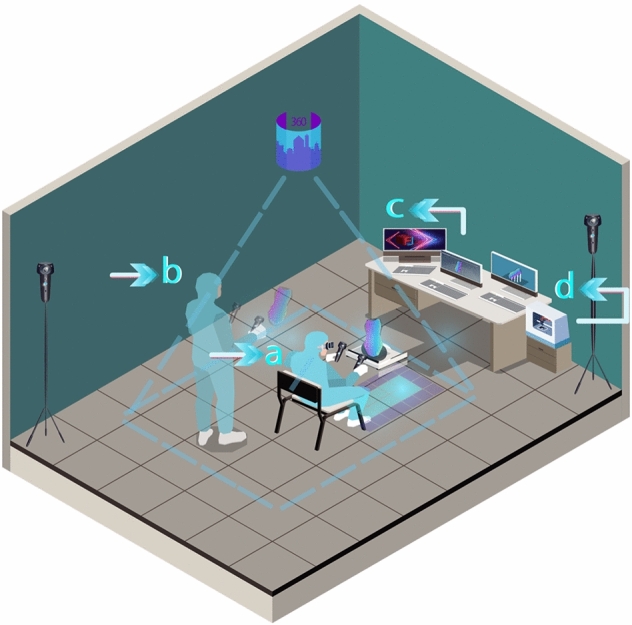
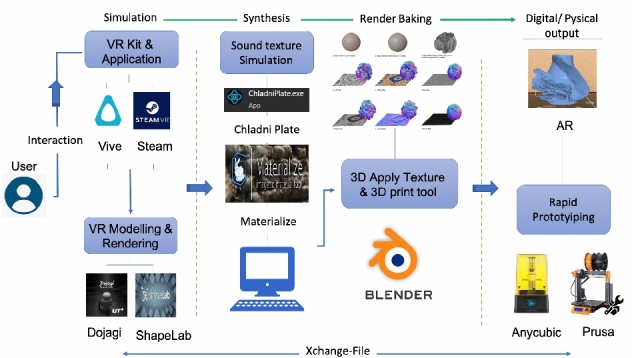
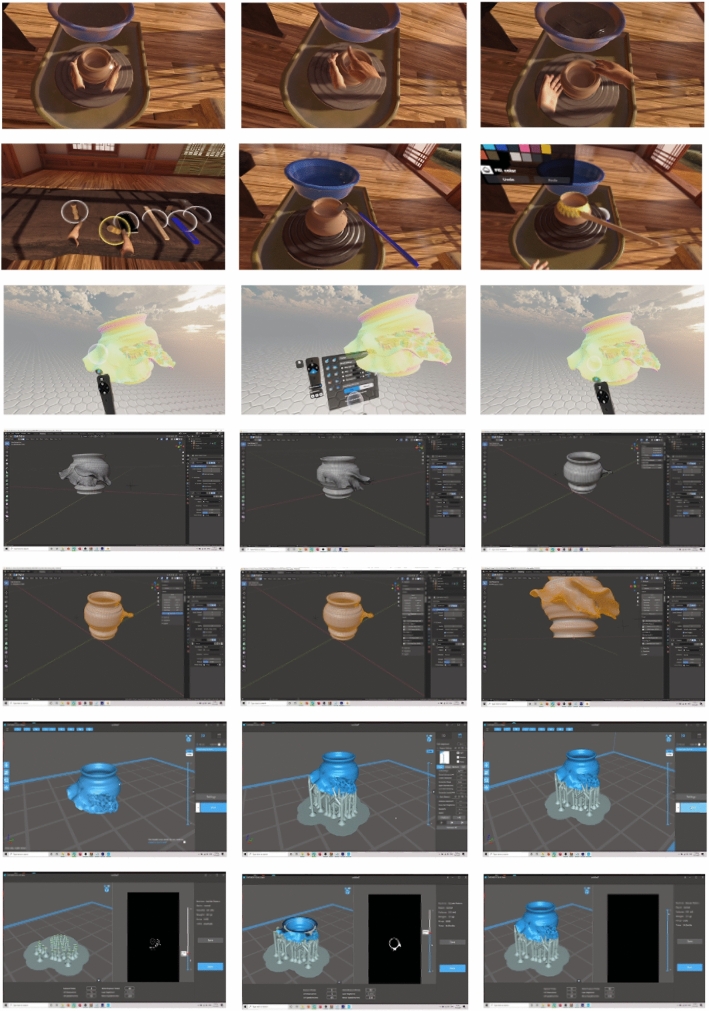
Handcrafting ceramic pottery in the traditional method or virtual reality (VR) with intricate surface details is still challenging for the ceramic and graphic artist. Free-form pottery modeling can be efficiently geometrically modeled with the right tools with detailed 3D print outputs, yet challenging to be manufactured using traditional art. The new advanced pottery VR simulation is a promising method to recreate the traditional pottery simulation for a better experience with some barriers. The challenges that arise from surface detail in pottery are a tedious task accomplished by mesh blending and retopology. This paper focuses on refining the VP application's performance by adding unique sound resonance as a more likely infinite geometric phenomenon textures, blending it into the basic shapes. This paper combines creativity and visual computing technologies such as VR, mesh blending, fixing errors, and 3D printing to bring the ceramic artist's imagination to life. We have used sound resonance with virtual pottery (VP) systems refinements to demonstrate several standard pottery methods from free form deformed pottery, retopology, mesh blended for surface details, and 3D printed pottery with materials including polymer and ceramic resins.
对于陶瓷艺术家和平面艺术家而言,采用传统方法或虚拟现实(VR)手工制作具有复杂表面细节的陶瓷陶器仍然具有挑战性。利用合适的工具,可以高效地对自由形态的陶器造型进行几何建模,并输出具有详细细节的3D打印成果,但使用传统工艺制造却颇具挑战。新型先进的陶器VR模拟是一种很有前景的方法,可用于重现传统陶器模拟,以获得更好的体验,但也存在一些障碍。陶器表面细节所带来的挑战是一项繁琐的任务,需要通过网格融合和重新拓扑来完成。本文着重于通过添加独特的声音共振来优化VP应用程序的性能,声音共振是一种更可能呈现无限几何现象的纹理,并将其融入基本形状中。本文结合了创造力和视觉计算技术,如VR、网格融合、修复错误和3D打印,以使陶瓷艺术家的想象力变为现实。我们已通过虚拟陶器(VP)系统优化使用声音共振,来展示几种标准的陶器制作方法,包括自由形态变形陶器、重新拓扑、用于表面细节的网格融合,以及使用包括聚合物和陶瓷树脂在内的材料进行3D打印的陶器。