Department of Psychology, McPherson Eye Research Institute University of Wisconsin - Madison, Madison, USA.
Sci Rep. 2017 Nov 22;7(1):16009. doi: 10.1038/s41598-017-16161-3.
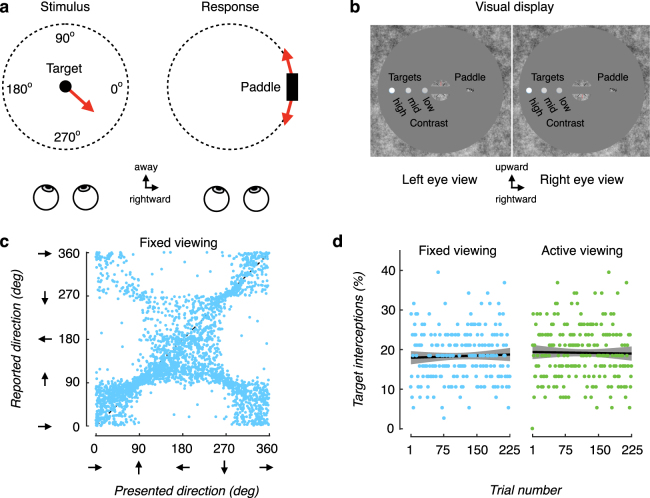
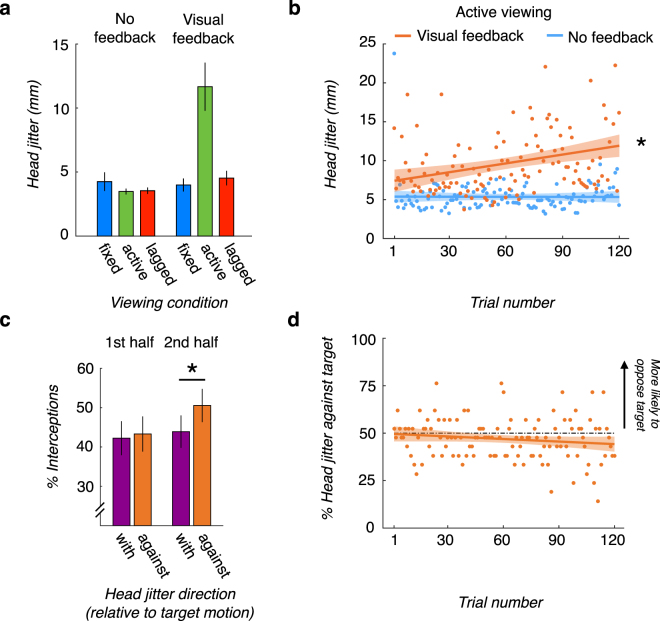
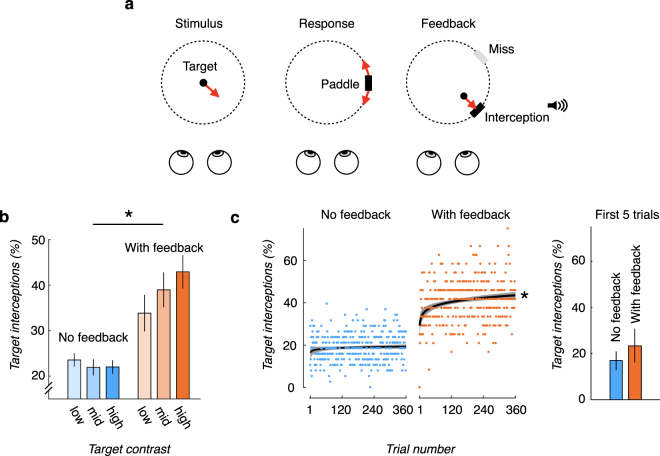
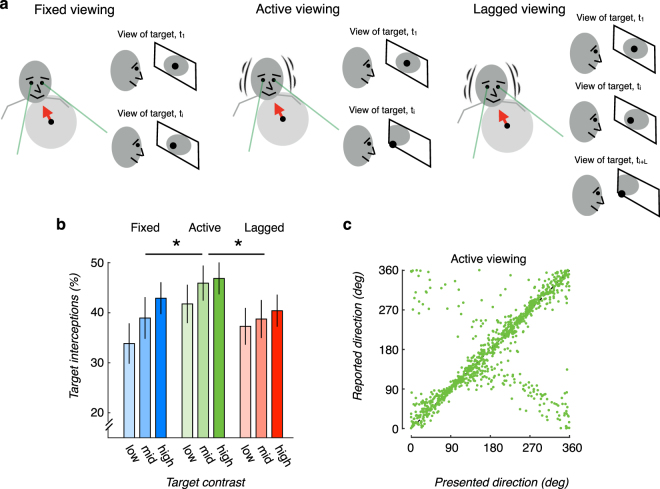
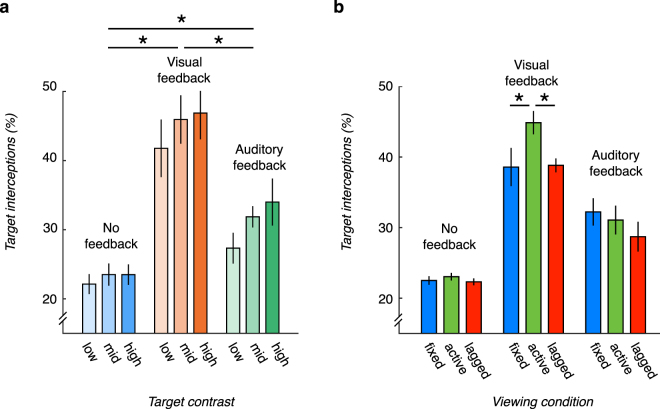
3D motion perception is of central importance to daily life. However, when tested in laboratory settings, sensitivity to 3D motion signals is found to be poor, leading to the view that heuristics and prior assumptions are critical for 3D motion perception. Here we explore an alternative: sensitivity to 3D motion signals is context-dependent and must be learned based on explicit visual feedback in novel environments. The need for action-contingent visual feedback is well-established in the developmental literature. For example, young kittens that are passively moved through an environment, but unable to move through it themselves, fail to develop accurate depth perception. We find that these principles also obtain in adult human perception. Observers that do not experience visual consequences of their actions fail to develop accurate 3D motion perception in a virtual reality environment, even after prolonged exposure. By contrast, observers that experience the consequences of their actions improve performance based on available sensory cues to 3D motion. Specifically, we find that observers learn to exploit the small motion parallax cues provided by head jitter. Our findings advance understanding of human 3D motion processing and form a foundation for future study of perception in virtual and natural 3D environments.
三维运动感知对日常生活至关重要。然而,当在实验室环境中进行测试时,人们发现对三维运动信号的敏感性很差,这导致人们认为启发式和先验假设对于三维运动感知至关重要。在这里,我们探讨了另一种可能性:对三维运动信号的敏感性是依赖于上下文的,必须基于在新环境中的明确视觉反馈来学习。在发展文献中,行动相关的视觉反馈的必要性已经得到了很好的证明。例如,被动地在环境中移动的小猫,但自己无法移动,它们无法发展出准确的深度感知。我们发现,这些原则在成人的感知中也适用。在虚拟现实环境中,那些没有体验到自身行为视觉后果的观察者无法发展出准确的三维运动感知,即使是经过长时间的暴露。相比之下,那些体验到自身行为后果的观察者会根据可用的三维运动感觉线索来提高表现。具体来说,我们发现观察者学会了利用头部抖动提供的小运动视差线索。我们的研究结果推进了对人类三维运动处理的理解,并为未来在虚拟和自然三维环境中的感知研究奠定了基础。